

Mavic 3T vs Mavic 3T Advanced - detailed model comparison
February 19, 2026
When it comes to industrial thermal imaging with a thermal camera, the choice usually comes down to two options - the basic and the "advanced" version. On paper, the differences may seem subtle, but in real-world use they feel quite different. Especially when the drone is used not for demonstration purposes, but for specific tasks: inspection of power lines, detection of heat losses, monitoring of facilities.
Both models belong to the DJI Enterprise lineup and look almost identical externally. However, the difference lies not in the body, but in the details - in the accuracy of the thermal sensor, processing algorithms, and depth of data analysis. This is exactly what determines which option turns out to be more reasonable.
What the DJI Mavic 3T and Mavic 3T Advanced series represent
The DJI Mavic 3T and DJI Mavic 3T Advanced series belong to DJI's industrial lineup. These are compact drones with a thermal imaging camera, designed not for hobby shooting but for professional tasks - inspections, surveys, object monitoring. The format remains mobile and foldable, but the level of functionality inside is completely different.
The main idea of the series is to combine a regular camera, thermal imager, and supporting tools in a single body. No bulky platforms or complicated assembly required. The drone quickly takes off, transmits a real-time image, and allows detection of temperature anomalies from a distance. For utility services, energy companies, security, and agriculture, this is more of a professional tool than a "gadget".
The difference between the versions is not in the concept, but in the details. Both models are built on the same base, but differ in the capabilities of the thermal module and the depth of analytics. Therefore, the choice should be made not by the name, but by how critical measurement accuracy and image detail are for the specific work.
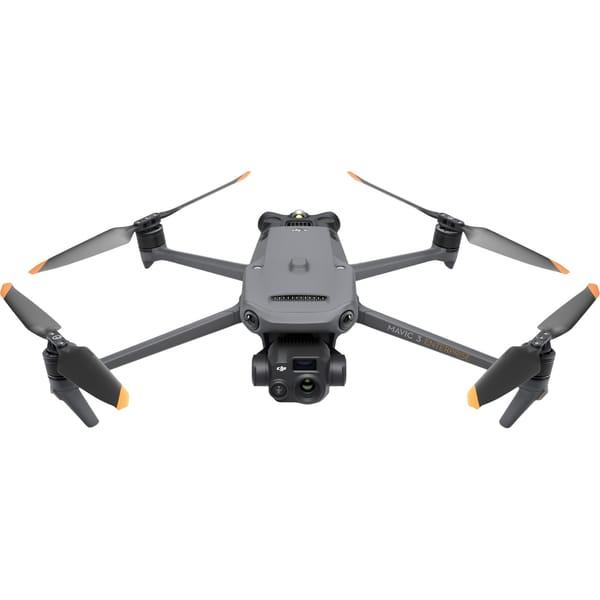
DJI Mavic 3T - basic version
DJI Mavic 3T - an industrial quadcopter with a thermal imaging camera and three-module optics. The design combines a wide-angle camera based on a 1/2-inch CMOS sensor with up to 48 MP resolution, a 640x512 thermal sensor, and a telephoto lens with hybrid zoom. This configuration allows simultaneous capture of detailed images and detection of temperature deviations on the object. It is a working tool for tasks where it is important to see not only the visual picture but also the thermal map.
Signal transmission is implemented through the DJI O3 Enterprise system with a range of up to 15,000 m. Control is performed via the DJI RC Pro Enterprise remote controller. Support for GPS, Galileo, and BeiDou with RTK capability ensures precise positioning. The foldable body, omnidirectional obstacle sensors, and return-to-home function simplify operation in real conditions - from inspections to search operations.
Key features:
Thermal camera 640x512
Main camera 48 MP, 1/2-inch CMOS
Telephoto lens with 56x hybrid zoom
DJI O3 Enterprise transmission system up to 15,000 m
RTK support
Omnidirectional obstacle sensors
Foldable body
Specifications:
Flight time: 46 min
Ascent speed: 28.8 km/h
Photo resolution, pixels: 8000x6000
Lens: 84°, f/2.8
Stabilization: 3-axis
Batteries: 1 pc
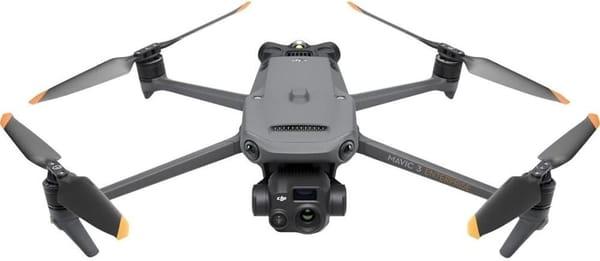
DJI Mavic 3T Advanced - advanced configuration
DJI Mavic 3T Advanced Universal Edition - a version with a thermal imaging module and extended package for professional tasks. The design retains the foldable format and familiar Mavic 3 series layout, but the emphasis is placed on thermal imaging and stable signal transmission. The camera with an 84° lens and variable aperture f/2.8-f/11 allows flexible operation in various lighting conditions, while the built-in 64 GB memory simplifies material storage without the immediate need for a memory card.
Flight time reaches 46 minutes, control is performed via the DJI RC Pro Enterprise remote. The body is finished in gray color, and the package includes a carrying case. The model is designed for operation at temperatures from -10 to +40 °C and can withstand wind up to 43.2 km/h. This is a configuration for situations where thermal imaging, signal stability, and clean operation without unnecessary complications are important.
Key features:
Thermal imaging module
84° lens with f/2.8-f/11 aperture
Built-in 64 GB memory
DJI RC Pro Enterprise remote controller
Carrying case included
Foldable design
Specifications:
Flight time: 46 min
Ascent speed: 28.8 km/h
Lens: f/2.8-f/11, 84°
Batteries: 1 pc
Main differences between Mavic 3T and Mavic 3T Advanced
In terms of construction, these are the same class of drones - foldable body, up to 46 minutes of flight time, control via DJI RC Pro Enterprise. Flight performance is identical, so when choosing, attention usually shifts to camera details and package contents. This is where the practical difference appears. Comparison of main parameters:
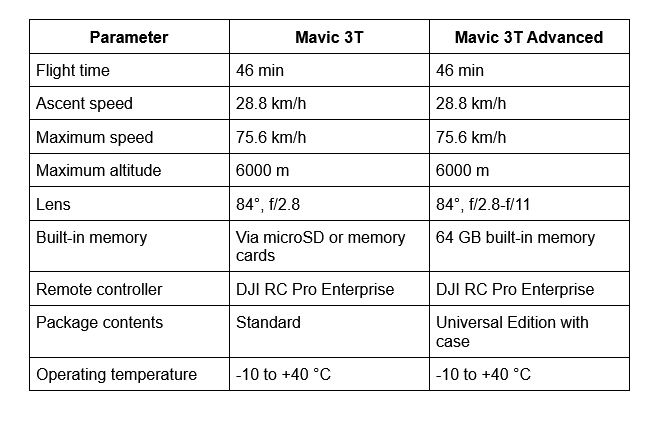
The Advanced version differs primarily in the thermal imaging module - it uses a more modern sensor with higher detail and a narrower field of view, providing better performance at longer distances; variable aperture and built-in memory are present in both versions, so the choice comes down to whether a more advanced thermal sensor is needed or if the standard model is sufficient for regular work.
What makes each model special
The series is built on a single platform, so the basic capabilities are the same. Differences appear in the camera configuration and ease of use. To avoid mixing everything into one list, it makes more sense to review each model separately.
DJI Mavic 3T - version features
640x512 thermal camera for monitoring and inspections
48 MP main camera for detailed shooting
Fixed f/2.8 aperture
Signal transmission up to 15,000 m
RTK support for precise positioning
Foldable body and omnidirectional obstacle sensors
Operation at temperatures from -10 to +40 °C
This configuration is oriented toward standard tasks - facility inspection, heat loss detection, infrastructure monitoring.
DJI Mavic 3T Advanced - version features
Thermal module for detailed temperature analysis
Main camera with variable f/2.8-f/11 aperture
64 GB built-in memory
DJI RC Pro Enterprise remote controller
Carrying case included in Universal Edition
Up to 46 minutes of flight time
Stable operation in wind up to 43.2 km/h
Advanced offers more flexibility in exposure settings and data storage. Otherwise, the platform and basic flight characteristics are identical, so the choice depends on shooting requirements and operating conditions.
How to choose between Mavic 3T and Mavic 3T Advanced
The choice usually starts not with the model name, but with the tasks at hand. If regular monitoring of facilities, roof inspections, power line surveys, or construction site checks is required, the standard Mavic 3T configuration is usually sufficient. Flight parameters are the same, the thermal module is present, and signal transmission is stable. For most working scenarios, this set is enough without additional adjustments.
The Advanced version makes sense when camera flexibility is important. The variable aperture allows more precise work with light in different conditions, and built-in memory simplifies data storage in the field. This is convenient for long trips or when there is no opportunity to constantly swap memory cards.
In short, the decision comes down to details. The basic version covers standard inspection and thermography tasks. Advanced is more logical to choose where greater control over shooting parameters and slightly more autonomy in operation are required.
Conclusion
Both models are built on the same platform and are designed for the same tasks - inspections, monitoring, thermal imaging work. Flight time, control, and basic parameters are identical. Therefore, the differences are not in power or range, but in the details. Mavic 3T is a standard working configuration without unnecessary complications. It is suitable for regular surveys and typical scenarios where stability and predictability of results are important.
Mavic 3T Advanced adds a variable aperture and built-in memory, providing more control during shooting and less dependence on external storage. This is convenient in challenging lighting conditions and during prolonged work on site. Ultimately, the choice comes down to the tasks - if basic inspection functionality is sufficient, the standard version is enough. If greater flexibility and additional autonomy are needed, it is more logical to consider the Advanced version.