

2 kW Power Stations: Best Models for Everyday Use
January 17, 2026
2 kW power stations are kind of the "goldilocks" option: not too bulky, but already capable of handling more serious loads than just charging a phone. They are often chosen for home use, travel, countryside workshops, or as an emergency backup during power outages. This selection features models that genuinely deliver 1800–2400 W, with decent capacity and no unnecessary extras.
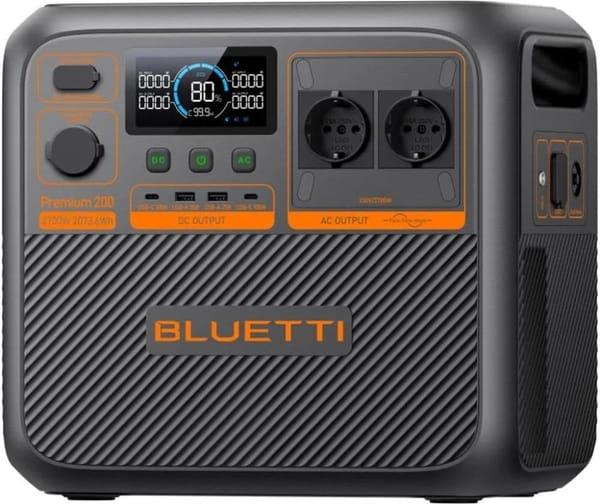
1. BLUETTI Premium 200 V2
BLUETTI Premium 200 V2 is the case when the power is enough for almost everything, while the station itself remains relatively compact. It’s frequently chosen as a home backup or for a workshop where you need to run power tools and small appliances. It operates stably, the LiFePO₄ battery has excellent cycle life, and it can be charged from the grid, solar panels, or a car.
On board you get four standard AC outlets, two USB-C ports, two regular USB ports, and a car cigarette lighter socket. It connects to virtually anything, charges quickly (even from solar), and supports remote control via the app so you don’t have to walk over to it every time. It’s fairly heavy, but it has handles and fits easily in a car trunk.
Key highlights:
Up to 6000 cycles on the LiFePO₄ battery
Supports charging from grid, car, and solar panels
4 × 230 V outlets + USB ports up to 100 W
Remote control via mobile app
Easy to carry thanks to the comfortable handle
Specifications:
Battery capacity: 2073 Wh
Continuous power: 2600 W
Battery type: LiFePO₄
Device connections: AC, USB-C, USB-A, car socket
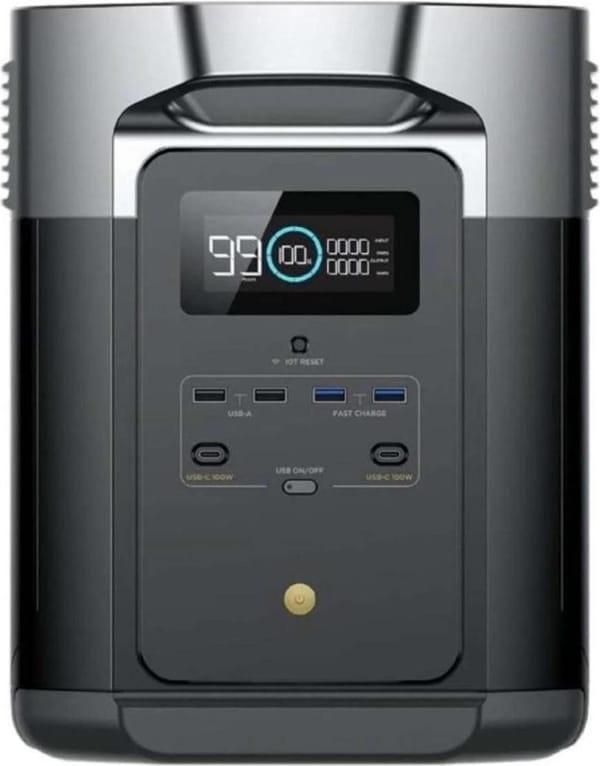
2. EcoFlow E2000 (EFE2000-EU-CBOX)
EcoFlow E2000 is a power station with slightly higher capacity and the option to expand battery capacity if needed. It’s popular among people who plan to run several high-power devices simultaneously or want extra runtime for travel. It runs quietly and charges very fast from the grid — up to 80% in 45 minutes.
Plenty of ports: AC outlets, two USB-C, two USB-A, DC outputs, and even battery expansion capability. Connects to the EcoFlow app for monitoring temperature, charge level, power usage, etc. The unit is fairly large, but it works well for stationary or semi-mobile use.
Key highlights:
Fast charging to 80% in 45 minutes
Option to connect extra battery packs
Many output options for different devices
Control via the EcoFlow app
Solar panel support
Specifications:
Battery capacity: 2048 Wh
Continuous power: 2300 W
Battery type: LiFePO₄
Device connections: AC, USB-A, USB-C, DC, car socket
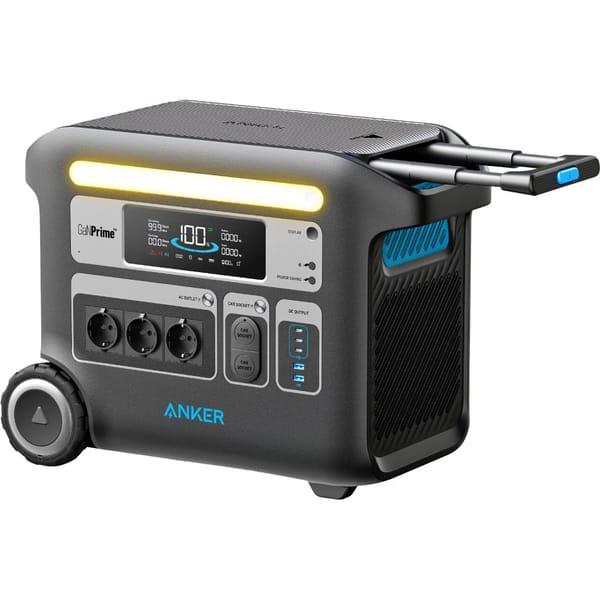
3. Anker 767 PowerHouse (A1780311)
Anker 767 PowerHouse was designed for people who value not only power but also ease of movement. It features wheels, a pull handle, a built-in flashlight, and a clear display — everything you need to avoid fumbling for cables in the dark. Specs-wise it delivers the familiar ~2 kW output, reliable LiFePO₄ chemistry, and 2048 Wh capacity.
Connects a ton of devices: three AC outlets, three USB-C ports, two USB-A, and two car outlets. Charges fairly quickly (especially from the wall), and it supports solar input as well. Thanks to the wheels you can roll it around the house instead of lifting. Downside — it’s quite heavy, but transportation is not an issue.
Key highlights:
Wheels and handle for easy transport
Built-in flashlight and informative display
Three USB-C ports including a powerful 100 W one
Solar panel and car charging support
Moderate noise level during operation
Specifications:
Battery capacity: 2048 Wh
Continuous power: 2400 W
Battery type: LiFePO₄
Device connections: AC, USB-A, USB-C, car socket
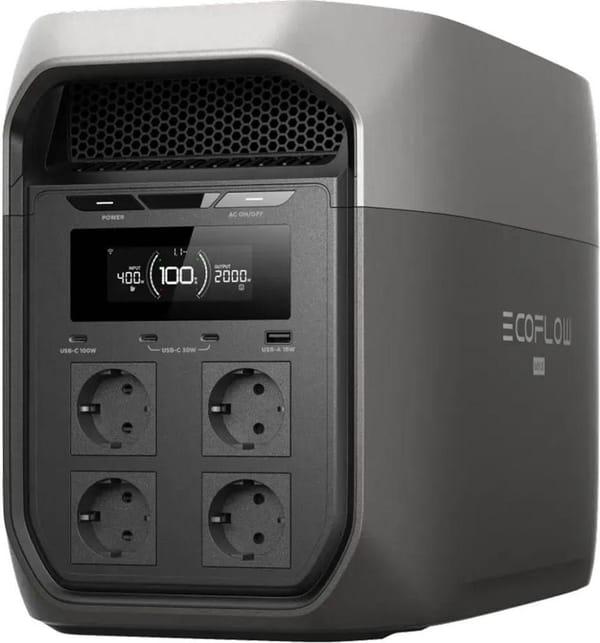
4. EcoFlow DELTA 3 Max
EcoFlow DELTA 3 Max is a power station people buy for home backup, frequent outages, or off-grid trips where stable power delivery is critical. It easily handles a refrigerator, power tools, and several gadgets at the same time. Despite its impressive specs, the size remains convenient for moving around, and it has a carrying handle.
Fast charging from both the grid and solar panels makes it great for a summer house or autonomous trips. Plenty of ports: 4 AC outlets, USB-C, USB-A, DC output. It features a built-in display and UPS (uninterruptible power supply) functionality — connected devices won’t shut down during brief outages. Runs on LiFePO₄, so longevity is not a concern.
Key highlights:
Charges to 100% in roughly one hour
UPS function to protect connected devices
LiFePO₄ with 4000 cycles before noticeable capacity loss
Many outputs: USB-C, USB-A, AC, DC
Can be charged from grid and solar
Specifications:
Battery capacity: 2048 Wh
Continuous power: 2400 W
Battery type: LiFePO₄
Device connections: 230 V AC, USB-A, USB-C, DC, XT60
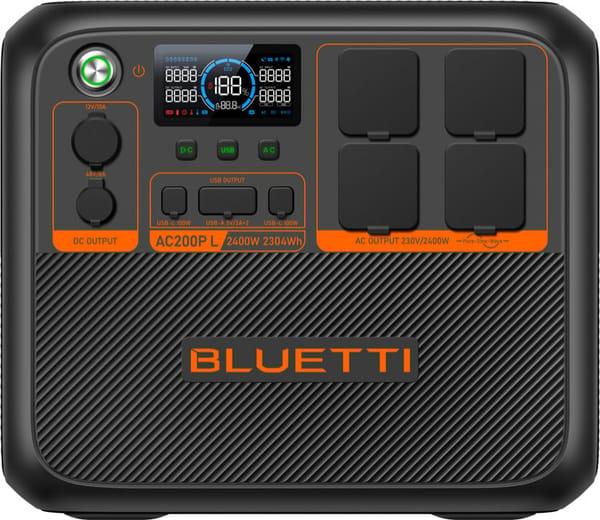
5. BLUETTI AC200PL 2400W
BLUETTI AC200PL feels like a more stationary unit but is still portable enough at 2400 W. It’s popular in private homes and small workshops. It comes with two wireless charging pads, four 230 V outlets, and all the standard ports for laptops, phones, and even a car socket. Inside is a reliable high-cycle-life LiFePO₄ battery.
Wall charging takes 1.5 hours, solar around 2.5 hours. It includes an MPPT controller, built-in display, UPS function, and fast USB charging. For its size the station is well thought out: everything is clearly labeled, ports are conveniently placed, and it has a handle. It’s heavy, but the battery capacity justifies the weight.
Key highlights:
2 wireless charging zones
Supports fast USB and AC charging
Grid and solar charging support
Built-in UPS function
Clear display and easy carrying
Specifications:
Battery capacity: 2304 Wh
Continuous power: 2400 W
Battery type: LiFePO₄
Device connections: AC, USB-A, USB-C, DC, car socket, wireless charging area
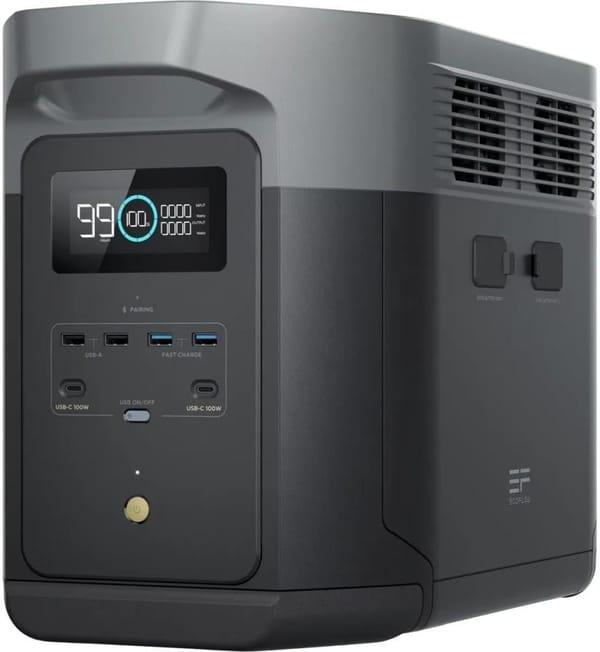
6. EcoFlow DELTA 2 Max
EcoFlow DELTA 2 Max is a great choice for those looking for a reliable power source with expansion options. It charges extremely fast: about one hour from the wall, a bit longer from solar. It outputs 2400 W continuously and up to 4800 W surge, so you can run not just lights but also kettles, microwaves, or refrigerators.
Lots of ports: 4 AC, 4 USB-A, 2 USB-C, DC outputs, car socket. Supports extra battery packs, has UPS functionality, and app control. Size- and weight-wise it’s still mobile enough to take on trips or keep handy at home.
Key highlights:
Expandable up to 6 kWh with extra batteries
13 outputs — works with a wide range of devices
Fast charging from grid and solar
Built-in display and app control
Uninterruptible power supply (UPS) support
Specifications:
Battery capacity: 2048 Wh
Continuous power: 2400 W
Battery type: LiFePO₄
Device connections: AC, USB-A, USB-C, DC, car socket
How to choose a 2 kW power station: what really matters
To avoid overpaying for features you won’t use, it’s best to first figure out exactly why you need the station. Charging a phone or running lights in a tent is one thing; keeping a fridge, pump, power tools, or boiler running is another. 2 kW is already enough for many real-world tasks, but there are still important nuances. Here’s what to pay attention to before buying:
Battery capacity: Power rating shows how much the station can deliver at once. Capacity shows how long it will last. For home backup, go for models 2000 Wh and up — so it runs for hours instead of just 40 minutes.
Battery type: Almost all modern stations use LiFePO₄ — and that’s a good thing. It’s safer, lasts much longer, and barely loses capacity over time. If another chemistry is listed, check how many cycles it supports and how it behaves in cold temperatures.
Ports & outlets: Think about what you’ll actually connect. Fridge or pump → AC outlets. Laptops & gadgets → USB-C. Car fridge → cigarette lighter port. Versatile ports save you from carrying adapters and extra hassle.
Charging speed: If you plan to use the station regularly, pick a model that recharges in 1–2 hours. Especially important for solar charging — make sure it has a good MPPT controller and decent input power rating.
Size & weight: Some units weigh 25–30 kg — fine for home use, but tough to carry on trips. If mobility matters, look for models with handles, wheels, and reasonable dimensions (check real photos rather than trusting website specs).
Reasonable minimum: You don’t always need the top-of-the-line model. Sometimes a simpler unit with clear controls, good ports, and a reliable battery without gimmicks is the smarter buy.
Conclusion
2 kW power stations are no longer just “phone chargers”. They comfortably run refrigerators, power tools, gear on the road, or essential appliances during outages — without taking up half the room. The models above are proven performers for everyday needs: some excel in compactness, others in charging speed, and some in port versatility.
The key is not to chase the “most powerful” option, but to pick what actually fits your real-life use case. Sometimes a simpler, lighter model with straightforward controls is far better than a heavy flagship that leaves you searching for adapters and cursing its weight. And once you’ve got the right base unit, you can always add solar panels or extra batteries later if needed.