

3D Printer – The Ideal Solution for Business and Scaling in 2026
March 2, 2026
In 2026, 3D printing has finally ceased to be a "toy for enthusiasts" and has transformed into a powerful scaling tool for small and medium-sized businesses. What previously required expensive molds, complex supply chains, and months of waiting can now be done in just a few days - right in your own office, garage, or small workshop.
Modern desktop and farm 3D printers print 5-10 times faster than models from 2022-2023, have significantly higher reliability, and work with engineering materials at a price accessible even to startups. This opens the door to several business models simultaneously: from selling unique custom products on Etsy and Prom to producing small series of components, prototyping for clients, and even creating your own product lines.
Most importantly - 3D printing provides unprecedented flexibility: you are not tied to minimum batch sizes, you do not bear huge warehouse costs, and you can instantly respond to trends or seasonal demand. That is why in 2025-2026 more and more entrepreneurs are calling the 3D printer "the new lathe of the 21st century" - a tool that allows you to start with minimal investment and then scale almost without limits.
Want to understand exactly how 3D printing can become the foundation or accelerator of your business? Let's break down the key advantages and real scaling scenarios next.
Scaling: from one printer to a farm
Scaling begins with farms - several printers managed centrally. In 2026, tools like Farm Manager allow control of the fleet without using the cloud, through a local network. Start with 5-10 devices, adding more as order volume grows. This increases productivity: one printer handles prototypes, others run production series. Savings on personnel because automation reduces manual labor.
Use AI for optimization: the software predicts print time and distributes tasks. For businesses with seasonal demand, a farm provides flexibility - print more during peak periods, less during slow periods. Invest in spare parts to avoid downtime. Local production reduces risks such as supply chain delays.
Start: one printer for testing.
Expansion: add AMS for multi-color printing.
Farm: 10+ printers with centralized management.
Optimization: AI for task distribution.
Savings: inventory reduction by 50-70%.
Overview of Bambu Lab models for business
Bambu Lab offers a lineup of printers designed for practical use in companies. These models combine speed, reliability, and flexibility, making them suitable for transitioning from prototyping to small-batch and serial production. They use FDM technology, feature enclosed chambers for stability, and support expansion through modules. In 2026 such printers are becoming the foundation for farms where multiple devices work together.
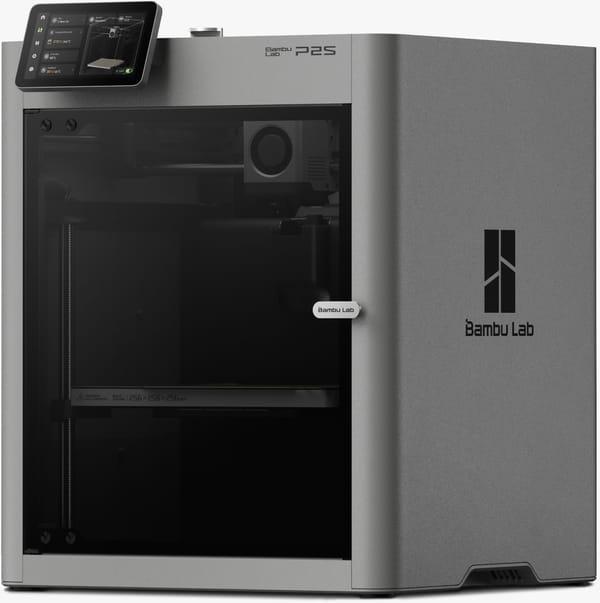
1. Bambu Lab P2S (PF004-U)
Model Bambu Lab P2S is an enclosed FDM printer designed for stable operation with various plastics, including engineering materials. The body is made of plastic, steel, and glass, which helps maintain temperature inside the chamber and reduces printing noise. The printer features an updated 5-inch touchscreen with a new second-generation interface that makes settings more convenient. The PMSM servo extruder delivers up to 8.5 kg of extrusion force, improving stability at high speeds and enabling real-time filament issue detection. It also includes an active air cooling system, HEPA filter with carbon cleaning to remove odors and particles, and a 1080p camera for process monitoring. Print speed can reach 500 mm/s, and the build plate automatically levels.
Key points:
Enclosed chamber with temperature control and air purification.
Reinforced servo extruder with real-time problem detection.
Convenient touchscreen and mobile control via Wi-Fi.
Suitable for fast printing and materials that require stable conditions.
Specifications:
Printing technology: FDM.
Build volume: 256 × 256 × 256 mm.
Maximum nozzle temperature: 300 °C.
Maximum bed temperature: about 110 °C.
Default nozzle diameter: 0.4 mm (supports 0.2; 0.6; 0.8 mm).
Print speed: up to 500 mm/s.
Interface: Wi-Fi, USB.
Printer dimensions: 392 × 406 × 478 mm.
Weight: about 14.9 kg.
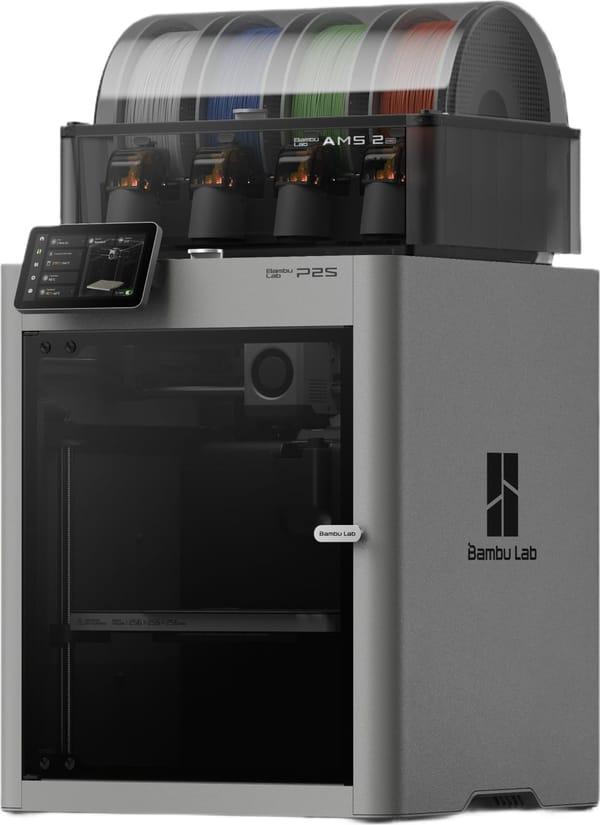
2. Bambu Lab P2S Combo (PF004-U+SA007)
Bambu Lab P2S Combo Combo version includes the base P2S together with the AMS 2 Pro system, which allows automatic switching between multiple filament spools. This enables multi-color or multi-material printing without manual filament changes. The AMS connects directly to the printer and supports up to 4 spools simultaneously (expandable with additional units). The extruder is the same reinforced type with high feed force, and the Adaptive Airflow system helps maintain optimal airflow in the chamber for different plastics. The printer retains all advantages of the base model: enclosed chamber, air purification, fast printing, and convenient control. The Combo variant is convenient when producing multi-color items or testing different materials without stopping.
Key points:
Includes AMS 2 Pro for automatic filament switching.
Ability to print in multiple colors or materials simultaneously.
Same stable chamber and extruder as the regular P2S.
Suitable for small-batch serial production with different colors.
Specifications:
Printing technology: FDM.
Build volume: 256 × 256 × 256 mm.
Maximum nozzle temperature: 300 °C.
Maximum bed temperature: about 110 °C.
AMS support: up to 4 spools (expandable).
Extruder: servo with 8.5 kg force.
Screen: 5-inch touchscreen.
Camera: 1080p.
Interface: Wi-Fi.
Supported materials: PLA, PETG, ABS, ASA, PA, PC, composites.
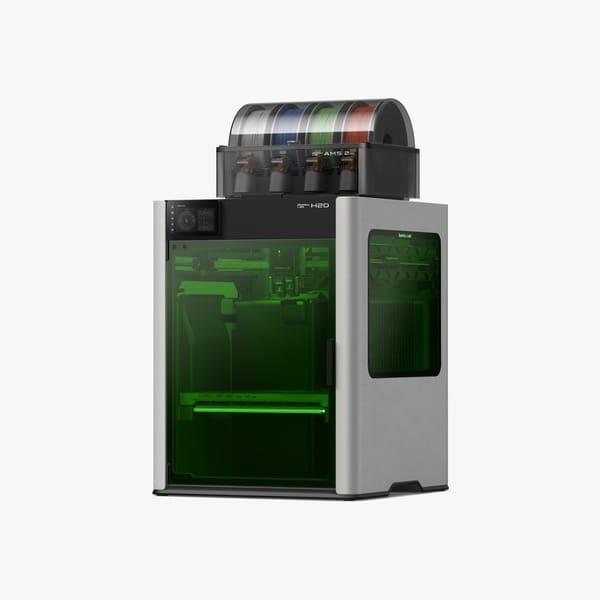
3. Bambu Lab H2D Laser Full Combo 40W (12031000)
Bambu Lab H2D Laser Full Combo 40W this model combines FDM printing with laser engraving and cutting thanks to a dual nozzle and 40 W laser module. The printer can operate in single- or dual-nozzle mode, providing greater flexibility when printing complex parts. The blue laser module (455 nm) is suitable for engraving and cutting materials such as wood, plywood, leather, acrylic, rubber, thin metals. It includes an AMS system for multi-color printing. The laser can process an area up to 310 × 250 mm with height up to 250-280 mm depending on settings. Engraving speed is high, and cutting thickness reaches 15 mm on plywood. This is a combined device for those who want not only to print but also to process materials with a laser.
Key points:
Dual nozzle for multi-material printing.
40 W laser for fast engraving and cutting of thick materials.
Large print volume with mode switching capability.
AMS support for color printing.
Specifications:
Printing technology: FDM.
Laser: 40 W, wavelength 455 nm.
Print volume: ~325 × 320 × 325 mm (single nozzle), ~300 × 320 × 325 mm (dual nozzle).
Maximum engraving speed: up to 1000 mm/s.
Maximum cutting thickness: up to 15 mm (plywood).
Interface: USB, Wi-Fi.
Nozzle diameter: 0.4 mm (optional 0.2; 0.6; 0.8 mm).
Laser processing area: up to 310 × 250 mm.
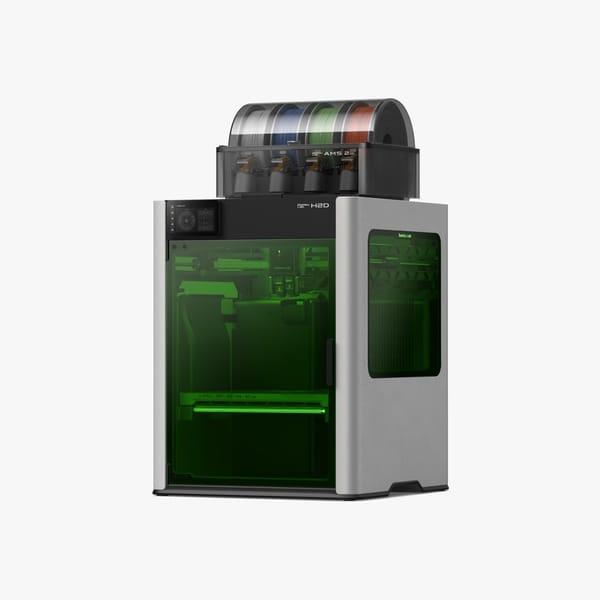
4. Bambu Lab H2D Laser Full Combo 10W (BAMH2DL10C-U1)
Bambu Lab H2D Laser Full Combo 10W this is a similar combined H2D model but with a lower-power laser module - 10 W. It retains the dual nozzle for 3D printing, AMS support, and large chamber volume. The laser is suitable for precise engraving and cutting of thin materials (up to 5 mm plywood). Engraving speed is lower than the 40 W version, but lines can be sharper at certain settings. The device is convenient for those who want both printing and light laser engraving without needing very thick materials. Overall construction and FDM printing capabilities are the same as the higher-power version.
Key points:
Dual nozzle + 10 W laser in one body.
Suitable for engraving and cutting thin materials.
Multi-color printing capability via AMS.
Lower laser power but more precise processing at low speeds.
Specifications:
Printing technology: FDM.
Laser: 10 W, wavelength 455 nm.
Print volume: ~325 × 320 × 325 mm (single nozzle), ~300 × 320 × 325 mm (dual nozzle).
Maximum engraving speed: up to 400 mm/s.
Maximum cutting thickness: up to 5 mm (plywood).
Interface: USB, Wi-Fi.
Nozzle diameter: 0.4 mm (optional 0.2; 0.6; 0.8 mm).
Laser processing area: up to 310 × 270 mm.
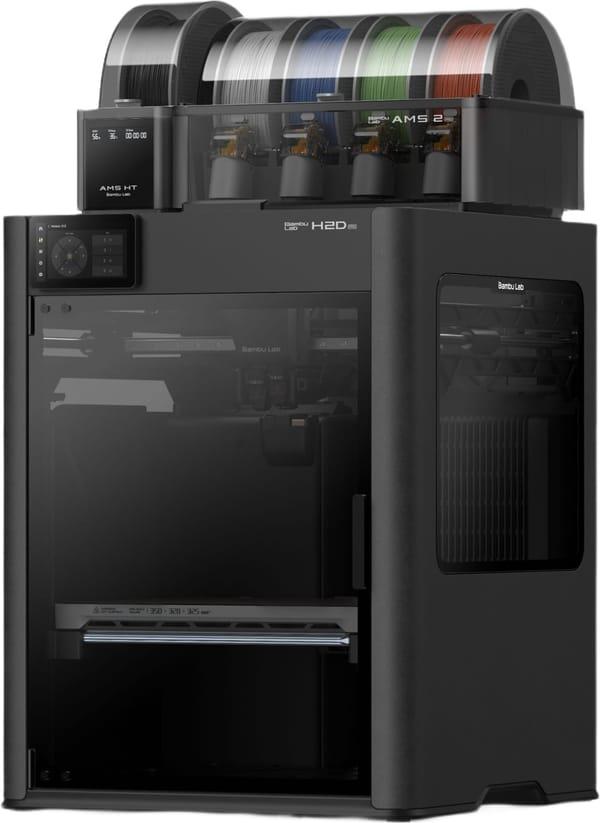
5. Bambu Lab H2D Pro
Model H2D Pro is a professional version with dual nozzle, focused on working with high-temperature materials. It features active chamber heating up to 65 °C, which helps reduce deformation of parts made from ABS, PC, nylon or composites. The extruder is equipped with a tungsten-carbide nozzle with high wear resistance, and the cooling & air filtration system includes G3 pre-filter, HEPA H12 and activated carbon. The printer supports Ethernet and Wi-Fi with WPA2-Enterprise for secure connection in corporate networks. It includes precise motion calibration using a vision encoder with 5 μm resolution, providing positioning accuracy of about 50 μm. The body is a combination of aluminum, steel, plastic and glass, weighing about 31 kg without AMS.
Key points:
Dual nozzle for multi-material printing with minimal waste.
Active chamber heating and high-temperature nozzle for engineering plastics.
Enhanced air filtration and secure network connection.
Vision encoder for high motion accuracy.
Specifications:
Printing technology: FDM.
Build volume: 325 × 320 × 325 mm (single nozzle), 300 × 320 × 325 mm (dual nozzle), overall up to 350 × 320 × 325 mm.
Maximum nozzle temperature: 350 °C.
Maximum chamber temperature: 65 °C.
Nozzle diameter: 0.4 mm (optional 0.2; 0.6; 0.8 mm).
Interface: USB, Wi-Fi, RJ45 (Ethernet).
Weight: about 31 kg.
Supported materials: PLA, PETG, ABS, ASA, PC, PA, PPA-CF, PPS and composites.
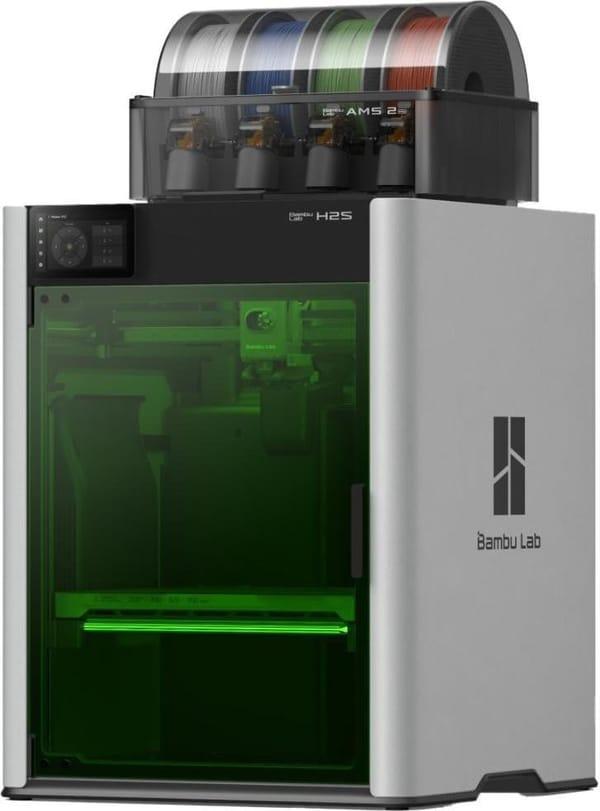
6. Bambu Lab H2S Laser Full Combo (PF003-S+SA007+SL001)
Bambu Lab H2S Laser Full Combo this configuration combines FDM printing with a 10 W laser module for engraving and cutting. The printer has a large print volume, enclosed chamber with active heating up to 65 °C, and air filtration system. The laser module includes air assist for better processing quality, and BirdsEye camera helps with precise positioning. The servo-motor extruder with closed-loop control manages filament feeding, and the printer supports speeds up to 1000 mm/s. It includes AMS 2 Pro for multi-color printing. The body is made of aluminum, steel, plastic and glass, with laser safety windows in the Laser Edition.
Key points:
Large print volume for bigger parts.
10 W laser for engraving and cutting thin materials.
AMS 2 Pro for automatic filament switching.
Enclosed chamber with heating and filtration.
Specifications:
Printing technology: FDM.
Laser: 10 W, 455 nm.
Print volume: 340 × 320 × 340 mm.
Maximum nozzle temperature: 350 °C.
Maximum chamber temperature: 65 °C.
Interface: USB.
Motion speed: up to 1000 mm/s.
Weight: about 30.5 kg (with laser).
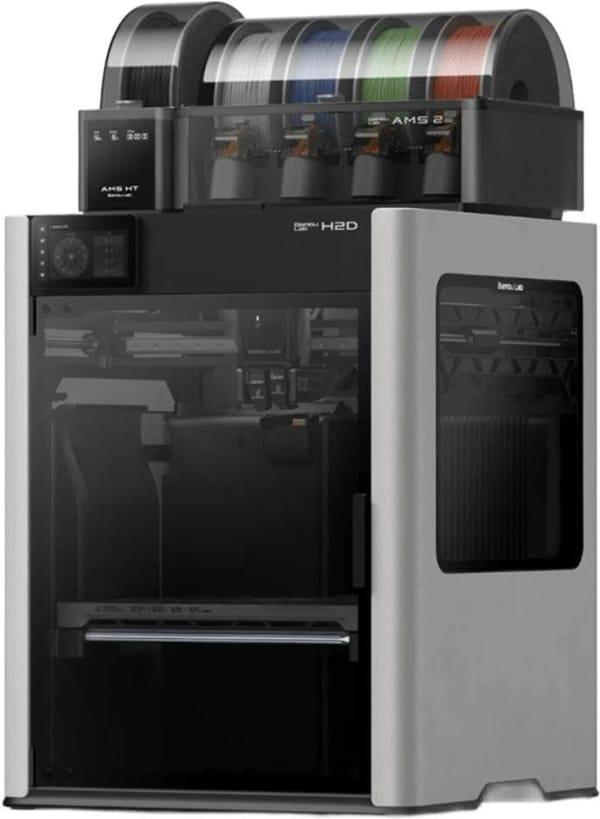
7. Bambu Lab H2D AMS HT Bundle (PF003-D+SA007+SA008)
Bambu Lab H2D AMS HT Bundle includes the base H2D with dual nozzle and specialized AMS HT for hygroscopic materials. The printer allows simultaneous printing with two nozzles, reducing waste during material changes. AMS HT features improved filament drying and servo motors for fast feeding. The chamber heats to 65 °C and the hotend to 350 °C, suitable for PC, PA, PPA-CF etc. Multi-color printing support via AMS. The sturdy body is made of combined materials, weighing about 31 kg without additional modules.
Key points:
Dual nozzle for efficient multi-material printing.
AMS HT for drying and working with hygroscopic filaments.
High-temperature capabilities for engineering plastics.
Automatic calibration and feed control.
Specifications:
Printing technology: FDM.
Build volume: 325 × 320 × 325 mm (single nozzle), 300 × 320 × 325 mm (dual nozzle), overall up to 350 × 320 × 325 mm.
Maximum nozzle temperature: 350 °C.
Maximum chamber temperature: 65 °C.
Interface: USB, Wi-Fi.
AMS HT support: for PA, PC, PVA, BVOH etc.
Weight: about 31 kg (base).
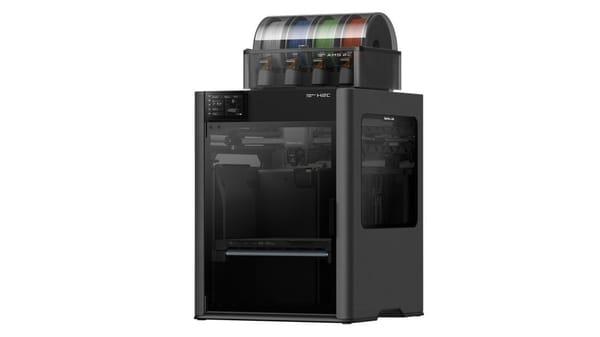
8. Bambu Lab H2C Combo (PF003-C+SA007)
Model H2C Combo is a dual-nozzle version with the Vortek system for fast material switching with less waste. It features an enclosed chamber with air filtration (G3 + HEPA H12 + carbon), heating up to 65 °C and hotend up to 350 °C. Hardened steel extruder, support for speeds up to 1000 mm/s. Comes with AMS for multi-color printing. Body made of aluminum, steel, plastic and glass, weight about 32.5 kg. Suitable for multi-color and multi-material projects.
Key points:
Dual nozzle with Vortek system to reduce waste.
AMS for multi-color printing.
Enclosed chamber with heating and filtration.
Support for high-temperature materials.
Specifications:
Printing technology: FDM / FFF.
Build volume: 325 × 320 × 320 mm (left nozzle), 305 × 320 × 325 mm (right), 300 × 320 × 325 mm (dual).
Maximum nozzle temperature: 350 °C.
Maximum chamber temperature: 65 °C.
Interface: USB, Wi-Fi.
Weight: 32.5 kg.
Supported materials: PLA, PETG, ABS, ASA, PC, PA and composites.
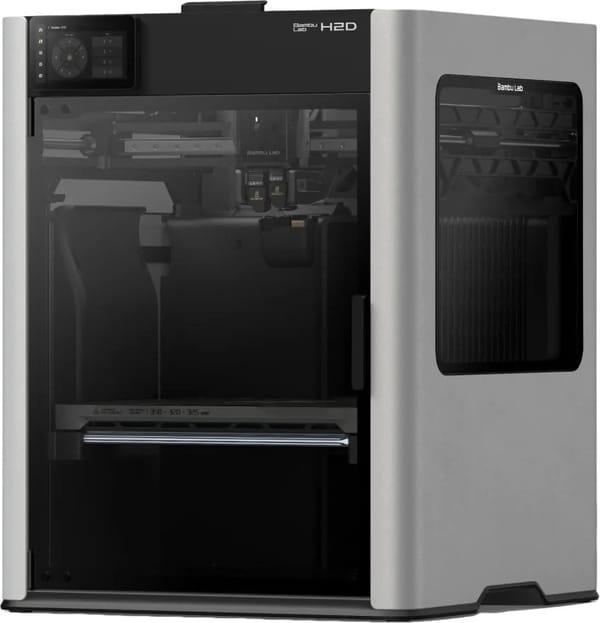
9. Bambu Lab H2D (BAMH2D-U1)
Model Bambu Lab H2D is the base dual-nozzle option for FDM printing. It features an enclosed chamber with aluminum and steel chassis, and an outer frame made of plastic and glass. The printer allows printing with one or two nozzles, with build volume varying depending on the mode. The extruder is equipped with hardened steel, and the nozzle is made of hardened steel or tungsten carbide in some versions. Various nozzle diameters are supported, and the printer can handle high temperatures for engineering materials. It also includes an air filtration system with pre-filter, HEPA and activated carbon.
It is equipped with a touch screen for control, a camera for monitoring, and supports Wi-Fi and USB connectivity. High toolhead movement speed with acceleration capability, and active chamber heating. This allows the use of materials such as PLA, PETG, ABS, ASA, PC, PA. The construction weighs about 31 kg, and the printer is compatible with AMS for multi-color printing.
Key points:
Dual nozzle for multi-material or multi-color printing.
Active chamber heating up to 65 degrees for stable printing.
High speed and motion accuracy with optical encoder.
Air filtration to reduce harmful emissions.
Specifications:
Printing technology: FDM.
Build volume: single nozzle 325 x 320 x 325 mm, dual 300 x 320 x 325 mm, overall 350 x 320 x 325 mm.
Maximum nozzle temperature: 350 degrees.
Maximum bed temperature: 120 degrees.
Nozzle diameter: 0.4 mm standard, supports 0.2, 0.6, 0.8 mm.
Interface: USB, Wi-Fi.
Dimensions: 492 x 514 x 626 mm.
Weight: 31 kg.
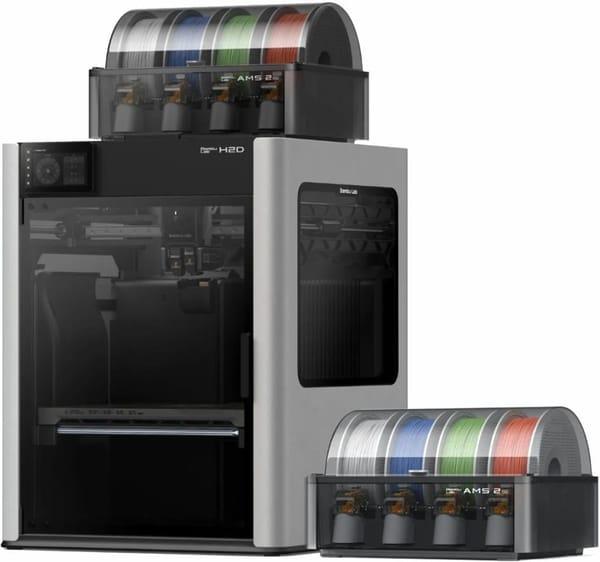
10. Bambu Lab H2D Dual AMS 2 Pro Bundle (PF003-D+SA007+SA007)
Bambu Lab H2D Dual AMS 2 Pro Bundle this configuration includes the H2D with two AMS 2 Pro modules for automatic filament feeding. The printer features a dual nozzle, enclosed heated chamber and cooling system. AMS 2 Pro units allow up to four spools per module, with servo motors for fast material switching. Sturdy body made of combined materials, and the printer supports high printing speeds. It is compatible with AMS HT for hygroscopic filaments.
Reinforced extruder mechanism, and the system monitors feeding in real time. Support for up to 12 AMS units for 24 slots. This makes the printer convenient for multi-color projects. Base unit weight 31 kg, more with modules.
Key points:
Two AMS 2 Pro for extended multi-color feeding.
Dual nozzle with minimal waste during material change.
Compatibility with AMS HT for special materials.
High performance with fast switching.
Specifications:
Printing technology: FDM.
Build volume: single nozzle 325 x 320 x 325 mm, dual 300 x 320 x 325 mm.
Maximum nozzle temperature: 350 degrees.
Interface: USB.
AMS support: up to 4 AMS 2 Pro + 8 AMS HT.
AMS 2 Pro dimensions: 372 x 280 x 226 mm.
AMS 2 Pro weight: 2.5 kg.
Materials: PLA, PETG, ABS, ASA, PA, PC etc.
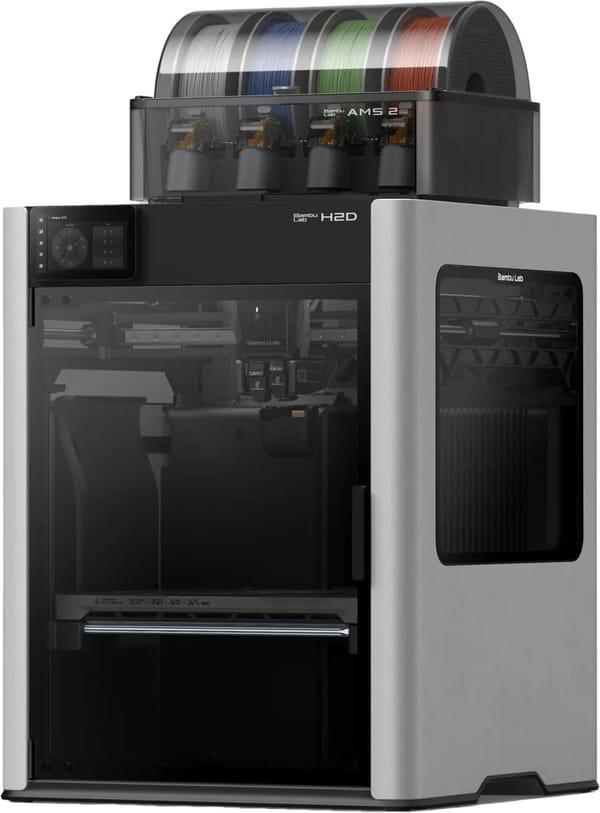
11. Bambu Lab H2D AMS Combo (572129)
Model H2D AMS Combo comes with base H2D and one AMS module for multi-color printing. It uses FDM technology with dual nozzle and enclosed chamber. The build volume allows large parts, and the chamber heating system helps with materials prone to warping. Extruder and nozzle made of durable materials, support for various diameters. The printer has sensors for detecting filament issues.
AMS adds automatic color switching, with support for multiple modules. The design includes air filtration and a monitoring camera. This is an option for those who need material flexibility without additional laser functions.
Key points:
Included AMS for multi-color printing.
Dual nozzle for efficient work with multiple materials.
Active temperature control in the chamber.
Precise positioning with optical sensors.
Specifications:
Printing technology: FDM.
Build volume: single nozzle 325 x 320 x 325 mm, dual 300 x 320 x 325 mm, overall 350 x 320 x 325 mm.
Maximum nozzle temperature: 350 degrees.
Interface: USB, Wi-Fi.
Nozzle diameter: 0.4 mm standard, supports 0.2, 0.6, 0.8 mm.
Speed: up to 1000 mm/s.
Dimensions: 492 x 514 x 626 mm.
Weight: 31 kg.
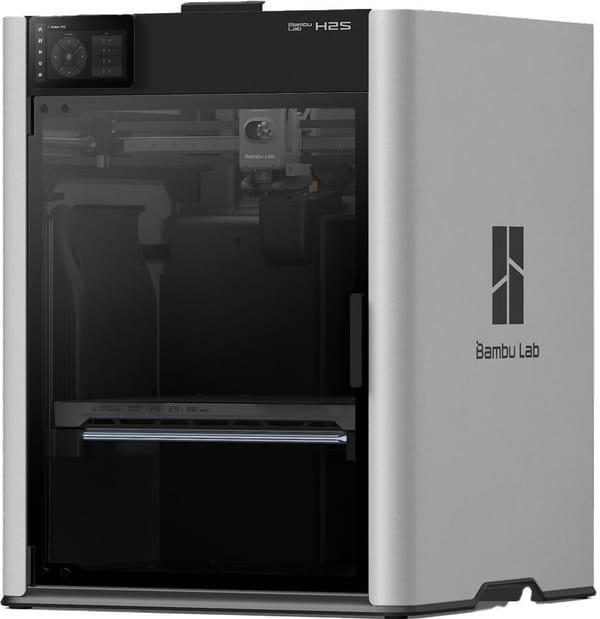
12. Bambu Lab H2S (PF003-S)
Bambu Lab H2S is a single-nozzle model with a large build volume for FDM printing. The chamber is enclosed, with aluminum and steel chassis, exterior plastic and glass. The printer features high movement speeds and acceleration, with a servo extruder for powerful feeding. Support for chamber heating and high nozzle temperature for engineering plastics. Multi-level air filtration system.
It is compatible with AMS for multi-color mode, with the ability to connect multiple modules. Includes cameras and sensors for monitoring. Weight 30 kg, with optional laser upgrade. This is a base option for large projects.
Key points:
Large volume for printing bigger parts.
Servo extruder with high feeding force.
AMS support for color expansion.
Filtration and chamber heating for stability.
Specifications:
Printing technology: FDM.
Build volume: 340 x 320 x 340 mm.
Maximum nozzle temperature: 350 degrees.
Maximum bed temperature: 120 degrees.
Speed: up to 1000 mm/s.
Acceleration: 20,000 mm/s².
Interface: USB.
Weight: 30 kg.
Examples of use in business
In the automotive industry, 3D printers produce components such as fixtures or tools, reducing development time. Furniture companies create custom elements, responding to trends. In the medical field - prosthetics or models for surgical planning. For startups, this is a way to launch a product without large investments.
In construction, printers with laser process materials for prototypes. Electronics manufacturers print enclosures, testing ergonomics. Eco-friendly businesses use recycled plastics for packaging. All these examples show how 3D printing makes companies more competitive.
Automotive: printing assembly tools.
Furniture: custom fittings.
Medical: organ models.
Electronics: test enclosures.
Eco: packaging from recycled materials.
Practical tips for implementing 3D printing
Start by assessing current processes: where can 3D printing replace traditional manufacturing? For prototypes use simple materials like PLA, for final parts - stronger ones like ABS. Train the team in basic modeling skills in programs such as Fusion 360. Integrate the printer with ERP systems for order automation. Regularly check calibration to avoid defects.
Choose materials depending on the task: PETG for flexibility, PA for strength. Reduce waste by optimizing design - add stiffening ribs, reduce wall thickness. For safety, install printers in a well-ventilated room and use filters. Start with one printer, test on real tasks, then scale up.
Training: conduct short courses for employees.
Design: avoid overhangs over 45 degrees, add supports.
Materials: test compatibility before series production.
Maintenance: clean the nozzle weekly, check belts.
Integration: connect to monitoring software.
Conclusion
In a world where business is constantly looking for ways to become faster and more efficient, 3D printing is coming to the forefront as a tool that truly changes the approach to manufacturing. With models like those from Bambu Lab, companies can not only test ideas in a matter of days, but also build entire systems for serial production without unnecessary costs for equipment or logistics. This is not about an overnight revolution, but about the gradual implementation of a technology that provides flexibility and reduces risks. In 2026, when global supply chains remain unstable, local production via 3D printers is becoming not a luxury but a necessity for growth. If approached with an understanding of one's needs and a willingness to learn, this tool can become the foundation for expansion, allowing small businesses to compete with large players. Ultimately, success depends on how ready the business is to integrate new tools into daily routines, and 3D printing offers real opportunities for those who are not afraid to experiment.
Frequently Asked Questions
How to determine if a business needs a printer with laser functions
Printers with laser modules, such as those in the Bambu Lab H2D series, add engraving and material cutting capabilities, which can be useful for companies working not only with plastic but also with wood, acrylic or leather. If a business is engaged in creating prototypes where printing needs to be combined with additional processing, such a function will reduce the time spent transitioning between stages. For example, for manufacturers of advertising materials or accessories, the laser allows immediate application of logos or cutting of shapes without separate equipment. However, if the main activity is limited to simple part printing, basic models without a laser will suffice to avoid overpaying for unnecessary options. It is worth assessing how often such processing is needed and testing on real tasks to understand whether the investment in versatility will pay off.
What material costs should be considered when scaling
Materials for 3D printing, such as PLA or ABS, cost from a few hundred hryvnias per kilogram, but when expanding production, filament price becomes a significant part of the budget. For a business planning a printer farm, it is important to calculate not only the cost of basic plastics but also special ones, such as carbon fiber composites, which can be three times more expensive. Add to this maintenance costs such as waste cleaning or nozzle replacement, which accumulate over time. In 2026, suppliers offer bulk discounts, so switching to large filament batches can reduce costs by 20-30 percent. It is recommended to keep records of costs per part to optimize design and reduce material losses, making production more predictable.
Is it possible to integrate 3D printers with a company's existing software
Integration of 3D printers with business systems such as ERP or CRM is becoming simpler thanks to open interfaces of models like P2S or H2S. Many printers support API for task automation, allowing files to be sent directly from modeling software or order databases. For companies already using software like Autodesk or SolidWorks, this means a seamless transition: design goes straight to printing without manual intervention. If a business has its own management system, it is worth checking compatibility via Wi-Fi or Ethernet, as in professional versions of H2D Pro. This helps avoid duplicate work and speeds up the process from order to finished product, making the entire chain more efficient.
How to ensure safety and environmental friendliness when using printers in business
Safety when working with 3D printers involves installation in a well-ventilated room, as some materials emit potentially harmful vapors. Models with built-in filters, such as HEPA in the Bambu Lab series, reduce this risk, but masks should still be used when working with engineering plastics. The environmental aspect includes choosing recycled filaments, which is becoming standard in 2026, and minimizing waste through optimized design. Businesses can implement plastic recycling programs, turning failed prints into new materials. Regular equipment checks prevent overheating or short circuits, ensuring stable operation without accidents.
What trends in 3D printing development will impact business in the coming years
In the coming years, 3D printing will evolve toward greater automation, with AI optimizing print parameters to reduce defects. Models with expanded capabilities, such as combined laser printers, will become standard for multi-tasking production. The use of biodegradable materials will grow, helping businesses meet environmental standards. Integration with IoT will allow remote management of printer farms, making scaling simpler. For companies, this means moving to hybrid systems where 3D printing is combined with traditional manufacturing, opening new markets such as personalized goods or real-time rapid prototyping.