

Canon EOS R8 review: complete guide 2026
July 1, 2026
In brief: Canon EOS R8 is a compact full-frame mirrorless camera that combines a 24.2-megapixel sensor, the DIGIC X processor, and the advanced Dual Pixel CMOS AF II autofocus system with 100% frame coverage. Thanks to 6K oversampled 4K video recording at 60 fps, C-Log 3 support, and continuous shooting at up to 40 fps, this camera offers an excellent balance between functionality and affordability. As of June 2026, the R8 is available for $1,299 ($350 discount valid from June 15 to July 5, 2026) and remains one of the best entry points into the Canon RF ecosystem.
Canon EOS R8 entered the market as an affordable full-frame alternative in Canon's mirrorless camera lineup. In the years since its release, it has established itself as a reliable tool for photographers and videographers looking for a compact solution without compromising image quality.
As of June 2026, the camera has received firmware version 1.6.0, which includes bug fixes and operational stability improvements. But does the R8 still remain relevant compared to newer Canon models and competing cameras?
In this review, we'll examine every key aspect of the Canon EOS R8—from its technical specifications to its real-world performance across different shooting scenarios.
Canon EOS R8 Key Specifications
Canon EOS R8 is built on a proven platform using components borrowed from more expensive models in the lineup. This allowed Canon to create a high-performance camera at a reasonable price.
Sensor and Processor
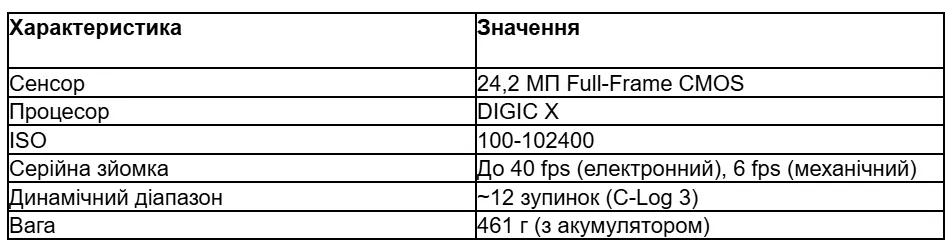
At the heart of the R8 is a 24.2-megapixel full-frame CMOS sensor paired with the powerful DIGIC X processor. This combination provides fast image processing and supports modern autofocus features.
The sensor supports an ISO range from 100 to 102400. The dynamic range reaches approximately 12 stops when using the C-Log 3 profile, providing ample flexibility for video post-production.
The camera delivers continuous shooting at up to 40 frames per second with the electronic shutter and up to 6 fps with the mechanical shutter. This makes the R8 suitable for sports and other fast-moving subjects.
Autofocus System
The R8 features the second-generation Dual Pixel CMOS AF II autofocus system. It provides 100% frame coverage both horizontally and vertically using 1,053 autofocus zones in Whole Area AF mode.
The face and eye detection system works for both people and animals. It also adds vehicle detection, which is useful for motorsports and aviation photography.
The R8 inherits autofocus algorithms from the higher-end R6 Mark II and R5 models, making it exceptionally reliable even in challenging lighting conditions. The camera also offers enhanced autofocus performance in low-light environments.

Choose Your Camera and Accessories at JustBuy
JustBuy offers cameras, video equipment, and shooting accessories. Here you can browse available cameras, lenses, memory cards, stabilizers, and other gear for both beginner and professional setups.
A successful shooting setup involves more than just the camera itself. It's worth considering the right lens, memory card, battery, stabilization equipment, and how you'll be shooting—photos, videos, travel, content creation, or commercial projects.
Looking for Photo or Video Equipment?
JustBuy can help you with:
choosing a camera and compatible lenses
choosing memory cards, batteries, and accessories
comparing available models
providing expert advice on photo and video equipment
👉 Contact JustBuy to find the right equipment for your shooting style.
Video Quality: Recording Capabilities and Limitations
The Canon R8's video capabilities look impressive on paper. The camera supports 6K oversampled 4K recording at 60 frames per second with no sensor crop. This delivers outstanding detail and excellent video sharpness.
Formats and Codecs
The R8 records video in the following primary formats:
4K UHD (3840 × 2160) at 60p/30p/24p — 6K oversampled, no crop
Full HD (1920 × 1080) at 180p/120p/60p/30p
HDR PQ and C-Log 3 support for extended dynamic range
File formats: MP4 (H.264/H.265)
The camera supports only IPB and IPB Light compression modes for standard 4K 60p recording. The maximum bitrate in 4K 60p (with Canon Log 3 or HDR PQ enabled) is approximately 340 Mbps (IPB Standard). All-I intra-frame compression is available only for creating time-lapse videos.
Overheating and Recording Duration
This is where the main compromise appears. According to DPReview testing, the R8 can record 4K 30p video for approximately 1 hour and 10 minutes at room temperature. This is an acceptable result for most shooting scenarios.
When recording in 4K 60p, operating time decreases. The camera has no active cooling system and instead relies on passive heat dissipation through the body. In hot weather or during extended recording sessions, overheating protection may be triggered.
However, it's worth noting that the temperature warning appeared during testing but later disappeared on its own, allowing the camera to continue recording without critical interruptions. For most videographers, this will not be a major issue.
C-Log 3 and Dynamic Range
C-Log 3 gives the R8 approximately 12 stops of dynamic range in video. This allows you to preserve shadow and highlight detail even in high-contrast lighting conditions.
For comparison, the standard picture profile is typically limited to 8–9 stops. C-Log 3 requires color grading in post-production but provides significantly greater editing flexibility.
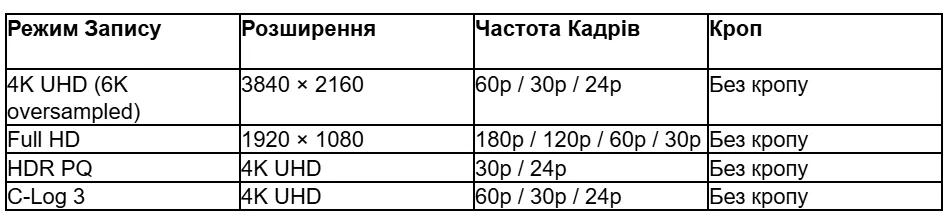
Image Quality
The R8's 24.2-megapixel sensor provides an excellent balance between resolution and low-light sensitivity. Its resolution is sufficient for most commercial applications, including prints up to A2 size.
ISO Performance in Low Light
The R8 delivers excellent results at high ISO settings. Its ISO 100–102400 range remains highly usable up to ISO 12800 without significant loss of detail.
At ISO 25600, visible noise begins to appear, but it remains well controlled and can be reduced effectively during post-processing. Higher ISO values are best reserved for extreme situations.
The camera's noise reduction system works efficiently, maintaining a good balance between clean images and fine detail preservation. Settings can be adjusted manually depending on your needs.
File Formats
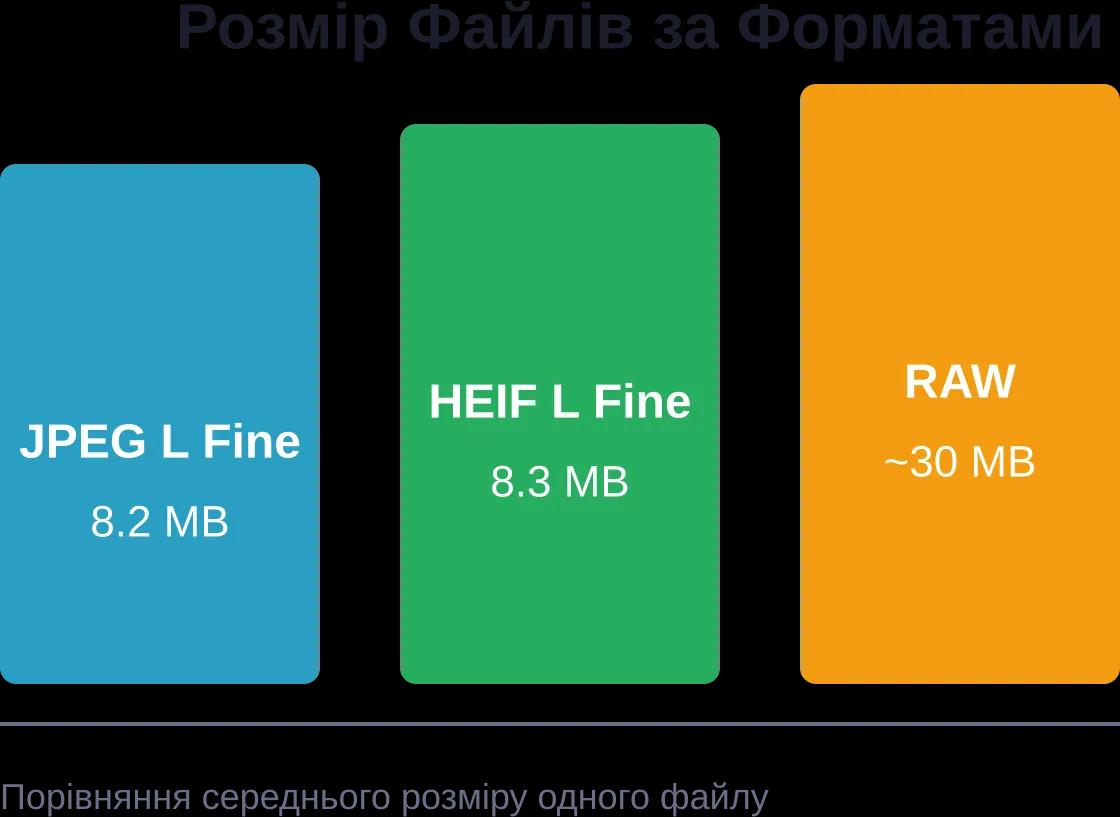
The R8 supports several still image formats:
JPEG — with Fine/Normal quality settings and L/M/S1/S2 image sizes
HEIF — a 10-bit format offering improved dynamic range and compression
RAW (CR3) — full uncompressed RAW format for maximum editing flexibility
C-RAW — compressed RAW with reduced file size
According to Canon's official specifications, a memory card can store approximately 3,700 JPEG L Fine images or more than 1,000 RAW images during continuous shooting.
Ergonomics and Body Design
The Canon EOS R8 continues Canon's lineup of compact full-frame cameras. In terms of size, it is close to the R6 but lighter thanks to its more compact body.
Dimensions and Weight
According to CIPA standards, the R8 measures approximately 132.5 × 86.1 × 70.0 mm and weighs around 461 grams with the battery and memory card installed. This makes it one of the lightest full-frame cameras available.
Compactness comes with a trade-off: the camera grip is smaller than those of the R6 Mark II or R5. Users with larger hands may find it less comfortable, although an optional battery grip improves handling.
Controls
The R8 features a minimalist set of buttons and controls. The top panel includes:
Main shooting mode dial
Shutter release button with integrated power switch
Video recording button
Control dial for camera settings
Exposure compensation button
The rear panel includes a joystick for focus point selection, a multi-controller, and several customizable buttons. Overall, the controls are intuitive for anyone familiar with Canon's interface.
Screen and Viewfinder
The R8 features a 3-inch fully articulating touchscreen with a resolution of 1.62 million dots. The screen flips out to the side and rotates, making it ideal for video recording and selfies.
The electronic viewfinder (EVF) offers a resolution of 2.36 million dots and a 120 Hz refresh rate. This provides a smooth, responsive viewing experience that is especially valuable during action shooting.
Battery Life and Power
The R8 uses the LP-E17 battery—the same battery found in older Canon APS-C models and some full-frame cameras. It has a smaller capacity than the LP-E6NH battery used in the R6 Mark II.
Battery Life
According to CIPA ratings, the R8 can capture approximately 220 shots using the electronic viewfinder or around 370 shots using the LCD screen on a single charge. For longer shooting sessions, carrying 2–3 spare batteries is recommended.
Video recording time depends on the selected recording mode. According to long-term users, you can expect approximately 1 hour and 10 minutes of continuous 4K 30p recording at room temperature.
USB-C Charging
The R8 supports charging via USB-C, allowing it to be recharged while on location.
through USB-C, making it convenient for charging while on location. The port also supports the USB 3.2 Gen 2 (SuperSpeed Plus) standard for fast file transfers to a computer. This is especially important when working with large RAW files or high-bitrate video.
Lens Compatibility and the RF Mount System
The Canon EOS R8 uses the RF mount, providing access to the entire lineup of Canon RF lenses. This includes both full-frame RF lenses and the more compact RF-S lenses designed for APS-C cameras (with the corresponding crop factor).
Native RF Lenses
The RF lineup includes more than 30 lenses for various applications:
Wide-angle lenses: RF 14-35mm f/4 L IS USM, RF 15-30mm f/4.5-6.3 IS STM
Standard zooms: RF 24-105mm f/4-7.1 IS STM, RF 24-50mm f/4.5-6.3 IS STM (kit lens)
Telephoto lenses: RF 100-500mm f/4.5-7.1 L IS USM, RF 600mm f/11 IS STM
Portrait prime lenses: RF 50mm f/1.8 STM, RF 85mm f/2 Macro IS STM
Premium L-series lenses: RF 28-70mm f/2 L USM, RF 70-200mm f/2.8 L IS USM
According to long-term testing by DPReview, one user purchased the R8 with the RF 24-50mm STM kit lens for £1,190 in the UK in late 2023 after importing it from Switzerland. After selling the kit lens, the camera's effective cost dropped to £1,040.
EF Lens Adapters
Using the EF-EOS R adapter, you can use the entire range of Canon EF and EF-S lenses. The adapter preserves full autofocus functionality and image stabilization (if available in the lens).
This makes the transition from DSLR cameras seamless—you can continue using your existing lenses while gradually upgrading to native RF lenses.
One important note: EF-M lenses (designed for EOS M series mirrorless APS-C cameras) are NOT compatible with the R8, even when using adapters.
Image Stabilization: No IBIS
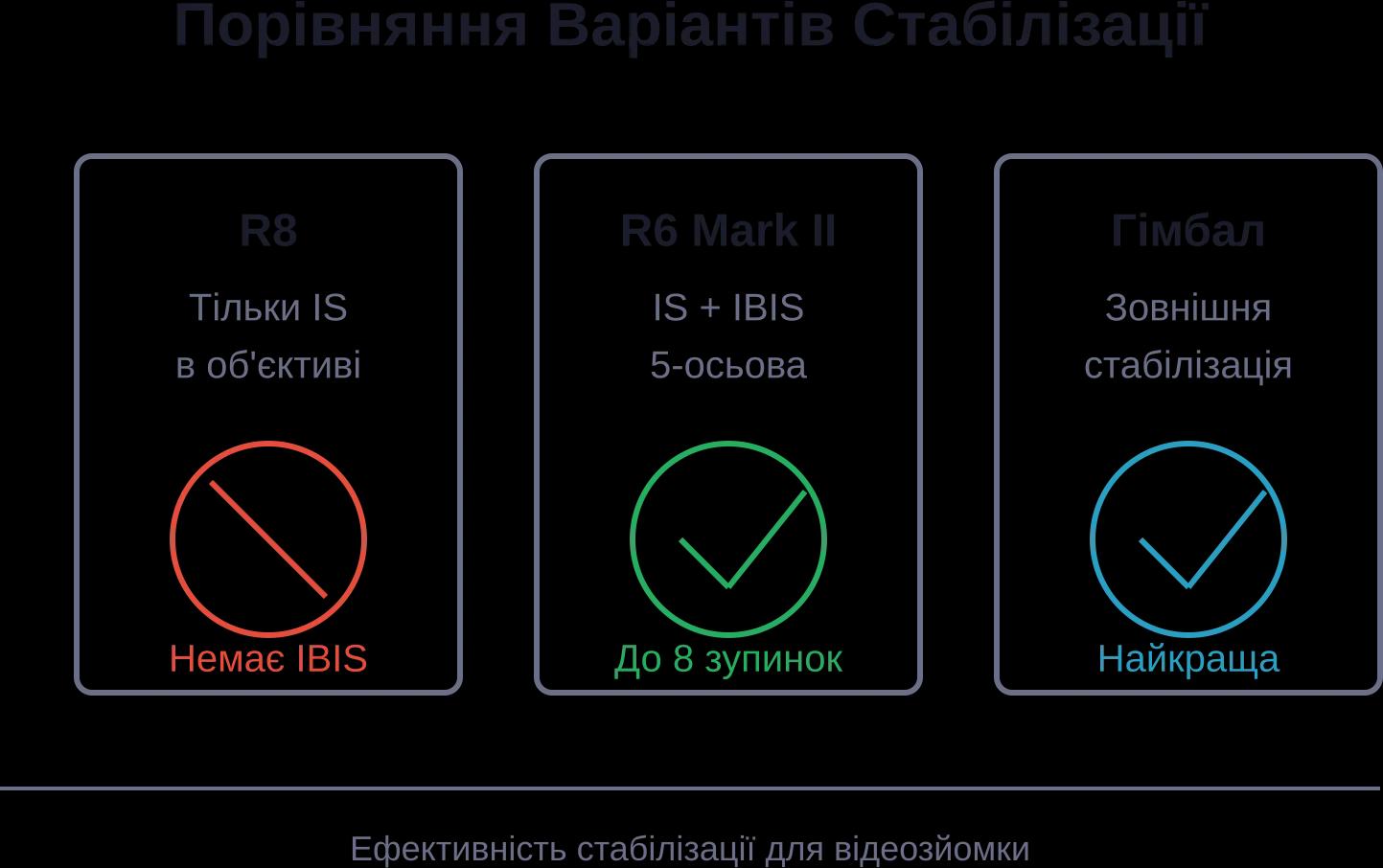
One of the biggest compromises of the Canon EOS R8 is the lack of in-body image stabilization (IBIS). This is a major difference compared to higher-end models such as the R6 Mark II and R5, both of which feature 5-axis IBIS.
Impact on Photography
Without IBIS, you'll need to rely entirely on optical image stabilization (IS) built into compatible lenses. Many RF lenses include IS, but not all of them.
For static subjects, this is generally not a problem. However, when shooting handheld in low light or using long telephoto lenses, the lack of IBIS can result in blurry images.
The classic "1/focal length" shutter speed rule becomes especially important. For example, when shooting at 100mm, you'll typically need a shutter speed of at least 1/100 second to avoid motion blur.
Impact on Video Recording
Current reviews indicate that the lack of IBIS makes the R8 less suitable for handheld action video. A gimbal or monopod is recommended for achieving stable footage.
Electronic Image Stabilization (EIS) is available for video, but it applies a digital crop and may reduce image quality. For professional work, external stabilization remains the better option.
Connectivity and Interfaces
The Canon R8 features the standard selection of ports expected on a modern
mirrorless camera:
USB-C (USB 3.2 Gen 2) — for fast file transfers, charging, and computer connectivity
Micro HDMI (Type D) — for outputting video to an external monitor or recorder (supports 4K 60p and HDR PQ)
3.5mm audio jack — for connecting an external microphone
Wi-Fi and Bluetooth — for wireless connectivity with a smartphone via the Canon Camera Connect app
Webcam Function
The R8 supports webcam mode when connected via USB-C. This is useful for high-quality streaming and video conferencing using Zoom, Microsoft Teams, or Skype.
The camera is recognized by the operating system as a video capture device without requiring additional software installation.
Wireless Connectivity
Wi-Fi allows you to transfer images to a smartphone or tablet for quick sharing on social media. Bluetooth maintains a constant low-power connection for remote camera control.
The Canon Camera Connect app lets you adjust settings, focus, and trigger the shutter directly from your mobile device.
Price and Availability in 2026
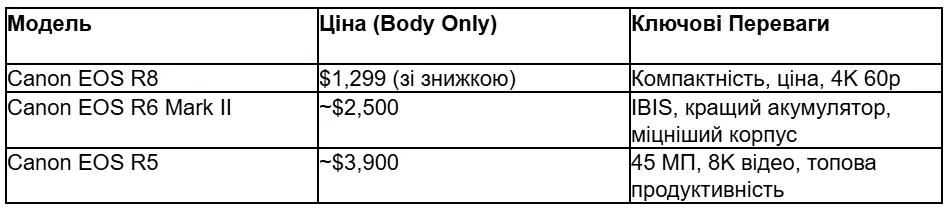
As of June 2026, according to the official Canon USA website, the EOS R8 is available for $1,299 (body only), compared to its regular MSRP of $1,649. The $350 discount is valid from June 15 through July 5, 2026 (ET).
The kit version with the RF 24-50mm lens is priced at $1,419 (discounted), down from the regular $1,769.
For comparison, the Canon EOS R6 Mark II costs approximately $2,500—more than $1,000 higher. For the additional cost, the R6 Mark II offers IBIS, a higher-capacity battery, and a more durable body, although the core imaging capabilities are very similar.
Canon EOS R8 Advantages
After months of testing, the camera's strengths become clear:
Affordable price: One of Canon's most affordable full-frame cameras with modern specifications
Compact and lightweight: At just 461 grams, it's comfortable to carry all day
Excellent autofocus: Dual Pixel CMOS AF II with 100% frame coverage and face detection delivers outstanding performance
4K 60p video: 6K oversampling provides exceptional detail without sensor crop
C-Log 3: Approximately 12 stops of dynamic range for professional color grading
Fast continuous shooting: Up to 40 fps with the electronic shutter
RF mount compatibility: Access to Canon's latest RF lenses as well as EF lenses via an adapter
Canon EOS R8 Disadvantages
There are also a few compromises worth considering:
No IBIS: Without in-body stabilization, you'll need to rely on lens-based IS
Small LP-E17 battery: Only 220–370 shots per charge, so spare batteries are essential
Overheating during extended video recording: 4K 60p can overheat, although this is rarely critical for most users
Single memory card slot: No backup recording as found in professional cameras
Small grip: May feel uncomfortable with large hands or heavy lenses
Micro HDMI: Less durable than a full-size HDMI connector
Who Is the Canon EOS R8 For?
The R8 is an excellent choice for several types of users:
Enthusiasts Upgrading from APS-C
If you've been shooting with a Canon APS-C camera (such as the Rebel or EOS M series) and want to move to full frame without spending a fortune, the R8 is an excellent choice. It delivers all the advantages of a full-frame sensor at a price only slightly higher than flagship APS-C cameras.
Travel Photographers
Its compact size and lightweight body make the R8 an ideal travel companion. It takes up little space in your bag and remains comfortable to carry throughout the day.
According to DPReview's long-term testing, one user chose the R8 as their primary travel camera because of its portability without sacrificing image quality.
Vloggers and Content Creators
Its 4K 60p recording, reliable autofocus, and fully articulating screen make the R8 an excellent option for vlogging. The webcam functionality is also useful for livestreaming.
The only limitation is that external stabilization is recommended for handheld walking shots due to the absence of IBIS.
Second Camera for Professionals
Photographers who already own a Canon R5 or R6 Mark II can use the R8 as a lightweight backup body that shares the same lens ecosystem and, with a battery grip, can integrate more easily into their existing workflow.
Canon EOS R8 Alternatives
If the R8 doesn't fully meet your needs, these models are worth considering:
Canon EOS R6 Mark II
The additional $1,000+ gets you up to 8 stops of IBIS, a larger LP-E6NH battery, a full-size HDMI port, and a more rugged body. For professional use, these upgrades can be well worth the investment.
Sony A7 IV
The R8's primary Sony competitor. It offers a 33 MP sensor, IBIS, dual memory card slots, and longer battery life. Its price is slightly higher than the R8 but lower than the R6 Mark II.
Nikon Z6 III
Another strong alternative featuring IBIS and a partially stacked sensor for faster readout speeds. If possible, it's worth comparing all three systems—Canon RF, Sony E, and Nikon Z—before committing to an ecosystem.
Firmware Update 1.6.0
Canon has released firmware version 1.6.0 for the EOS R8. According to the official release notes, the update includes:
A fix for an issue that could prevent the camera from being recognized when connected to a smartphone via USB
Improved operational stability
It is recommended to update the firmware to the latest version through the official Canon website or the EOS Utility application.
Practical Tips for Canon R8 Owners
Here are a few tips to help you get the most out of this camera:
Invest in IS Lenses
Since the R8 does not feature IBIS, it's best to prioritize lenses with built-in image stabilization. Most modern RF lenses include IS, but always check the specifications before purchasing.
Buy Spare Batteries
The LP-E17 has a relatively small capacity, so having at least 2–3 spare batteries is essential for extended shooting sessions. The R8 also supports USB-C charging, making it convenient for use in the field.
Use Fast UHS-II Memory Cards
Fast UHS-II SD cards are recommended for continuous shooting and high-bitrate video recording. Slower cards can limit the camera's buffer performance and recording capabilities.
Customize the Camera Controls
The customizable buttons allow quick access to frequently used settings. Take some time to configure them according to your shooting style.
Practice Shooting in C-Log 3
C-Log 3 produces a flat image profile that requires color grading. Practicing post-production workflows will help you get the most out of the camera's dynamic range.
Conclusion: Is the Canon EOS R8 Worth Buying in 2026?
The Canon EOS R8 remains one of the best entry points into full-frame photography within the Canon ecosystem. At around $1,300, it delivers a modern sensor, the powerful DIGIC X processor, excellent autofocus, and impressive video capabilities.
There are compromises—no IBIS, a smaller battery, and only a single memory card slot. However, for many users, these limitations are outweighed by the camera's compact size and lightweight design.
If you're looking for a lightweight full-frame camera for travel, content creation, or as a backup body, the R8 is well worth considering. However, for professional work requiring maximum reliability and extended battery life, the R6 Mark II or R5 may be a better choice.
As of mid-2026, the R8 continues to be a highly relevant camera thanks to ongoing firmware updates and its competitive price. It proves that high-quality full-frame photography can be both affordable and portable.
Frequently Asked Questions (FAQ)
Does the Canon EOS R8 have in-body image stabilization (IBIS)?
No. The Canon EOS R8 does not feature in-body image stabilization (IBIS). To reduce camera shake, it is recommended to use Canon RF or EF lenses with built-in optical image stabilization (IS), and for video recording, a tripod, monopod, or gimbal is recommended.
How long can the Canon EOS R8 record 4K video?
Under normal room temperature conditions, the Canon EOS R8 can continuously record 4K 30p video for approximately 70 minutes. When recording in 4K 60p or operating in hot environments, recording time may be shorter due to automatic overheating protection.
How much does the Canon EOS R8 cost in 2026?
As of mid-2026, the Canon EOS R8 has a suggested retail price of approximately $1,299 for the body only, while the kit including the RF 24–50mm lens costs around $1,419. Pricing may vary depending on the country, retailer, and current promotions.
Can Canon EF lenses be used on the Canon EOS R8?
Yes. Using the Canon EF-EOS R adapter, the camera fully supports Canon EF and EF-S lenses while preserving autofocus, image stabilization, and electronic aperture control. Canon EF-M lenses designed for the EOS M system are not compatible with the Canon EOS R8.
What battery does the Canon EOS R8 use?
The Canon EOS R8 uses the LP-E17 battery. According to CIPA ratings, one charge provides approximately 220 shots when using the electronic viewfinder or up to 370 shots when using the LCD screen. The camera also supports charging via its USB-C port.
Is the Canon EOS R8 suitable for professional photography?
Yes. The Canon EOS R8 delivers professional-level image quality and is frequently used for documentary, travel, and wedding photography as either a primary or secondary camera. However, the lack of IBIS, the single memory card slot, and the smaller battery may be limiting factors for long or mission-critical commercial projects.
What is the difference between the Canon EOS R8 and the Canon EOS R6 Mark II?
Both cameras feature a similar full-frame sensor, the DIGIC X processor, and Canon's latest autofocus system. However, the Canon EOS R6 Mark II adds 5-axis in-body image stabilization (IBIS), dual memory card slots, a higher-capacity LP-E6NH battery, a full-size HDMI port, and a more durable body. The Canon EOS R8 is significantly more compact, lighter, and more affordable.