

Canon RF 35mm f/1.2L USM review: is it worth waiting for in 2026?
July 1, 2026
In brief: Canon RF 35mm f/1.2L USM remains the most anticipated lens in the RF system despite several years of rumors and patent applications. Canon has two 35mm versions in the RF ecosystem — the budget f/1.8 Macro IS STM and the hybrid f/1.4L VCM, but the flagship f/1.2L has still not been announced. The Japanese Patent Office has published several impressive designs, indicating a possible release in 2026.
Canon EOS R system photographers have been waiting for a flagship 35mm lens for several years. This is one of those cases where the rumors have circulated for so long that the lens has gained the status of a "unicorn" — a legendary but nonexistent product.
But this is where it gets interesting. The company continues to file patent applications with impressive optical designs. And these documents look like production-ready specifications rather than just theoretical experiments.
The current situation with RF 35mm lenses
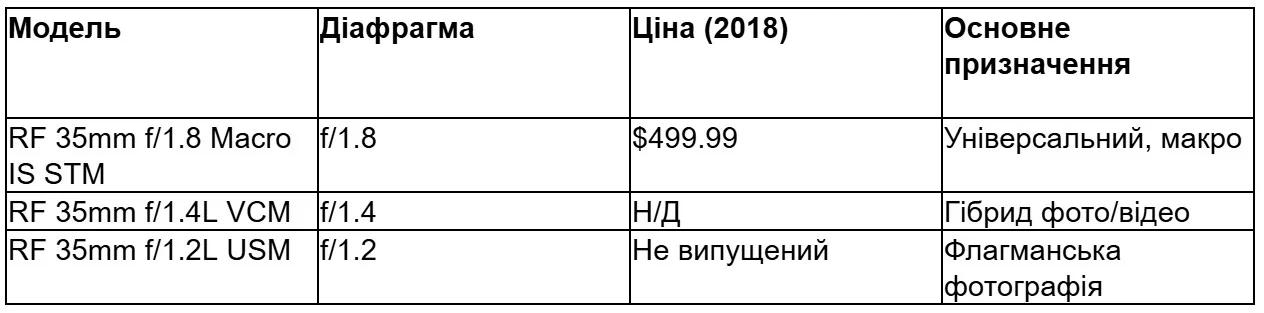
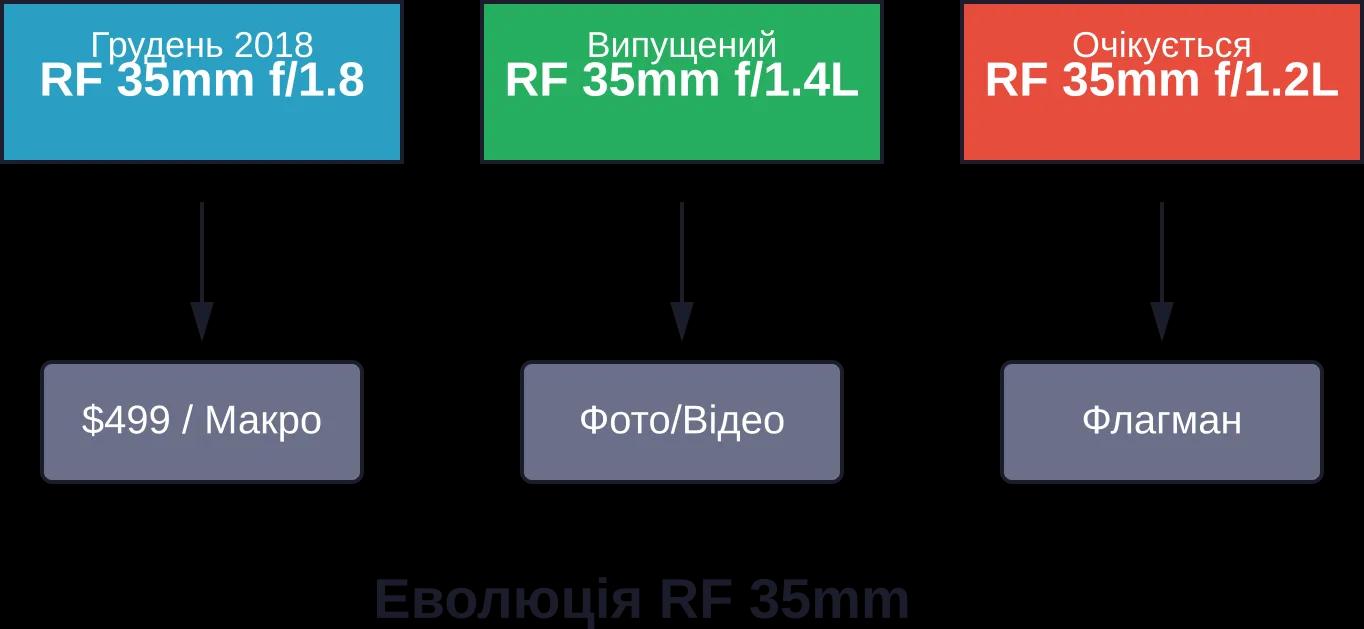
Canon has two RF lenses with a 35mm focal length, but neither is a flagship f/1.2 L-series model. Let's take a look at what is currently available.
The Canon RF 35mm F1.8 Macro IS STM became available in December 2018 at a price of $499.99. It is an excellent lens for most scenarios — compact, with image stabilization and macro capabilities. Some users in the DPReview community noted that it has significantly more "punch" compared to the M50 + 22mm f/2 STM combination.
The second option is the Canon RF 35mm f/1.4L VCM. It is a hybrid lens designed for both photography and video. The problem? Many photographers consider it too video-oriented rather than focused on traditional photography.

Choose a lens for shooting at JustBuy
JustBuy works with photo and video equipment as well as shooting accessories. Here you can browse available lenses, cameras, memory cards, stabilizers, and other items for a personal or professional kit.
For a lens, not only the focal length and aperture matter. It is worth considering compatibility with your camera, the type of shooting, weight, autofocus, performance in low light, and whether it is suitable for photography, video, or a hybrid workflow.
Looking for a lens or a shooting kit?
JustBuy can help with:
selecting a compatible lens
comparing available models
choosing accessories for photo and video
consultation before purchase
👉 Contact JustBuy to choose a lens for your shooting style.
Patent applications and technical specifications
The Japanese Patent Office has published application 2026-013481, which contains several impressive optical design variants. And this is where things get serious.
The first design shows a focal length of 34.80mm with an f/1.24 aperture and a viewing angle of 31.87 degrees. The overall length of the lens is 135.00mm, which is quite reasonable for such an aperture.
The second design is even more compact — a focal length of 24.72mm with the same f/1.24 aperture. Both variants contain many elements and dual focusing groups to maximize autofocus speed.
Design features from the patents
The patent documents reveal impressive details. An image height of 21.64mm and a back focal distance of 11.00mm are classic parameters for a full-frame lens.
One of the designs (patent 34.97mm f/1.24) shows an increased overall lens length of 154.96mm with a back focal distance of 13.45mm. This indicates a more complex optical design with better aberration correction.
Dual focusing groups are a key feature of these designs. This configuration makes it possible to maximize autofocus speed, which is critically important for professional photography.
Why f/1.2 matters
The difference between f/1.8, f/1.4, and f/1.2 may seem insignificant on paper. But in real-world shooting, it can have a significant impact.
At f/1.2, the depth of field becomes extremely shallow, allowing you to create portraits with creamy bokeh and perfect subject separation from the background. This is the level of control that professionals need.
In addition, the extra aperture means better performance in low-light conditions. The difference between f/1.4 and f/1.2 is almost a full stop, doubling the amount of light.
Comparison with competitors
Leica released the Noctilux-M 35mm f/1.2 ASPH — a lens that received enthusiastic reviews from PetaPixel. The problem? The price is $10,000.
Sony has excellent G Master series lenses, but Canon traditionally competes in the f/1.2 segment, where other brands offer f/1.4. This is an important distinction for professionals.

Why Canon is delaying the release
The question that concerns everyone: if the patents exist, why hasn't the lens been released yet?
The Canon RF 35mm f/1.4L VCM appeared as a hybrid solution for photography and video. Perhaps the company is testing the market to understand whether there is demand for a "pure" f/1.2 photography lens.
Another theory is production priorities. Canon released the RF 100-300mm F2.8 L IS USM in 2025, pushing beyond the limits of traditional 70-200mm lenses. This points to a strategy of first filling the most important gaps in the lineup.
But here's what's interesting — the photography community continues to actively discuss this lens. On Reddit, Canon Community, and the DPReview forums, the topic regularly reappears.
Predictions and expectations for 2026
The photography community has split into two camps. Some continue to wait, while others have moved on to alternatives.
On the DPReview forum, users actively discuss adapting EF lenses via an adapter. The EF 50mm f/1.4 USM provides most of the capabilities of the flagship f/1.2L at a significantly lower price.
Interestingly, Canon offered Portrait and Travel Combo promotional bundles (EF 50mm f/1.8 STM + EF-S 10-18 IS STM) with 10% cashback on Amazon. This indicates a strategy of retaining customers through affordable alternatives.
Alternative solutions for EOS R owners
While Canon decides whether or not to release the RF 35mm f/1.2L, photographers are finding other options.
The RF 15-35mm f/2.8L IS USM offers a bright f/2.8 aperture and a 15-35mm range. With a discount, it was available for $2,299 (down from the regular $2,599) through the Canon online store.
For landscape photography, Canon Rumors Co research recommends the RF 14-35mm f/4L IS USM as the best balance of weight, sharpness, and focal range.
Verdict: wait or buy now
Here's the real conversation. The RF 35mm f/1.2L USM may appear in 2026, or it may not.
If your professional work requires this specific aperture and these characteristics, it is worth considering alternatives — the RF 35mm f/1.4L VCM or adapted EF lenses.
But if your budget allows you to wait and your current kit meets your needs, the patent applications offer hope. The designs appear ready for production, and Canon traditionally releases flagship lenses after thorough testing.
North American photographers can take advantage of Canon's current promotions — free standard shipping on selected products is available until June 30, 2026 (subject to offer validity).
Conclusion
The Canon RF 35mm f/1.2L USM remains one of the biggest mysteries in the world of photography. The patent applications reveal impressive optical designs that promise exceptional image quality.
For professionals who need this specific lens, the wait may be worthwhile. But the reality is that no one knows the exact release date.
The current RF 35mm options meet different needs: f/1.8 for all-around shooting, f/1.4L for hybrid use. And for those waiting for the flagship f/1.2L, all that remains is to follow Canon's updates.
Frequently Asked Questions (FAQ)
When will Canon release the RF 35mm f/1.2L USM?
There is no official announcement date. The patent applications were published in 2026, but Canon has not confirmed a release timeline. The community expects a possible announcement at the end of 2026, but this is only speculation based on patent activity.
What will the price of the RF 35mm f/1.2L USM be?
The official price has not been announced. For comparison, the RF 50mm f/1.2L USM costs $2,299. The RF 35mm f/1.2L may have a similar or higher price due to its more complex optical design, but the official price has not been confirmed.
How will the RF 35mm f/1.2L differ from the f/1.4L VCM?
The RF 35mm f/1.4L VCM is a hybrid lens for photography and video with VCM (Voice Coil Motor) for quiet autofocus during video recording. The expected f/1.2L will be a dedicated photography lens with a larger aperture and an emphasis on image quality rather than video features.
Is it worth buying the RF 35mm f/1.8 Macro now?
The RF 35mm f/1.8 Macro IS STM at $499.99 (as of December 2018) is an excellent lens for most photographers. It is compact, with stabilization and a macro mode. If you do not need the extreme f/1.2 aperture for professional portraits, the f/1.8 will meet most needs.
What alternatives to the RF 35mm f/1.2L are available now?
The main options are: the RF 35mm f/1.8 Macro IS STM (budget-friendly, versatile), the RF 35mm f/1.4L VCM (hybrid photo/video), adapted EF lenses via a mount adapter, or the RF 15-35mm f/2.8L IS USM and RF 14-35mm f/4L IS USM zoom lenses.
Will the RF 35mm f/1.2L work on all EOS R cameras?
All RF lenses are compatible with EOS R system cameras via the native RF mount. The 12-pin communication provides full autofocus, stabilization, and electronic aperture control functionality on the R5, R6, R3, R8, and other models.
Will there be two versions of the RF 35mm f/1.2L?
Some rumors suggest the possibility of two versions — a standard one and a specialized one (possibly with DS coating for smooth bokeh, like the RF 85mm f/1.2L USM DS). However, there is no official confirmation, and the patent documents do not indicate multiple versions.