

Best DSLR Cameras For Beginners
March 30, 2026
When you start looking for your first camera, you quickly catch yourself thinking that there are too many options. It seems like they are all similar, the specifications are almost the same, and it is not so easy to understand what is really important. As a result, the choice often drags on or is made at random.
In practice, everything is simpler. For a start, you do not need complex equipment - it is more important that the camera is understandable, does not scare you away with settings and allows you to learn calmly. This list contains exactly such options: without overload, with normal functionality and with that reserve which is enough not only for the first shots, but also for the next step.
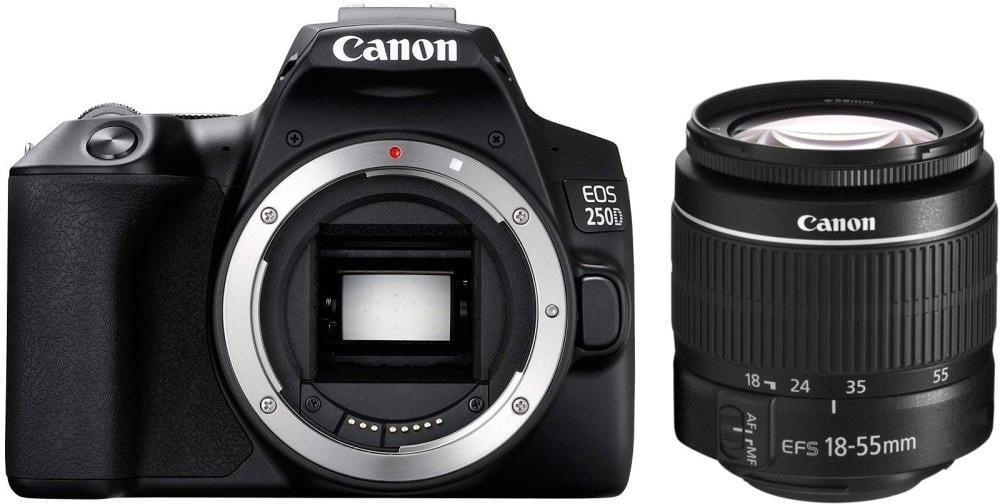
1. Canon EOS 250D Kit 18-55mm DC
Canon EOS 250D (18-55mm) DC is often considered as one of those DSLRs from which it is convenient to start. It does not overload with settings from the first power-on, but at the same time it allows you to feel the difference between shooting on a smartphone and a camera with a large sensor. The swivel screen here really simplifies life - you can calmly shoot from different angles and immediately see what comes out. For a beginner, this reduces the number of mistakes and makes the process less annoying.
Over time, the camera does not get boring, because it allows you to gradually delve into the settings. You can start with automatic modes, and then carefully move on to manual ones without changing the equipment. The autofocus behaves predictably, there is Wi-Fi for quick photo transfer, and 4K video gives you the opportunity to try yourself not only in photography. In general, it feels like a logical first step towards more conscious shooting.
Key features:
Swivel touchscreen
4K video recording
Autofocus with eye detection
Support for RAW and JPEG
Wi-Fi for file transfer
Compact body for a DSLR camera
Who it is suitable for:
Those who are just starting and want to figure it out without extra stress
Users who are tired of smartphone limitations
Those who want to try both photo and video
For everyday shooting and trips
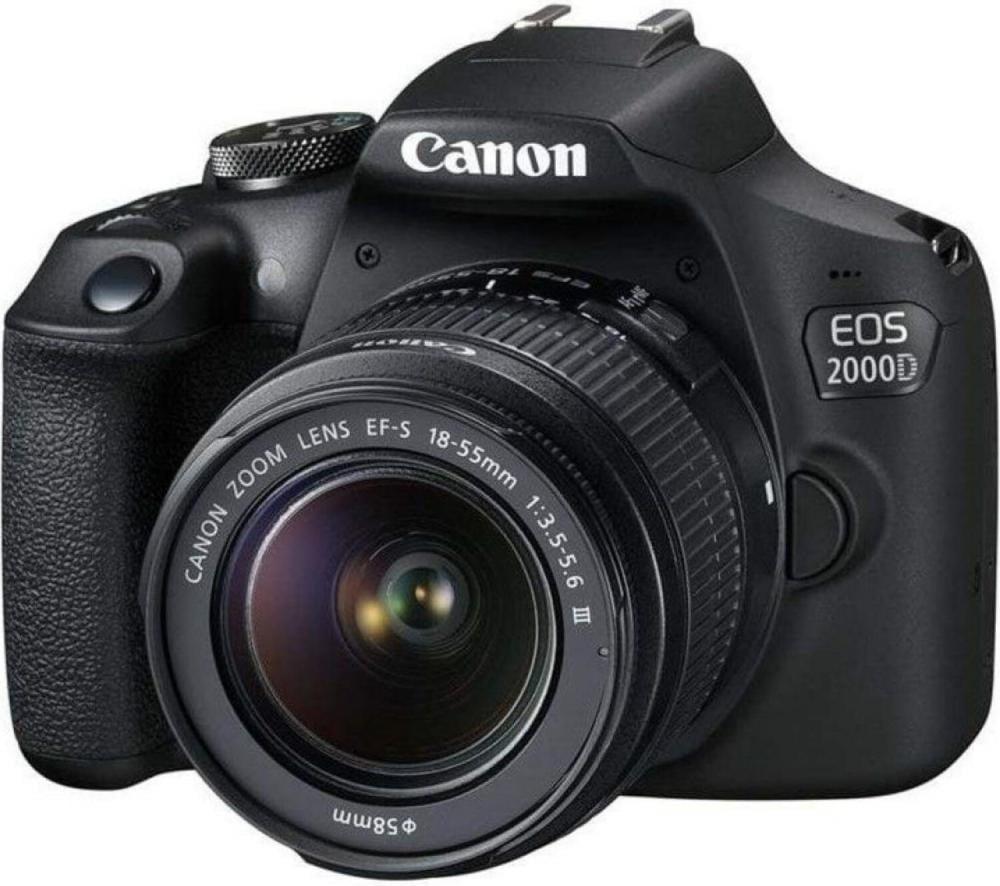
2. Canon EOS 2000D Kit 18-55mm DC III
Canon EOS 2000D kit (18-55mm) DC III feels like the most simple entry into the world of DSLR cameras. There is no touchscreen and unnecessary functions here, and there is even a plus in this - a beginner does not get lost in the interface. All control is through buttons, and at first it may seem unusual, but this is exactly how you understand faster how shutter speed, aperture and ISO work.
This model is more about the basics. It calmly handles ordinary shooting, gives the opportunity to work with different lenses and try manual modes. Video here is rather an additional function, not the main scenario. But as a learning tool, the camera is quite understandable - without distracting details and with normal image quality.
Key features:
Classic control without a touchscreen
Support for interchangeable lenses
Wi-Fi and NFC for photo transfer
Shooting in RAW and JPEG
Basic Full HD video recording
Optical viewfinder
Who it is suitable for:
Those who want to understand the basics of photography from scratch
Users for whom simplicity without unnecessary functions is important
Those who plan to learn manual settings
For calm shooting without emphasis on video
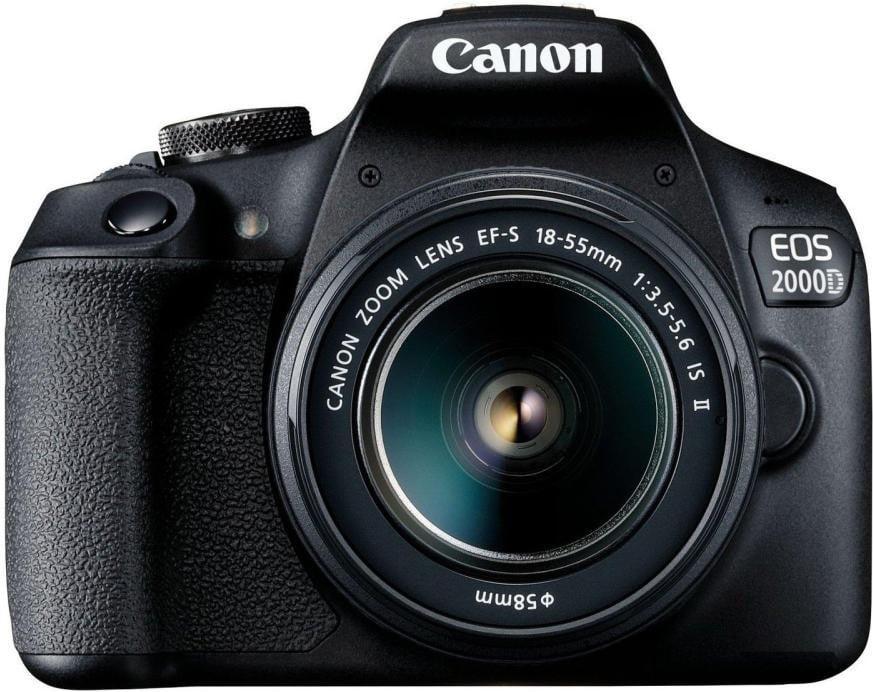
3. Canon EOS 2000D Kit 18-55mm IS II
Canon EOS 2000D (18-55mm) IS is perceived a little calmer in use, especially if your hands are not yet used to holding the camera steadily. The stabilization in the lens really helps at the start, when there is still no confidence in every shot. This is a small detail, but for a beginner it often plays a role.
Otherwise, it is the same basic DSLR that does not try to be complicated. It provides a clear set of functions, allows you to learn in practice and does not distract with unnecessary features. There is Wi-Fi, support for applications, you can shoot in RAW and gradually master processing. This option is suitable for those who just want to start shooting and understand the process without overload.
Key features:
Lens with image stabilization
Wi-Fi and NFC support
Shooting in RAW and JPEG
Classic button control
Optical viewfinder
Possibility to change lenses
Who it is suitable for:
Beginners for whom stability when shooting handheld is important
Those who want to learn gradually without a complex interface
Users with no experience working with cameras
For everyday and amateur shooting
Conclusion
In the end, with DSLR cameras, everything comes down not so much to specifications as to sensations. The same model will turn out to be convenient and understandable for someone, and too complicated or, on the contrary, boring for another. Therefore, there is no point in chasing the "best" camera here - it is more important to take the one with which you will really want to go out and start shooting.
If you look soberly, any of the basic models already gives more opportunities than needed at the start. The main thing is not to put it off because of doubts and not to try to figure everything out at once. Usually everything comes in the process: first you shoot on automatic, then you start turning the settings, and at some point you catch yourself understanding what you are doing. And that is when the camera really begins to open up.