


EcoFlow Delta 3 2000 Air: 2026 Review
May 7, 2026
Quick Summary: The EcoFlow Delta 3 2000 Air is a portable charging station with a 1920Wh capacity, a maximum output of 1000W, and a transfer time of less than 10ms to backup power. It provides up to 40 hours of refrigerator operation, charges from a wall outlet in 2 hours, and supports solar panels up to 500W, making it a versatile solution for home, office, and travel.
Portable charging stations have become an essential part of life in areas with unstable power grids. The EcoFlow Delta 3 2000 Air strikes a balance between capacity, compactness, and functionality—without excess weight, yet with enough power for critical devices.
The Delta 3 Air line is aimed at users who require a reliable backup system rather than maximum performance. It's a compromise, but a conscious one.
Let's explore what the Delta 3 2000 Air offers in real-world conditions—from battery life to charging speed and operating features.
Delta 3 2000 Air Specifications
The Delta 3 2000 Air is built around a 1920 Wh LiFePO₄ battery. This lithium iron phosphate chemistry is known for its stability and durability—the manufacturer claims a service life of up to 10 years.
The maximum output power is 1000 W AC. This isn't the highest-end rating, but it's sufficient for most household appliances—refrigerators, laptops, fans, routers, and lighting.
The station supports UPS functionality with a transfer time of 10 ms or less. Real talk: this is faster than most budget UPSs. This is a critical parameter for routers, modems, and computers.
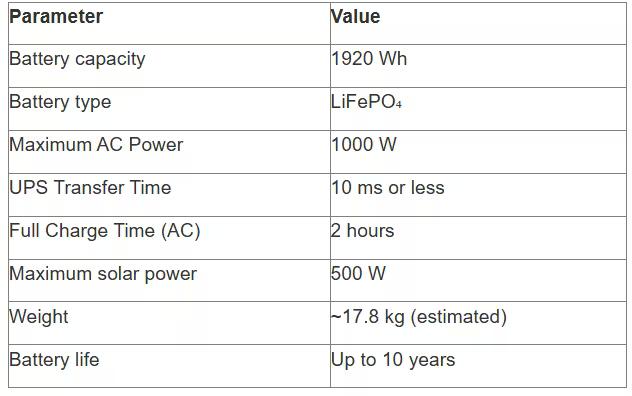
Charging from a wall outlet takes just 2 hours—one of the fastest in its class. It also supports charging from solar panels up to 500W, a car cigarette lighter, and a generator.
The station weighs approximately 17.8 kg, making it portable but not pocket-sized. For home use, it's perfectly acceptable.
Battery Life
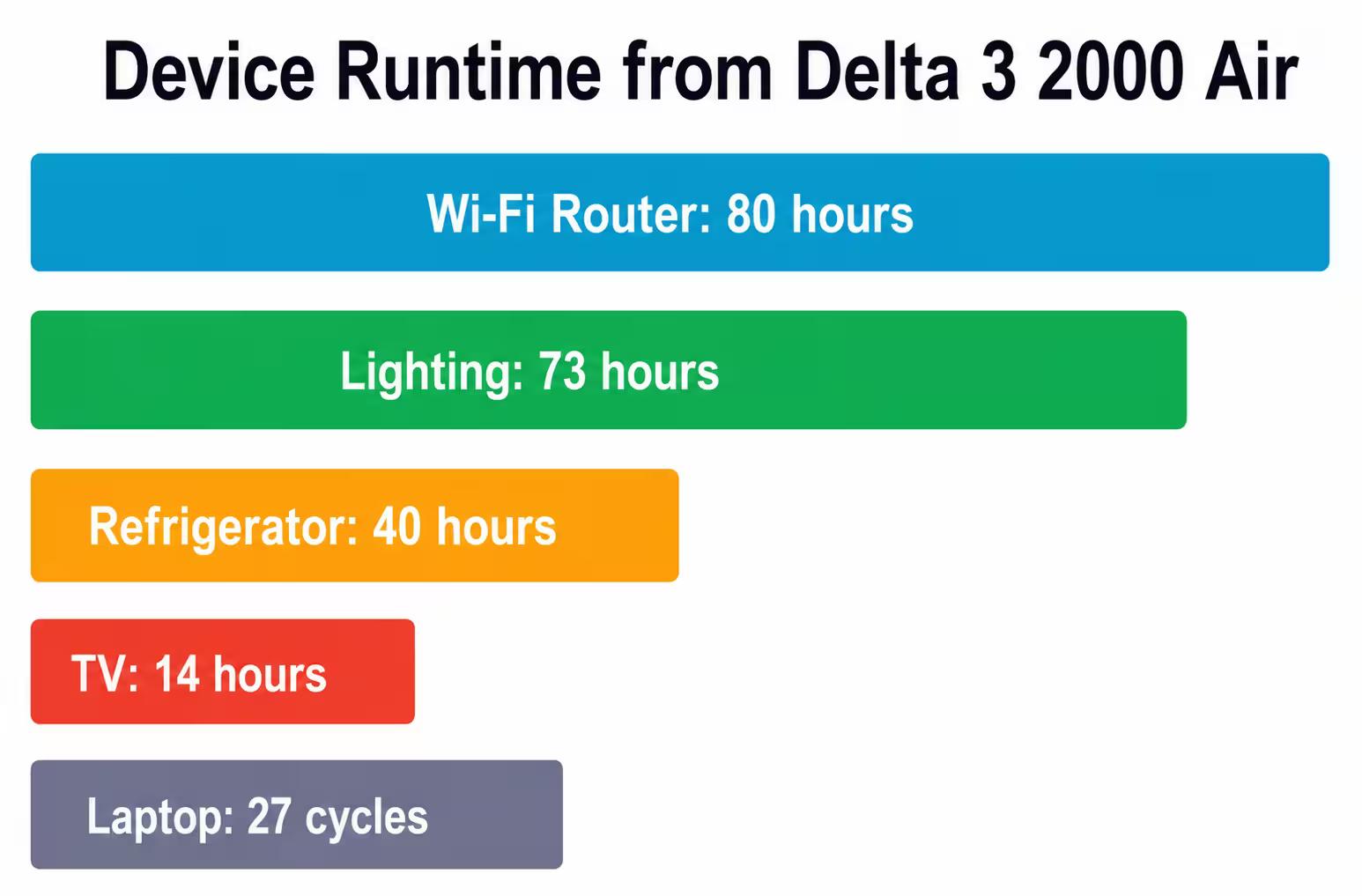
A capacity of 1920 Wh sounds abstract. Here are the official runtime figures for popular Delta 3 2000 Air devices:
Wi-Fi router: up to 80 hours
Lighting: up to 73 hours
Portable fan (DC): up to 110 hours
Refrigerator (150W): up to 40 hours
TV: up to 14 hours
Laptop: up to 27 charges
Smartphone: up to 80 charges
Car refrigerator: up to 34 hours
Starlink: up to 23.2 hours
Coffee maker: up to 2.8 hours
Please note: the router and lighting provide multi-day battery life. For an office or home workstation, this means the ability to survive extended outages without losing connection.
A 150W refrigerator will last 40 hours—almost two days. This is critical for preserving food during blackouts.
But there's a catch. Tests on the Delta 3 Max Plus model showed that in standby mode with the inverter enabled, the station consumes approximately 22 watts. Over 12 hours without a load, the battery loses approximately 13% of its charge.
This means that if you leave the station on without any devices connected, it will discharge itself in approximately 3-4 days. The solution is simple: turn off the AC outlet when not in use.

EcoFlow Portable Stations and Other Solutions at JustBuy
JustBuy is a convenient place to find portable power sources, including the EcoFlow Delta 3 2000, without having to search through various websites.
The catalog features current models for home, travel, and standalone use. You can quickly compare specifications, check prices, and understand what options are currently available.
Looking for where to buy a portable station?
At JustBuy, you can:
Select current power supply models
Compare specifications and find the perfect option
Check availability, price, and delivery options
Place an online order or get a consultation
👉 Contact JustBuy to quickly find the EcoFlow Delta 3 2000 or a similar station that fits your needs.
Charging speed and recharge options
The Delta 3 2000 Air supports four charging methods:
AC: Full charge in 2 hours. This is faster than most competitors in its price range. For comparison, tests of the Delta 3 Max Plus showed a peak charging power of 2300W, reaching 80% in 50 minutes and 100% in 70 minutes. The Delta 3 2000 Air uses similar fast charging technology.
Solar: Supports up to 500W of input power. Under optimal conditions (bright sun, proper tilt), a full charge will take approximately 4-5 hours.
Using a car cigarette lighter: A slower option, but useful when traveling. A full charge can take 10-12 hours, depending on the power of the car outlet.
Using a generator: A versatile method for field conditions or when the power grid is completely out of reach.
The station is equipped with a battery management system (BMS) that provides protection against overcharging, overheating, short circuits, and overload. This is standard for modern LiFePO₄ batteries, but the EcoFlow implementation is considered reliable.
UPS Function and Voltage Stabilization
One of the key features of the Delta 3 2000 Air is its built-in uninterruptible power supply (UPS) function with a transfer rate of 10 ms or less.
How it works: the station is constantly connected to the power grid while simultaneously powering critical devices. If the power grid fails, the Delta 3 2000 Air instantly switches to battery power—so quickly that computers, routers, and modems don't even have time to notice the outage. According to a review on reviews.matanich.com, this series was designed for regions with unstable power grids—frequent short-term outages, power surges, and sags.
But there's an important point. The Delta 3 Air lineup includes two versions of the 1000 Air model:
A version with 10 ms switching (premium)
A version with 20 ms switching (basic)
The difference may seem insignificant, but it's critical for sensitive equipment. The Delta 3 2000 Air comes with a version with 10 ms or less switching—this is confirmed by official data.
Built-in voltage regulation protects connected devices from power surges. This is especially important for expensive equipment—gaming computers, servers, and medical devices.
Portability and Design
The Delta 3 2000 Air is designed with an emphasis on compactness. The station weighs approximately 17.8 kg, lighter than many competitors with a similar capacity.
The housing is made of fire-resistant plastic with an anti-vibration structure that meets UL94V-0 standards. This ensures resistance to mechanical impact and increased safety during transportation.
Ergonomic handles allow one person to easily carry the station. Ideal for home use (from room to room) or for outdoor use (in the trunk of a car).
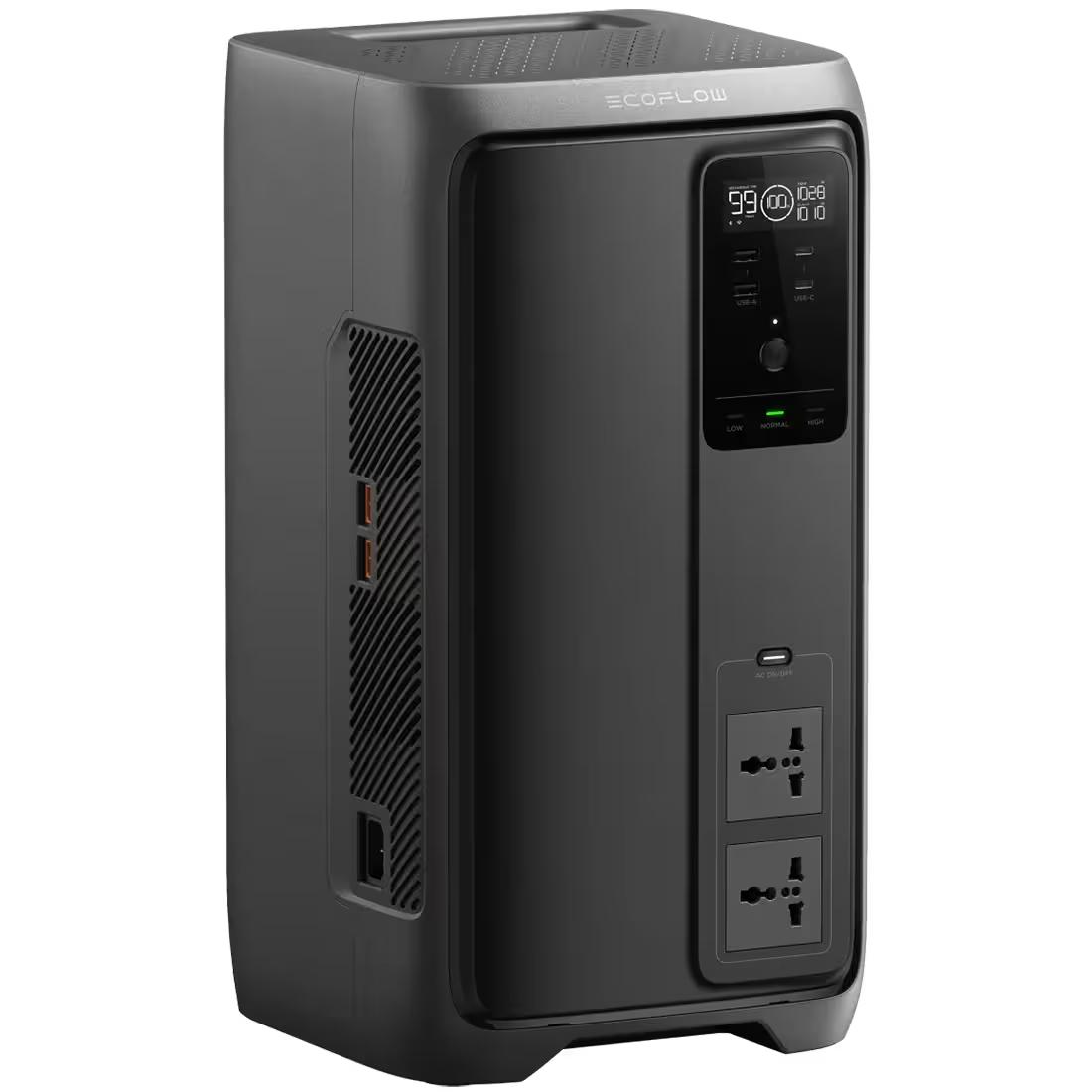
The design is minimalist: a matte finish, an information display on the front panel, and logically grouped ports. There are no unnecessary elements.
Ports and Device Connections
The Delta 3 2000 Air is equipped with a variety of ports for connecting multiple devices simultaneously:
AC outlets (220V): 2 standard outlets for household appliances
USB-A ports: for charging smartphones, tablets, and power banks
USB-C ports: with fast charging support for modern devices
DC output (car outlet): for specialized equipment
According to official specifications, the Delta 3 2000 Air is equipped with 2 AC outlets, 2 USB-A ports, and 2 USB-C ports (according to www.ecoflow.com).
The information display shows the current charge level, input and output power, and remaining runtime. Intuitive controls allow you to turn on/off individual port sections using separate buttons to save energy.
Real-World Efficiency
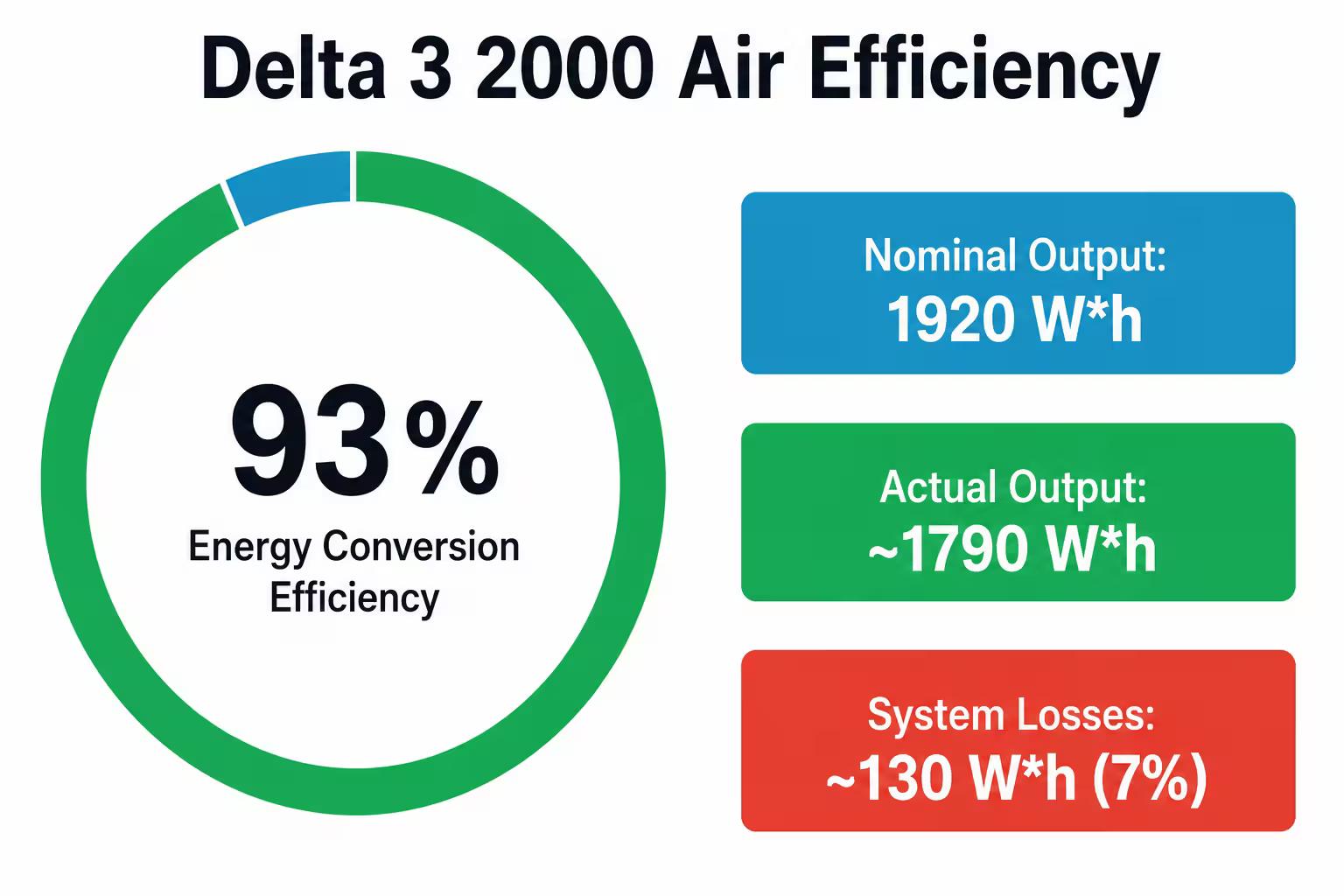
The rated capacity of 1920 Wh does not equal the actual available energy. Losses occur in voltage conversion (inverter), internal battery resistance, and cooling.
Tests of the older Delta 3 Max Plus model (2048 Wh nominal) showed a real efficiency of 1898 Wh at a 2 kW load—approximately 93% efficiency.
Applying a similar factor to the Delta 3 2000 Air, one can expect a real efficiency of approximately 1780-1800 Wh. This is a normal figure for stations of this class.
With a resistive load of 1000 W (the maximum for the Delta 3 2000 Air), the runtime will be approximately 1.8 hours—this is consistent with the stated parameters for a coffee maker and rice cooker.
Standby power consumption is 22W according to tests. Over a 24-hour period without load, the station will lose approximately 26% of its charge—a significant loss if it's intended to be stored in standby mode for extended periods.
Recommendation: Turn off the AC inverter with the power button when not using the outlet. This will minimize parasitic power consumption and extend standby battery life.
Mobile App Control
EcoFlow offers a mobile app for remote station control via Wi-Fi or Bluetooth. Features include:
Real-time battery level monitoring
View input and output power
Remotely turn on/off port sections
Configure charging modes (slow/fast)
Station firmware update
Usage history and statistics
The app has received positive reviews in Delta 3 Max Plus reviews as one of the most comprehensive among competitors. The interface is intuitive, with minimal lag. The remote port activation feature is especially useful—you can activate device charging without approaching the charging station. This is convenient for home use, and practical for the office or remote locations.
Comparison of the Delta 3 2000 Air with the Delta 3 1000 Air
EcoFlow has released the Delta 3 Air line in two capacities—the 1000 Air and the 2000 Air. Let's look at the key differences:
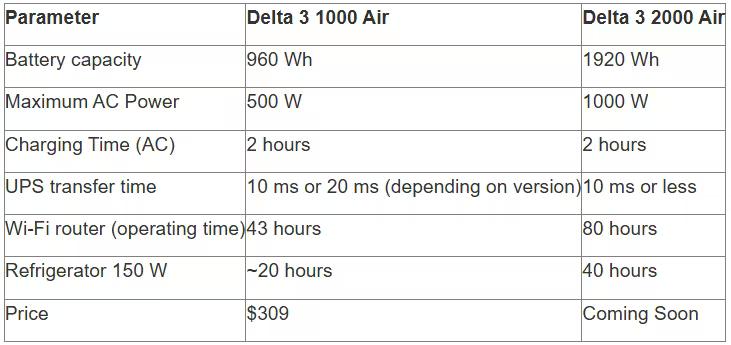
The Delta 3 2000 Air offers exactly double the capacity and double the power. In terms of price/capacity, this model is competitive on the official market.
However, if the maximum load does not exceed 500W (router, lighting, laptop, fan), the 1000 Air is a smart choice—it's lighter, more compact, and less expensive.
For powering a refrigerator, microwave, coffee maker, or TV, the 2000 Air, with its 1000W output, is the perfect choice.
Who is the Delta 3 2000 Air suitable for?
This power supply is designed for specific use cases:
Regions with unstable power grids: frequent blackouts, power surges, and short-term outages. A UPS with a transfer rate of 10ms or less ensures uninterrupted operation of critical equipment.
Home office: router, modem, laptop, monitor—the Delta 3 2000 Air provides 15-20 hours of battery life. For freelancers and remote workers, this is insurance against loss of productivity.
Backup power for the home: refrigerator, lighting, fan, phone charging—basic comfort for 1-2 days without power.
Travel and camping: the station is lightweight enough to transport in a car. Starlink will operate for 23 hours, a car refrigerator for 34 hours, and lighting for 73 hours. For long outdoor trips, it offers sufficient battery life.
However, the Delta 3 2000 Air is not suitable for:
Powering powerful tools (drills, grinders, welders)—the maximum 1000W is too low
Whole-home backup power systems—the capacity is sufficient for basic needs, but not for a full-scale power supply replacement
Commercial use with high intensity charge-discharge cycles—a 2-year warranty (according to reviews.matanich.com)
Warranty and Support Features
An important point noted in an independent review: the Delta 3 Air series comes with a two-year warranty, while the higher-end Delta 3 and Delta 3 Plus models receive an extended warranty.
This is a signal from the manufacturer that the Air series is not a full-fledged member of the flagship Delta line, but a compromise with simplified support.
LiFePO₄ batteries are rated for 3,000-4,000 cycles before the capacity drops to 80% of the nominal value. With daily use, this is 8-10 years. However, the practical service life depends on operating conditions, such as depth of discharge, ambient temperature, and load intensity.
EcoFlow offers lifetime technical support for customers, including consultations on use, problem diagnostics, and assistance with firmware updates. This is standard practice for the brand.
Price and Availability
According to official data (us.ecoflow.com), the Delta 3 1000 Air (10ms UPS) is priced at $329, while the Delta 3 2000 Air is listed as 'Coming Soon' with no official pricing. In terms of cost per Watt-hour of capacity, this is roughly in the mid-range of the portable power supply market.
For comparison, budget models cost $0.30-0.35/Wh, while premium models cost $0.20-0.25/Wh. The Delta 3 2000 Air strikes a balance between affordability and quality.
In regional markets (for example, the Philippines, according to ph.ecoflow.com), the unit is sold with promo codes—a discount of up to ₱1,500 reduces the price from ₱42,990 to ₱29,990. This makes the product competitive in developing regions with high demand for backup power.
Availability varies by region. The model has not yet been released in some countries; the official website offers a subscription to receive notifications about the release date.
Market Alternatives
It's worth considering competitors in the 1500-2000 Wh capacity range and $400-$600 price range:
Bluetti AC180 (characteristics mentioned as competitor comparison)
Jackery Explorer 2000 Pro (characteristics mentioned as competitor comparison)
Anker 757 (characteristics mentioned as competitor comparison)
The Delta 3 2000 Air excels in charging speed (2 hours is one of the best), UPS transfer time (10 ms or less versus 20-30 ms for competitors), and the EcoFlow ecosystem (extensibility with additional batteries, integration with the brand's solar panels).
Practical Operation Tips
To maximize the lifespan of the Delta 3 2000 Air and improve its efficiency:
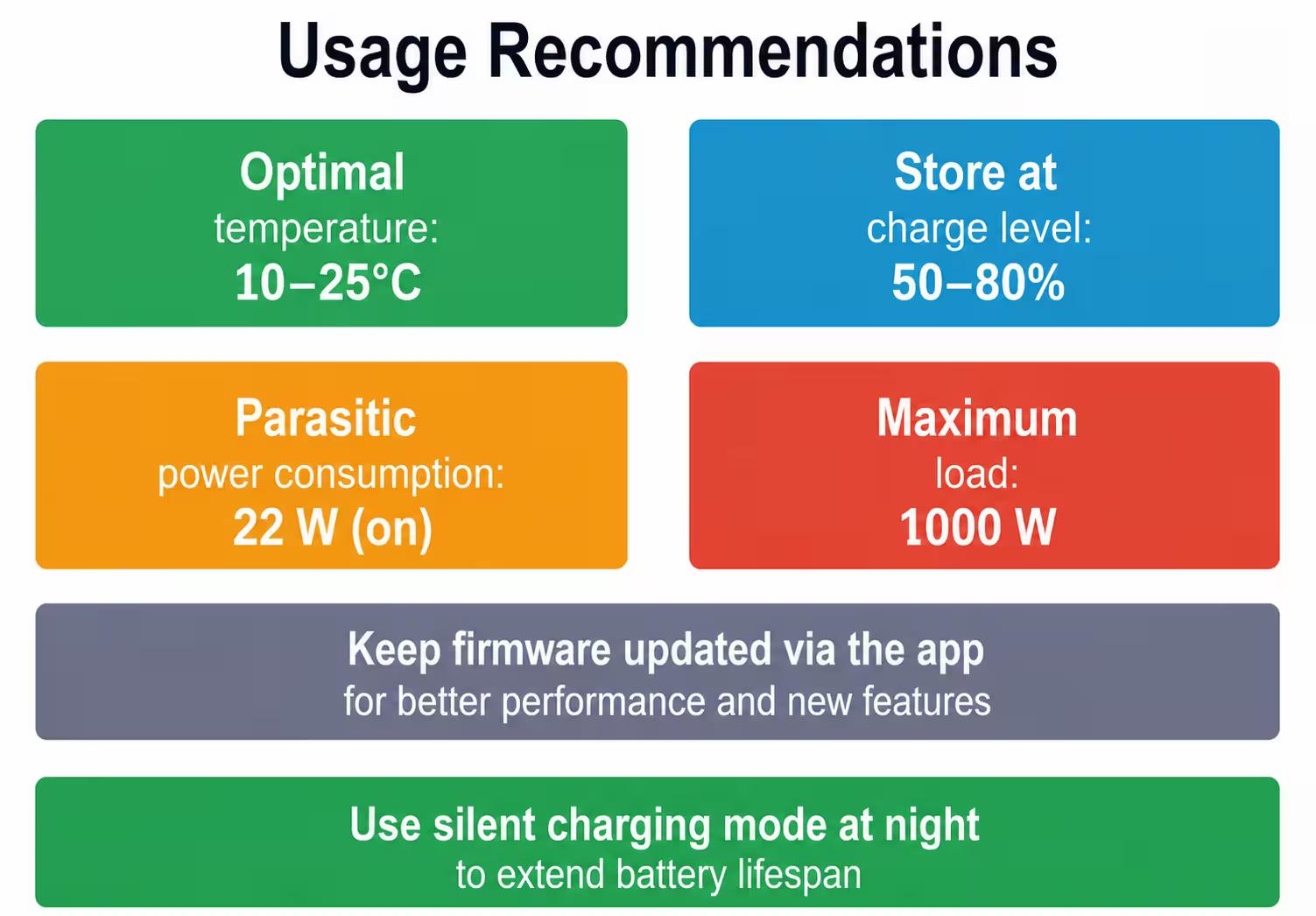
Store the station at a temperature of 10-25°C. Extreme temperatures accelerate the degradation of LiFePO₄ batteries. Do not leave them in a car during the summer, or use them in freezing temperatures without warming them up.
Maintain a charge of 50-80% during long-term storage. A fully charged or discharged battery degrades faster. Recharge to 80% every 3 months if not actively used.
Disconnect the AC inverter with the button when not using the outlet. This will reduce parasitic consumption from 22 W to 2-3 W and extend standby time by 7-10 times.
Use slow charging mode if you're not in a rush. Fast charging is convenient, but it creates additional heat in the battery. For regular overnight top-ups, select slow mode via the app.
Update the station firmware via the mobile app. EcoFlow regularly releases updates that improve BMS stability, charge indicator accuracy, and compatibility with new devices. Do not exceed the maximum load of 1000W for long periods. Short-term peaks are acceptable (X-Boost technology can provide some reserve), but continuous operation at the maximum load will reduce the lifespan of the inverter and battery.
Environmentally Friendly and Safe
The Delta 3 2000 Air operates without emissions, fuel, or noise—unlike gasoline generators. This is critical for use in areas where exhaust fumes are unacceptable.
LiFePO₄ batteries are considered the safest type of lithium battery—they are resistant to thermal runaway, do not ignite when damaged, and do not emit toxic gases.
The flame-retardant casing, meeting UL94V-0 standards, means the plastic self-extinguishes when exposed to an open flame—an additional layer of protection.
The BMS system monitors the temperature of each battery cell, balances the charge, and disconnects the load in the event of anomalies. The risk of fire or explosion is minimized—equal to that of certified industrial-grade UPS systems.
However, basic safety rules remain: do not leave the charging station unattended for long periods, do not use damaged cables, and do not block ventilation openings.
Disadvantages and Limitations
No station is perfect. The Delta 3 2000 Air has some weaknesses:
Short warranty: 2 years versus 3-5 years for premium models. This limits its use in high-intensity commercial scenarios.
Lineup confusion: Two versions of the Delta 3 1000 Air with different transfer times (10 ms and 20 ms) create difficulty in choosing. Buyers may accidentally receive the wrong version.
High parasitic consumption: 22 watts in standby mode with the inverter enabled consumes 13% of the battery in 12 hours. Competitors offer 10-15 watts.
Limited power: 1000 watts is sufficient for most home devices, but excludes powering high-power tools, heaters, and air conditioners.
Weight: The station may be difficult for elderly or physically weak users to carry.
These limitations don't make the product inferior—they define its target audience and use cases.
Frequently Asked Questions
Can I charge the Delta 3 2000 Air and power devices at the same time?
Yes, the station supports pass-through charging. You can connect it to the power outlet and simultaneously power devices—the battery will be charged in parallel. This is especially useful in UPS mode, where the station is constantly plugged into an outlet and automatically backs up during a power outage.
How many charge-discharge cycles will the battery last?
LiFePO₄ batteries are rated for approximately 3,000–4,000 cycles before their capacity drops to 80%. With full daily cycles, this equates to approximately 8–11 years of use. Partial discharge cycles, such as to 50-70%, further extend the battery's life.
Does the Delta 3 2000 Air work with solar panels from other manufacturers?
Yes, the station is compatible with most third-party solar panels, as long as they meet the following specifications: 11-60 V and up to 500 W. It uses standard MC4 or XT60 connectors, depending on the configuration. EcoFlow panels are optimized for maximum efficiency but are not required.
Can the Delta 3 2000 Air's capacity be expanded with additional batteries?
Currently, there is no official confirmation of support for additional batteries for the Delta 3 2000 Air. The older Delta 3 and Delta 3 Plus models support capacity expansion, but this feature may not be available for the Air version. We recommend checking the latest specifications on the official EcoFlow website.
Is the station noisy during operation?
The cooling system activates at approximately 30-40% of maximum power. At approximately 300-400 watts, the station is virtually silent. Approaching 1000 watts, the noise level is approximately 45-50 dB—comparable to a quiet conversation and significantly quieter than a gasoline generator.
Can the Delta 3 2000 Air be used in a car while driving?
Yes, the anti-vibration design allows the station to be used in a car while driving. It's important to securely mount the device to prevent movement when braking or making sharp turns. Charging from a car cigarette lighter is also supported.
How accurate is the remaining runtime indicator?
The station calculates the remaining runtime based on the current load. For example, when connected to a 150W refrigerator, the system may show approximately 40 hours of battery life. However, with varying loads, accuracy decreases—a deviation of approximately ±15–20% from the estimate is considered normal.
Final Verdict
The Delta 3 2000 Air is a specialized power supply for stabilizing power in unstable grid conditions. Its 1920 Wh capacity and 1000 W output cover the basic needs of a home or office for 1-2 days of battery life.
Key advantages: fast charging in 2 hours, UPS with a transfer rate of 10 ms or less, support for solar panels up to 500 W, and a LiFePO₄ battery lasting up to 10 years. For regions with frequent blackouts, this is the perfect balance of price and functionality.
Disadvantages: short 2-year warranty, high parasitic consumption of 22 W, confusion among Air series versions. This is not a universal power supply, but a targeted solution.
Buyers get a reliable mid-range device with an emphasis on response time during power outages. It doesn't offer maximum capacity or maximum power, but it delivers fast readiness and stable operation. Check current prices and availability for your region on the official EcoFlow website. Consider your usage scenarios: if you need more than 1000 W of power, consider the Delta 3 Plus; if 500 W is sufficient, the Delta 3 1000 Air may be more economical.
For those who need protection against unstable power grids without breaking the bank, the Delta 3 2000 Air is worth considering.