

Fujifilm X-Pro4 review: specs and release date 2026
July 1, 2026
In Brief: Fujifilm X-Pro4 is the latest camera in the legendary X-Pro series, which is rumored to feature a 40.2 MP X-Trans CMOS 5 HR sensor, X-Processor 5, an improved hybrid viewfinder, 6.2K video recording, AI autofocus, and five-axis image stabilization. The camera is expected to launch in the second half of 2026 with a price of around $1,699–$1,899.
More than six years have passed since the release of the Fujifilm X-Pro3, and photographers around the world have been patiently waiting for the successor to this unique camera. The X-Pro series has always held a special place in the Fujifilm lineup thanks to its hybrid viewfinder and retro design reminiscent of classic rangefinder cameras.
Now, in February 2026, specific information about the X-Pro4 specifications has emerged. According to Imaging Resource, the new camera promises to be a significant upgrade over the previous generation.
But will the X-Pro4 meet the expectations of professionals and enthusiasts? Let's take a closer look.
Key Technical Specifications of the Fujifilm X-Pro4
According to a leak published by Imaging Resource in February 2026, the X-Pro4 will receive significant improvements across all key aspects.
Sensor and Processor
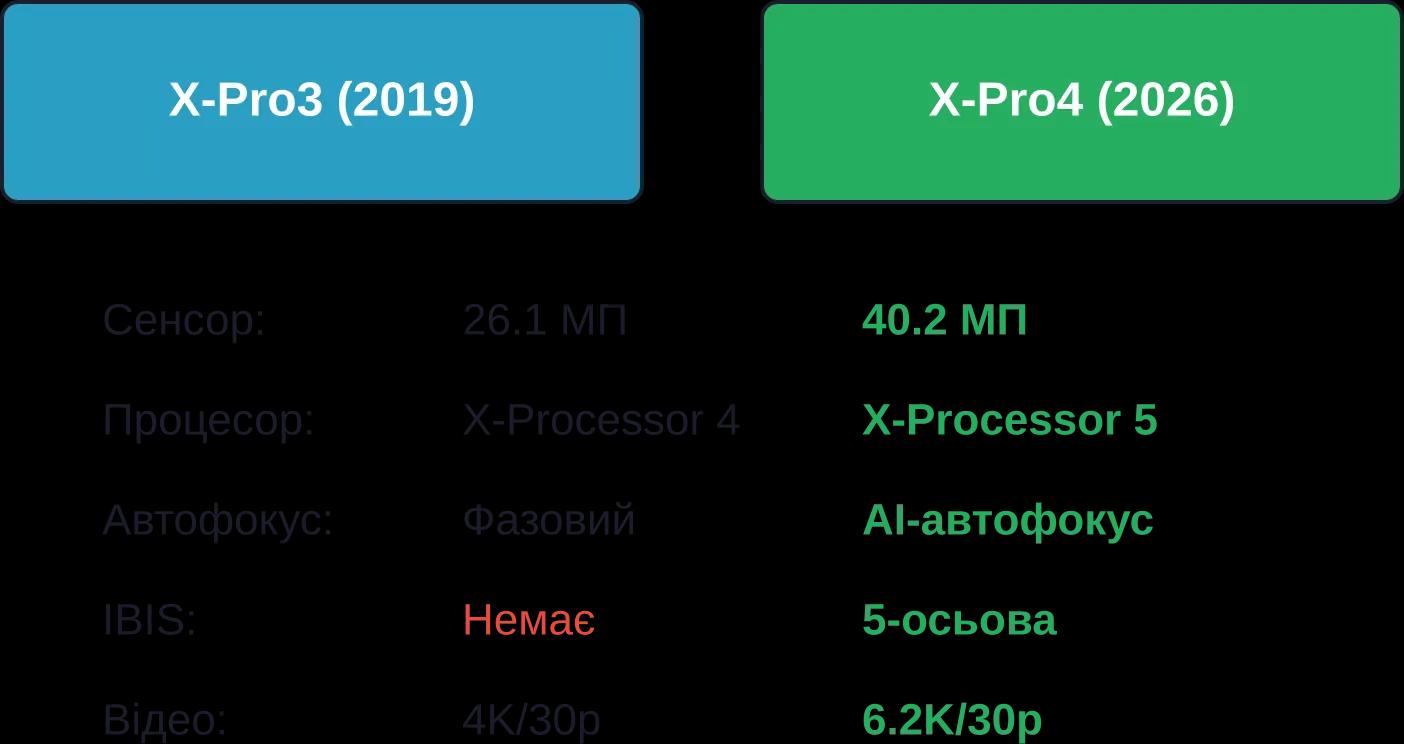
At the heart of the camera is a 40.2-megapixel X-Trans CMOS 5 HR sensor, similar to the one used in the flagship X-H2 models. This is a noticeable increase in resolution compared to the 26.1 MP sensor in the X-Pro3.
Paired with the sensor is the X-Processor 5, which provides faster image processing and unlocks the latest Fujifilm features. This combination has already proven its effectiveness in the X-H2 and X-T5 models.
What does this mean in practice? More detail in images, better cropping capabilities, and higher-quality large-format prints. For landscape and studio photographers, this is a significant improvement.
AI Autofocus System
The X-Pro4 will feature AI autofocus—a technology that uses deep learning to recognize and track subjects. The system can automatically detect faces, eyes, animals, birds, cars, and other subjects.
This is a dramatic improvement over the traditional phase-detection autofocus system in the X-Pro3. For street and documentary photographers, this means fewer missed shots and a higher percentage of accurately focused images.
Five-Axis Image Stabilization (IBIS)
One of the most anticipated features is the addition of in-body image stabilization. The X-Pro3 did not have IBIS, which was a limitation for photographers working in low light or with longer shutter speeds.
IBIS in the X-Pro4 compensates for camera shake across five axes. This allows for longer shutter speeds without a tripod and delivers better handheld results even with lenses that do not have built-in optical stabilization.
For street photographers and travelers, this is a game-changer—fewer blurry shots when shooting at dusk or indoors without a flash.

Choose a Camera and Accessories at JustBuy
JustBuy works with photo and video equipment as well as shooting accessories. Here you can look at available cameras, lenses, memory cards, stabilizers, and other items for a personal or professional kit.
More than just the camera body's specifications matter. It's worth considering the lens, battery life, memory card, stabilization, and what you plan to shoot: travel, portraits, video, a blog, or commercial content.
Looking for a camera for photography or video?
JustBuy can help with:
choosing a camera for your needs
selecting compatible lenses
choosing memory cards, batteries, and accessories
providing advice on photo and video equipment
👉 Contact JustBuy to choose a kit for your shooting style.
Hybrid Viewfinder: The Evolution of a Legendary Feature
The hybrid viewfinder has always been the hallmark of the X-Pro series. It allows you to switch between the optical viewfinder (OVF) and the electronic viewfinder (EVF) using a single switch.
Why is this important?
The optical mode shows the scene through glass without any lag, just like classic Leica rangefinder cameras. This provides a natural perception of light and allows you to see what is happening beyond the frame.
The electronic mode displays accurate exposure, white balance, and depth of field in real time. It is useful for precise control of exposure and composition.
The X-Pro4 is expected to feature an improved version of this viewfinder with a higher-resolution EVF component and possibly greater frame coverage in OVF mode. The exact specifications have not yet been disclosed, but Fujifilm engineers have six years of experience refining this technology.
Second Rear Display
The X-Pro3 introduced a unique design with a hidden main screen and a small secondary display that shows basic shooting settings. This decision received mixed reviews—some photographers loved the minimalist approach, while others found it inconvenient.
It is still unknown whether the X-Pro4 will retain this design or return to a traditional screen. Discussions on DPReview Forums show that the community is divided on this issue.
Video Capabilities: 6.2K Recording
Although the X-Pro series has traditionally been focused on photography, the X-Pro4 is rumored to gain the ability to record 6.2K video. This matches the capabilities of the flagship X-H2 model and makes the camera more versatile for hybrid content creators.

What does this mean in practice? The ability to create extremely detailed videos with plenty of room for cropping and stabilization during post-processing. 6.2K also allows you to extract 26-megapixel still frames directly from video.
But remember: the X-Pro4 remains a camera designed primarily for photography. For serious video production, it is better to consider the X-H2S or X-H3 (when it is released).
Body Design and Ergonomics
The X-Pro series has always been known for its elegant retro design inspired by classic film rangefinder cameras. The X-Pro4 is expected to retain the overall aesthetic while adding some modern refinements.
Materials and Build Quality
The magnesium alloy body provides durability while keeping the weight relatively low. Weather sealing protects against moisture and dust—critically important for photographers working in a variety of conditions.
Controls typically include three top dials (ISO, shutter speed, and exposure compensation), plus an aperture ring on XF series lenses. This allows you to quickly adjust settings without diving into the menu.
Size and Weight
The exact dimensions of the X-Pro4 have not yet been officially announced. The addition of IBIS may slightly increase the thickness and weight, but not significantly.
For comparison: the X-E5 was priced at $1,699 for the body or $1,899 bundled with the XF 23mm f/2.8 R WR lens, according to 5050 Travelog. The X-Pro4 may fall within a similar price range or be slightly more expensive due to its additional features.
Lens Compatibility and Ecosystem
One of the biggest advantages of Fujifilm X Series cameras is the extensive collection of XF and XC lenses. The X-Pro4 will be fully compatible with all existing X-mount lenses.
Recommended Lenses for the X-Pro4
To make the most of the 40-megapixel sensor, it is worth choosing Fujifilm's sharpest lenses:
XF 23mm f/2 R WR — a compact wide-angle lens, ideal for street photography
XF 35mm f/1.4 R — a classic lens with excellent bokeh and sharpness
XF 50mm f/2 R WR — a lightweight portrait lens with weather sealing
XF 16-55mm f/2.8 R LM WR — a professional zoom for versatile use
XF 70-300mm f/4-5.6 R LM OIS WR — a telephoto lens for wildlife and sports photography
Fujifilm also develops GF series lenses for GFX medium format cameras. Discussions on Reddit compare the GFX100RF with the X-Pro3, highlighting the differences between the two ecosystems.
Film Simulation Features
Fujifilm's film simulation modes are among photographers' favorite features. They emulate the color characteristics of classic Fujifilm films, allowing users to produce publication-ready JPEG files directly from the camera.
With the X-Processor 5, the X-Pro4 will support all 19 film simulation modes, including:
Provia/Standard — neutral and accurate colors
Velvia/Vivid — vibrant colors for landscapes
Astia/Soft — soft tones for portraits
Classic Chrome — muted tones in a documentary style
Classic Neg. — a negative film simulation with warm tones
Nostalgic Neg. — soft colors with a subtle sepia effect
For many photographers, this eliminates the need for complex post-processing. Images come straight out of the camera with the desired mood and color palette.
Performance and Continuous Shooting
The exact continuous shooting speed of the X-Pro4 has not yet been confirmed, but performance is expected to be comparable to other cameras equipped with the X-Processor 5:

For comparison: the sports-oriented X-H2S can shoot at 40 fps in electronic shutter mode with crop mode enabled. The X-Pro4, being a more versatile camera, is unlikely to reach such extreme performance, but 15–20 fps should be sufficient for most applications.
Shutter Lag and Responsiveness
The X-Pro series has always been known for its minimal shutter lag, which is critically important for street and documentary photography. With its more advanced processor, the X-Pro4 is expected to be even faster.
Every millisecond matters here. The difference between capturing and missing a moment is often determined by how quickly the camera responds to pressing the shutter button.
Battery Life
The X-Pro3 used the NP-W126S battery with a capacity of 1260 mAh. Battery life under the CIPA standard was approximately 370 shots per charge when using the EVF.
The X-Pro4 will likely use the newer NP-W235 battery with a capacity of 2200 mAh—the same one found in the X-H2 and X-T5. This should provide significantly longer battery life than the previous generation.
the previous generation.
For photographers who spend all day outdoors, this means fewer battery changes and greater confidence that the camera will not run out of power at the worst possible moment.
Connectivity and File Sharing
Modern cameras are expected to support fast and convenient file sharing. The X-Pro4 is expected to include:
Wi-Fi 802.11ac — for wireless image transfer to a smartphone or computer
Bluetooth LE — for a constant connection with a smartphone and remote control
USB-C — for fast file transfers and battery charging
Dual SD card slots — for backup storage or separate RAW and JPEG recording
The Fujifilm Camera Remote app allows you to view images, change camera settings, and capture photos remotely from your smartphone. It is useful for self-portraits, group photos, or shooting from awkward angles.
Comparison with Competitors
The X-Pro4 does not exist in a vacuum. There are other cameras on the market competing for the attention of professional photographers and enthusiasts.
Sony α7 IV
The Sony α7 IV is a full-frame 33-megapixel camera with excellent autofocus and 4K/60p video capabilities. It is more compact than most full-frame cameras, but it is still noticeably larger than the X-Pro4.
The main difference is the sensor size. Sony's full-frame 35mm sensor delivers better high-ISO performance and shallower depth of field at the same aperture. However, Fujifilm APS-C cameras are more compact, and their lenses are also smaller and lighter.
According to a discussion on DPReview Forums about the iPhone 17 Pro versus the X-H2, even powerful smartphones are approaching the image quality of DSLR cameras in certain scenarios. However, for serious work, a dedicated camera remains indispensable.
Fujifilm X-E5
The X-E5, reviewed by 5050 Travelog, is an entry-level model without the hybrid viewfinder and some professional features. It costs $1,699 for the body and is suitable for travelers and enthusiast photographers.
The X-Pro4 will be more expensive and aimed at professionals who value the hybrid viewfinder and more robust construction. If your budget is limited, the X-E5 is an excellent alternative with the same sensor and processor.
Fujifilm X-H2
The X-H2 is the flagship model for photographers who require maximum resolution. It features the same 40-megapixel sensor expected in the X-Pro4, but with a larger body, a vertical grip, and a design focused on studio and landscape photography.
The X-Pro4 is more compact and features a unique hybrid viewfinder, making it a better choice for street photography and documentary work.
Release Date and Price
According to information published by Imaging Resource in February 2026, the X-Pro4 is expected to arrive by the end of 2026. The exact release date has not yet been officially announced.
Expected Price
Based on the prices of previous models and competing cameras, the expected price range is:
Body only: $1,699–$1,799
Kit with a lens: $1,899–$2,099 (depending on the lens)
For context: the X-E5 costs $1,699 for the body, according to 5050 Travelog. Remove or verify with official source - no pricing data for X-Pro3 launch found in provided sources. Given the addition of IBIS, the improved sensor, and 6.2K video, the X-Pro4 may be slightly more expensive, slightly more expensive, but Fujifilm strives to maintain competitive pricing.
Official pricing will be announced at the launch event, so it is worth following updates on the official Fujifilm website.
What Are Early Discussions Saying?
On the DPReview forum, users discussed what they would like to see in the next X-Pro model. Their wishes included:
Higher sensor resolution (40 MP) — this wish appears likely to be fulfilled
IBIS — also supported by rumors
Improved autofocus — the AI system is expected to deliver this
Better video — 6.2K exceeds many people's expectations
Preserving the classic design — it appears Fujifilm will do this
Overall, the rumors align with the community's expectations. If they prove true, the X-Pro4 could become the camera many photographers have been waiting for over the years.
Fujifilm Alternatives and Future Releases
If the X-Pro4 does not meet your needs, there are other Fujifilm models worth considering.
X-H3 — The Future Flagship
On the DPReview forum in July 2025, users asked about the release date of the X-H3. According to the discussions, the X-H3 may arrive later in 2026 or in early 2027. The camera is expected to feature improved video capabilities, possibly including 8K or high-frame-rate 4K/120p recording.
For videographers and hybrid creators, the X-H3 will be a better choice than the X-Pro4.
X-T6 — A Versatile Model
The X-T series has always been Fujifilm's most popular lineup thanks to its classic design with a centrally positioned viewfinder and its excellent price-to-performance ratio. When it is released, the X-T6 will likely use the same sensor and processor as the X-Pro4, but in a more affordable body.
GFX100RF — Medium Format
For those who demand the absolute best image quality, Fujifilm offers GFX series medium format cameras with 44×33 mm sensors (larger than full frame). Discussions on Reddit compare the GFX100RF with the X-Pro3, highlighting the difference in image quality.
Medium format delivers unmatched detail, dynamic range, and color depth, but the cameras are significantly larger, heavier, and more expensive. For most applications, APS-C cameras such as the X-Pro4 provide the optimal balance.
Practical Use Cases
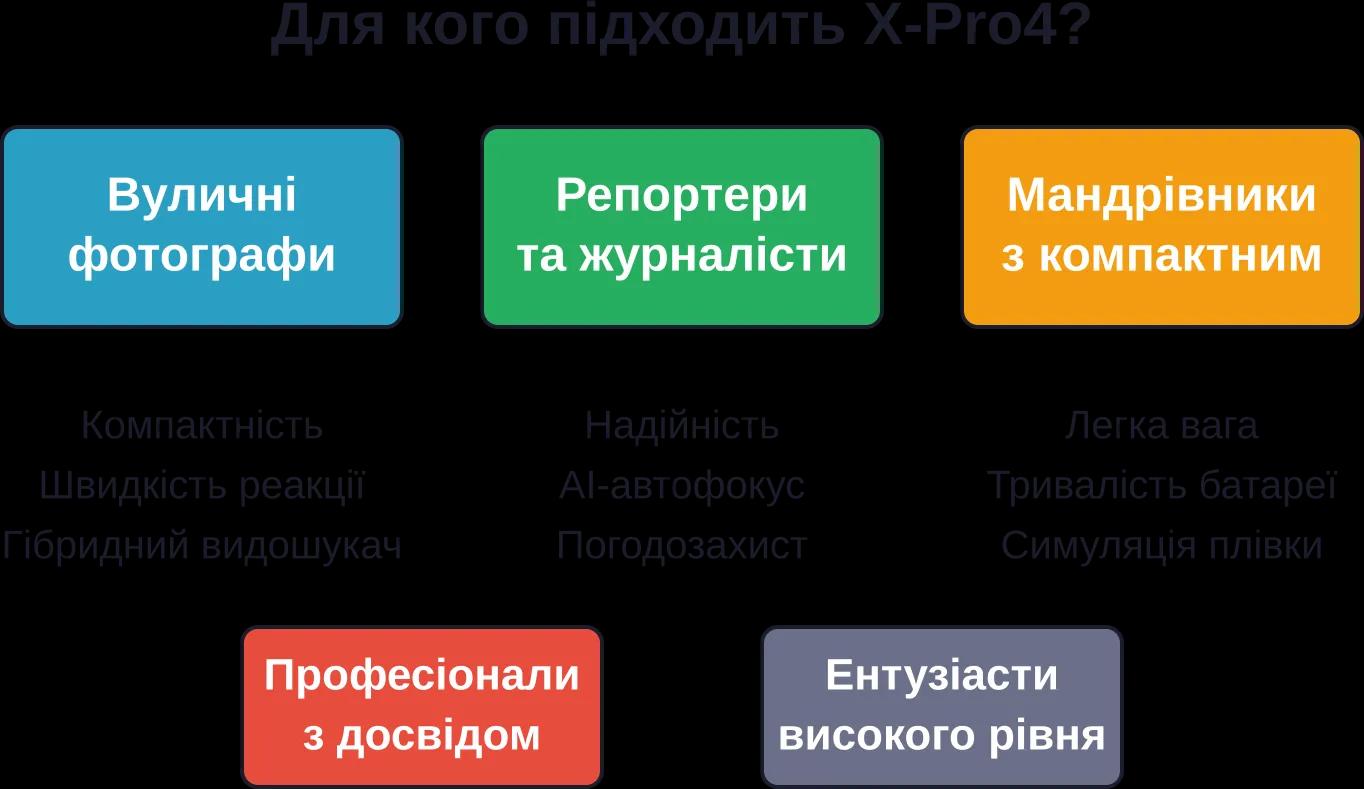
Who exactly is the X-Pro4 designed for? Let's look at several real-world scenarios.
Street Photographer in a Big City
The compact body, fast shutter response, and hybrid viewfinder make the X-Pro4 ideal for street photography. The optical viewfinder lets you see the scene without delay and anticipate the moment when the subject enters the frame.
The 40-megapixel sensor provides room for cropping during post-processing if the composition needs adjustment. AI autofocus quickly locks onto people's faces and eyes in a crowd.
Wedding Photographer
The weather-sealed body, long battery life, and the ability to use dual memory card slots for backup are critically important for wedding photography, where there is no room for error.
Film simulation modes make it possible to quickly deliver preview JPEG files to the client immediately after the event while detailed RAW processing is still underway.
Traveler and Blogger
The lightweight body and 6.2K video recording capability make the X-Pro4 an excellent choice for creating combined photo and video content while traveling. Wireless connectivity allows you to quickly upload images to social media directly from the camera.
Film simulation provides a unique visual style that stands out among millions of photos taken with smartphones.
What Could Be a Drawback?
No camera is perfect. The X-Pro4 may have some limitations:
APS-C versus full frame: full-frame sensors deliver better high-ISO performance and shallower depth of field
Continuous shooting speed: sports photographers may find 15–20 fps not fast enough
Video capabilities: although 6.2K is impressive, dedicated video cameras offer more professional features
Price: the premium price may be a barrier for enthusiasts with a limited budget
It is important to honestly assess whether the camera's capabilities match your specific needs. For some users, the X-E5 or X-T5 may be a better choice.
Preparing for the Launch
If you are seriously considering buying the X-Pro4 when it is released, there are several steps worth taking now:
Evaluate your current system: which lenses are already in your collection? Will they be suitable for a 40 MP sensor?
Subscribe for updates: follow the official Fujifilm website and trusted news sources
Set aside your budget: the expected price is $1,699–$1,899 plus taxes
Consider pre-ordering: pre-orders often include bonuses or priority delivery
Explore the ecosystem: it may be worth purchasing extra batteries, memory cards, or lenses in advance
But remember: it is always better to wait for real-world reviews after the release before making a major investment.
Conclusion: Is the X-Pro4 Worth the Wait?
If the rumors prove true, the Fujifilm X-Pro4 will represent a significant step forward for this legendary series. The 40-megapixel sensor, AI autofocus, IBIS, and 6.2K video transform this compact rangefinder-style camera into a modern tool capable of competing with much larger systems.
Retaining the hybrid viewfinder and classic design means the X-Pro4 stays true to the philosophy of the series—a combination of the best of photography's past and future. It is a camera for those who value not only technical specifications but also the experience and enjoyment of the shooting process.
For street photographers, photojournalists, wedding photographers, and travelers, the X-Pro4 promises to become the ideal tool—compact, fast, reliable, and capable of producing images of the highest quality.
However, it is worth remembering that all of this information is based on rumors and leaked information. The official announcement will reveal the camera's actual capabilities. The best strategy is to wait for the release, read independent reviews, and try the camera yourself before investing.
Frequently Asked Questions About the Fujifilm X-Pro4
When Will the Fujifilm X-Pro4 Be Released?
According to Imaging Resource, the X-Pro4 is expected to arrive by the end of 2026. The exact date of the announcement and the start of sales has not yet been officially announced by Fujifilm. It is recommended to follow the company's official website for the latest information.
How Much Will the X-Pro4 Cost?
The official price has not yet been announced. Based on the prices of competing models, the expected range is $1,699–$1,799 for the body or $1,899–$2,099 for a kit with a lens. For comparison, the X-E5 costs $1,699 for the body at the time of the 5050 Travelog review.
What Are the Main Improvements Compared to the X-Pro3?
The main improvements include a 40.2 MP sensor (compared to 26.1 MP), the X-Processor 5, AI autofocus, five-axis image stabilization (IBIS), 6.2K video (compared to 4K/30p), and possibly an improved hybrid viewfinder. This makes the X-Pro4 significantly more powerful in every aspect.
Will the X-Pro4 Have the Same Unusual Screen Design as the X-Pro3?
This has not yet been confirmed. The X-Pro3 featured a hidden main screen with a small secondary display on the back. Community discussions show mixed opinions about this design. Fujifilm may keep it to preserve the uniqueness of the series or return to a traditional screen based on user feedback.
Is the X-Pro4 Suitable for Video Recording?
The X-Pro4 will be able to record 6.2K/30p video, making it suitable for high-quality video content. However, the X-Pro series remains primarily a photography-focused camera. For serious professional video production, it is better to consider the X-H2S or the upcoming X-H3, which offer more specialized video features.
Is the X-Pro4 Compatible with Existing Fujifilm Lenses?
Yes, the X-Pro4 is fully compatible with all XF and XC lenses using the X-mount. This is one of the greatest advantages of the Fujifilm ecosystem—all lenses work across all X Series cameras. To get the most out of the 40 MP sensor, Fujifilm's sharpest professional-series lenses are recommended.
Should You Wait for the X-Pro4 or Buy the X-Pro3 Now?
The X-Pro3 was discontinued in 2023, so new units are difficult to find. If you do not need a camera immediately, it is worth waiting for the X-Pro4 with its substantial improvements. Alternatively, you can consider the X-E5 or X-T5, which are already available and offer modern features at a lower price.