

RTX 5070, 5080, and 5090 Graphics Cards for 1080p, 1440p, and 4K: A Complete Review
April 3, 2026
Quick Summary: NVIDIA GeForce RTX 5070, 5080, and 5090 series graphics cards based on the Blackwell architecture offer varying levels of performance for 1080p, 1440p, and 4K gaming. The RTX 5070/5070 Ti provide an excellent balance for 1080p and 1440p gaming, the RTX 5080 confidently handles 1440p and 4K at high settings, and the RTX 5090 is an uncompromising solution for 4K with maximum settings and ray tracing.
Choosing a graphics card for a specific monitor resolution is a decision that directly impacts the quality of your gaming experience and budget. With the release of the GeForce RTX 50 series based on the Blackwell architecture, NVIDIA has offered several solutions at different levels.
But is it worth paying extra for the RTX 5090 if you game at 1440p? Can the RTX 5070 Ti handle modern games at 4K? How critical is the difference between the 5080 and 5090 for real-world gaming?
We'll explore the key differences between the new graphics cards, their performance at different resolutions, and help you choose the optimal choice for your needs.
NVIDIA Blackwell Architecture and New Features
The GeForce RTX 50 series is built on the Blackwell architecture, which brings significant changes to the approach to rendering and graphics processing. It is built on three key components.
Fifth-generation Tensor Cores deliver AI computing power measured in AI TOPS (trillions of operations per second). Fourth-generation Ray Tracing Cores handle lighting and reflection calculations. Blackwell CUDA cores handle traditional graphics calculations.
DLSS 4 and Multi-Frame Generation Technology
The main innovation of the series is DLSS 4 with Multi-Frame Generation. Previous versions of DLSS generated a single intermediate frame between two actual frames. DLSS 4 can generate multiple intermediate frames between two actual frames.
In practice, this results in a 150-250% increase in fps in supported games. The image becomes noticeably smoother, especially in fast-paced scenes. However, there is a caveat: response times may increase slightly, which is critical for esports.
The technology only works on RTX 50 series cards. Older models support DLSS 3 with single-frame generation, but will not receive Multi Frame Generation via a driver update.
Reflex 2 and Latency Reduction
NVIDIA Reflex 2 works in conjunction with DLSS 4 to compensate for frame generation delays. NVIDIA claims that Reflex 2 can reduce latency compared to games without Reflex.
This is crucial for competitive shooters. Even a few milliseconds of advantage can decide the outcome of a duel.
Neural Rendering and RTX Neural Rendering
Blackwell adds support for neural rendering—a technology where neural networks are directly involved in image creation, not just upscaling.
RTX Neural Shaders use AI to create realistic materials without traditional high-resolution textures. RTX Neural Faces improve real-time character facial animation. These features are just beginning to be implemented in games, but the potential is significant.

Choose your graphics card and place your order at JustBuy
Want to see current models, compare specifications, and figure out what's right for your monitor and resolution? JustBuy is an online tech store where you can find computer components, laptops, gadgets, and other electronics. Here you can easily check availability, price, delivery, payment, and warranty terms.
Looking for a place to view and buy a graphics card?
At JustBuy you can:
View current models and their specifications
Compare devices and choose the right option
Check availability, price, delivery, and warranty
Place an order online or get advice before purchasing
👉 Contact JustBuy to select a graphics card and clarify the terms of purchase.
Technical Specifications of the 5070, 5080, and 5090 Series
Understanding the specifications helps you assess the true capabilities of each graphics card. Let's take a look at the key parameters.
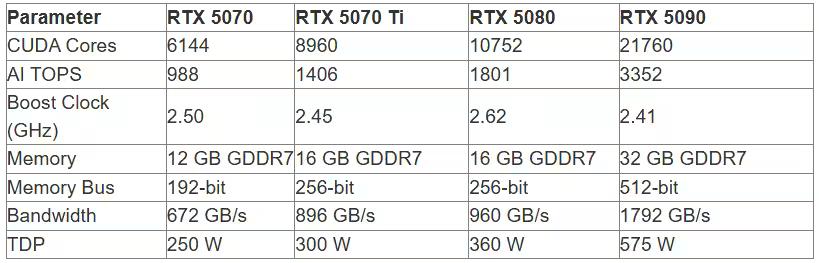
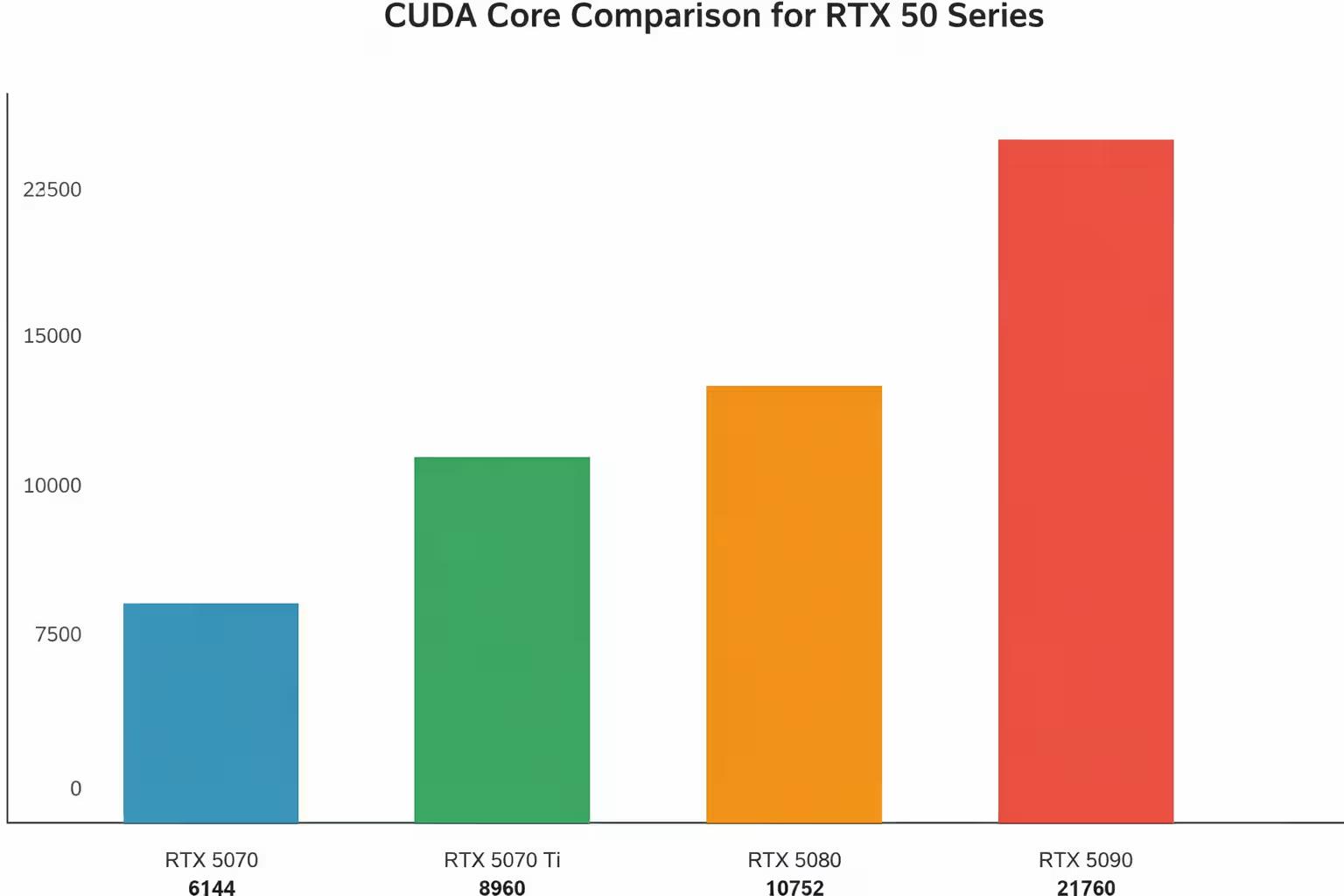
The RTX 5070 is the base model of the series, with 6,144 CUDA cores and 12 GB of video memory. This is a significant upgrade over the previous generation, but with a narrower memory bus.
The RTX 5070 Ti has 8,960 CUDA cores and 16 GB of memory with a wider 256-bit bus. The performance boost over the entry-level model is approximately 30-40%, depending on the game.
The RTX 5080 offers 10,752 CUDA cores and even higher memory bandwidth—960 GB/s—thanks to faster GDDR7 chips. This is a significant step up for working with high resolutions.
The RTX 5090 has significantly more cores than the 5080 (OFFICIAL: 21,760 CUDA cores vs. 10,752 estimated) and a whopping 32 GB of GDDR7 memory. According to NVIDIA, the GeForce RTX 5090 is twice as fast as the GeForce RTX 4090 in games that support Blackwell technologies.
GDDR7 Memory and Its Impact on Performance
All RTX 50 series cards use the latest GDDR7 memory. This is the first generation of consumer graphics cards with this memory type.
GDDR7 operates at higher frequencies while consuming less power. Bandwidth is critical at high resolutions—the more pixels there are to process, the more memory is used.
For 4K gaming, the difference between the RTX 5070's 192-bit bus (672 GB/s) and the RTX 5090's 512-bit bus (1792 GB/s) becomes noticeable in demanding games with ray tracing.
RTX 5070 and 5070 Ti for 1080p and 1440p
The entry-level RTX 50 series models are aimed at mainstream gamers who play in Full HD or switch to 1440p. How do they handle these tasks?
1080p Performance
At 1920x1080, both cards are overkill when playing at maximum settings without ray tracing. In most modern games, the RTX 5070 delivers 100-150 FPS, while the RTX 5070 Ti delivers 120-180 FPS.
However, 1080p remains relevant for esports and competitive shooters that require high frame rates. Here, these cards really shine, delivering stable 200+ FPS in CS:GO, Valorant, and Apex Legends even without DLSS.
When ray tracing is enabled in games like Cyberpunk 2077 or Alan Wake 2, performance drops. Here, DLSS 4 becomes a necessity—with frame generation enabled, the RTX 5070 Ti maintains around 120-140 FPS at 1080p with ultra settings and ray tracing.
1440p Performance
2560x1440 resolution offers the optimal balance between detail and performance. This is where the RTX 5070 Ti shines.
In demanding games, the RTX 5070 requires settings optimization or the use of DLSS 4 to achieve stable performance. With DLSS 4 enabled, performance increases to 120-150 FPS.
The RTX 5070 Ti delivers better performance in demanding games at 1440p. For most gamers, this is the ideal range, ensuring smooth gameplay without compromising graphics.
Should I upgrade to the RTX 5070 Ti over the base 5070?
There's a price gap between the RTX 5070 and RTX 5070 Ti, but the performance boost is 30-35%. In terms of price/performance, the RTX 5070 appears to be the better value.
However, there's an important consideration: video memory capacity. The RTX 5070 Ti gets 16 GB versus the base model's 12 GB. For current games at 1440p, the difference is negligible, but the Ti version offers more future-proofing.
If your budget allows and you plan to use the card for 3-4 years, the RTX 5070 Ti is a more promising investment. For those who upgrade cards more frequently or play primarily at 1080p, the base RTX 5070 is perfectly sufficient.
RTX 5080 for All-Round Gaming
The RTX 5080 occupies an interesting position in the lineup. It's the first card in the series that reliably handles 4K, yet costs significantly less than the flagship.
Performance at 1440p and 4K
At 1440p, the RTX 5080 delivers strong performance. It easily exceeds 200 FPS with DLSS 4 even in the most demanding games. The RTX 5080's true strength is 4K gaming. At 3840x2160, the card handles 4K gaming at high settings in most AAA games. With DLSS 4 enabled, the performance increases significantly.
In games with ray tracing, the difference becomes even more noticeable. Cyberpunk 2077 with path tracing at 4K requires optimized settings on the RTX 5080.
Comparison with the RTX 4090
An interesting comparison is the RTX 5080 versus last year's flagship RTX 4090. Although the 5080 is positioned at a lower tier, its new architecture and DLSS 4 partially bridge the gap.
In games without DLSS, the RTX 4090 is approximately 20-25% faster. But when frame generation is enabled, the RTX 5080 with DLSS 4 outperforms the RTX 4090 with DLSS 3 by 10-15% thanks to the ability to generate multiple intermediate frames.
For current gaming, the RTX 5080 offers a better price/performance ratio than the aftermarket RTX 4090, especially considering its lower power consumption (360W vs. 450W).
Who is the RTX 5080 for?
The RTX 5080 is an optimal choice for those who want to play 4K games at high settings but aren't willing to pay the premium price of the RTX 5090. It's also a great choice for 1440p enthusiasts who need some extra power for future games.
An important point is that 16GB of VRAM is sufficient for the vast majority of 4K games. The RTX 5090 with 32GB is more secure in this regard.
RTX 5090 for Uncompromising 4K Gaming
The RTX 5090 is the most powerful consumer graphics card ever released. But is it worth the price for gaming?
Performance at Maximum Settings
At 4K with Ultra settings, the RTX 5090 delivers significantly higher performance in 4K. With DLSS 4 enabled, these figures increase significantly, opening the door to 4K monitors with 240Hz refresh rates.
In games with ray tracing, the RTX 5090 shows a significant advantage. According to NVIDIA, the GeForce RTX 5090 is twice as fast as the GeForce RTX 4090 in games that support Blackwell technologies. In practice, the performance gains are Varies depending on the game and settings.
32 GB of video memory: overkill or necessity?
Modern 4K games typically use less than 32 GB of video memory. However, this amount opens up opportunities for other tasks. Rendering complex 3D scenes in Blender, working with large projects in Premiere Pro, and generating images in Stable Diffusion all heavily utilize video memory.
For pure gaming, 32 GB is future-proof. Next-generation games, especially those with extensive use of neural rendering, may require more memory.
Power Consumption and Cooling
The RTX 5090 has a high power consumption (Total Graphics Power 575 W), which translates to a significant thermal load. A minimum 850 W power supply is required for stable operation, with 1000 W or more recommended.
The reference version of the Founders Edition uses a massive three-slot cooling system. The card has an active cooling system. Partner versions from ASUS, MSI, and Gigabyte often use even larger coolers that take up multiple expansion slots. Before purchasing, it's important to ensure the card will fit in your case.
Is the RTX 5090 worth the extra money?
The RTX 5090 is significantly more expensive than the RTX 5080, and the performance boost is 40-60% depending on the game. In terms of price/performance, the RTX 5080 appears more reasonable.
The RTX 5090 makes sense in several scenarios. Those who need maximum performance at 4K at 144+ Hz; those who will use the card not only for gaming but also for professional tasks; and those who value maximum performance headroom for the future without upgrades.
For the average gamer, even those playing at 4K, the RTX 5080 offers the best balance of features and price.
Comparing performance in real games
Theoretical specifications are one thing, but real-world performance in games is another. Let's look at some specific examples.
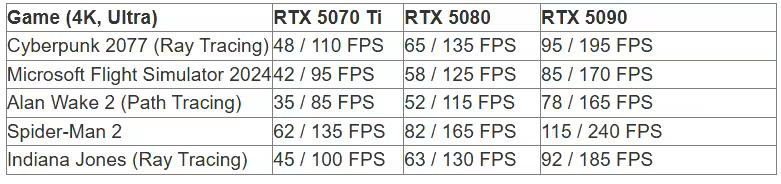
The first number is performance without DLSS, the second is with DLSS 4 Multi Frame Generation. The data represents average results based on various tests.
Esports Games at High Resolutions
For competitive shooters, the excess graphics card power allows for consistently high FPS even at resolutions above 1080p.
In Counter-Strike 2, RTX 50 series graphics cards deliver high frame rates at 1440p on high settings. The RTX 5090 maintains 200+ FPS even in native 4K, which is important for professional players with dedicated monitors.
Valorant, Apex Legends, and Overwatch 2 run on the RTX 5070 Ti and above at 240+ FPS at 1440p, providing the perfect smoothness for competitive play.
Choosing a Graphics Card for Different Resolutions
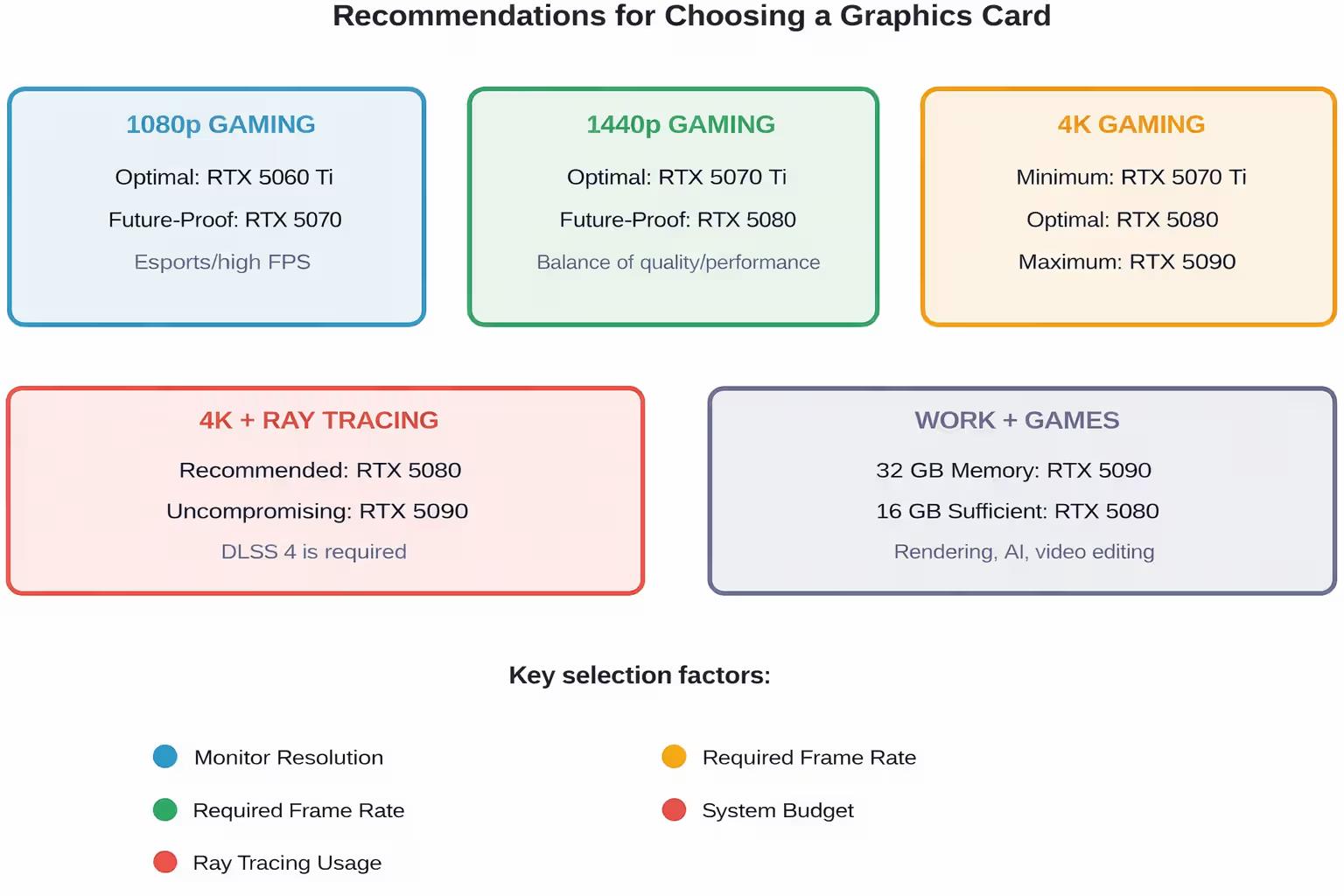
How to make a final decision? Let's look at recommendations for different scenarios.
For 1080p gaming
If the primary resolution is 1920×1080, even the RTX 5070 will be overkill for most games for the next 2-3 years. It's worth considering more affordable options like the RTX 5060 Ti or even the previous generation.
The RTX 5070 Ti is only worthwhile for 1080p if you need maximum frame rates for esports (300+ FPS) or plan to upgrade your monitor soon.
For 1440p gaming
The 2560×1440 resolution is the optimal range for the RTX 5070 Ti. The card provides comfortable gaming at maximum settings with plenty of performance to spare.
The RTX 5080 for 1440p only makes sense if you want guaranteed 144+ FPS in all games or plan to upgrade to 4K in the future. For pure 1440p gaming, this is an overprice.
For 4K gaming
At 4K, the true performance divide begins. The RTX 5070 Ti can run at 4K, but requires optimized settings or the use of DLSS 4.
The RTX 5080 is the minimum recommended card for comfortable 4K gaming at high settings. It delivers good 4K performance at high settings, and performance improves significantly with DLSS 4.
The RTX 5090 is for those who want maximum settings, ray tracing, and high frame rates simultaneously. It's also suitable for those who use 4K monitors with refresh rates of 144-240 Hz and want to exploit their full potential.
Alternatives from AMD and Intel
NVIDIA isn't the only graphics card manufacturer. Should you consider the competition?
AMD Radeon RX 9070 and 9070 XT
AMD announced the Radeon RX 9000 series based on the RDNA 4 architecture, which is intended to compete with the low-end and mid-range RTX 50 models.
The RX 9070 XT is expected to compete with the RTX 5070 Ti, offering comparable rasterization performance but lagging behind in ray tracing. AMD's main advantage is its traditionally more aggressive pricing policy.
However, AMD doesn't have a multi-frame equivalent for DLSS 4. FSR 4 (FidelityFX Super Resolution) has improved, but still lags behind NVIDIA's solution in image quality and efficiency.
Second-Generation Intel Arc
Intel is working on second-generation Arc graphics cards based on the Battlemage architecture. The top-end model is expected to compete with the RTX 5060 Ti in performance.
For the mid-range and high-end segments, Intel isn't yet ready to offer a worthy alternative to NVIDIA. The Arc's main advantage is its attractive price for budget gaming.
Additional factors when choosing a graphics card
Performance isn't the only criterion. There are several important factors that influence the actual user experience.
Power Supply Requirements
Modern graphics cards are demanding when it comes to power. The RTX 5070 Ti requires a minimum 650W PSU, the RTX 5080 requires a 750W PSU, and the RTX 5090 requires an 850-1000W PSU.
Not only the wattage is important, but also the quality of the PSU. Cheap PSUs with inflated specifications may not be able to handle peak loads, leading to system instability.
Make sure your power supply has the necessary power connectors—the RTX 5090 uses the new 16-pin 12V-2x6 connector, although an adapter to standard 8-pin connectors is usually included.
Case Size and Compatibility
RTX 50 series graphics cards are large. The reference RTX 5090 takes up three slots and is approximately 304 mm long. Partner versions may be even larger.
Check your case dimensions before purchasing. Pay attention not only to the length but also to the number of expansion slots—the massive coolers on some versions block adjacent slots.
Processor and System Balance
Even a top-end graphics card won't fully utilize its capabilities with a weak processor. For the RTX 5080 and 5090, processors such as 14th Gen Intel Core i7/i9 and AMD Ryzen 7/9 7000-9000 series are recommended. In 4K gaming, the graphics card is usually the bottleneck, and the CPU has less of an impact. However, at 1080p and 1440p, a weak CPU can limit maximum FPS even on a powerful graphics card.
Future Outlook
Buying a high-end graphics card is an investment for at least 3-4 years. What will new cards look like in a couple of years?
Development of Neural Rendering
NVIDIA is actively promoting the concept of neural rendering, where neural networks are directly involved in image generation. RTX Neural Shaders and Neural Faces are just the beginning.
As these technologies are implemented in games, the graphics card's AI performance (AI TOPS) will become more important than traditional metrics. The RTX 5090, with its high AI TOPS, has an advantage in AI tasks.
Next-Generation Games
Unreal Engine 5 with Nanite and Lumen technologies, like other modern engines, is gradually raising the bar for requirements. Games in 2026-2027 will be more demanding than today's. The RTX 5070 Ti with 16 GB of memory should comfortably handle games for the next 3-4 years at 1440p. The RTX 5080 will provide 4K gaming headroom for the same period. The RTX 5090 ensures long-term usability thanks to its high performance.
Possible SUPER Versions
Historically, NVIDIA releases updated SUPER versions of its cards 8-12 months after the main release. There are rumors of an RTX 5080 SUPER with 24 GB of memory.
If not urgent, it makes sense to wait for the announcement of potential SUPER models, which could offer improved performance at the same or slightly higher price.
Frequently Asked Questions
Is RTX 5070 Ti good for 4K gaming?
It can handle 4K, but requires DLSS 4 or lower settings. RTX 5080 is better for stable performance.
What’s the difference between RTX 5080 and 5090?
RTX 5090 is significantly more powerful. Not critical for 60 FPS, but important for 144+ Hz.
Should you upgrade from RTX 4080 to 5080?
Not necessary, but beneficial for 4K + ray tracing and 100+ FPS.
How much VRAM is needed for 4K?
12–16 GB is enough. 32 GB is future-proof.
Do older GPUs support DLSS 4?
No. Only RTX 50 series supports it.
Best GPU for 1440p 240 Hz?
RTX 5080 is ideal. RTX 5070 works for esports titles.
How long will RTX 5090 last?
5+ years of relevance thanks to its performance.
Conclusion
Choosing between the RTX 5070, 5080, and 5090 depends on your current needs, budget, and future plans. Each card has its place in the ecosystem.
The RTX 5070 and 5070 Ti are optimal choices for 1080p and 1440p gaming with plenty of performance to spare. These cards deliver high frame rates at maximum settings and are ideal for mainstream gamers.
The RTX 5080 is a versatile solution that confidently handles 4K gaming at high settings and offers the best price/performance ratio at this resolution. It's a smart choice for enthusiasts who want a top-end experience without breaking the bank.
The RTX 5090 is a no-compromise card for maximum 4K settings, ray tracing, and high-resolution monitors. It's also suitable for professionals working with 3D rendering, video editing, and AI tasks.
Regardless of your choice, all RTX 50 series cards offer a significant step up from the previous generation thanks to Blackwell architecture and DLSS 4. Investing in any of them will ensure comfortable gaming for years to come.
Check current prices on the official NVIDIA website and with authorized partners to choose the optimal configuration for your budget and needs.