

Klipsch The Fives II Review: Dolby Atmos and 2026 Sound
May 11, 2026
Briefly about the main points: Klipsch The Fives II are second-generation active bookshelf speakers with Dolby Atmos support, integrated streaming, and an improved acoustic platform based on Onkyo technologies. The model features a 5.25-inch Jet Cerametallic driver, horn-loaded compression with a titanium tweeter, and a maximum volume of 103 dB, making it a versatile solution for music, movies, and gaming.
Klipsch has updated its legendary line of active speakers, launched between 2020 and 2022. The Fives II continue the company's tradition of 80 years of acoustic engineering in the USA and are now equipped with technologies developed in collaboration with Onkyo.
This isn't just a cosmetic upgrade. The second generation includes Dolby Atmos, a hi-res streaming platform, and HDMI 2.1 with eARC. But should owners of the original The Fives upgrade?
Let's break it down.
What's New in The Fives II: Key Second-Generation Changes
Klipsch launched The Fives at around $799 USD (MSRP), though they may have been available at a different price at launch. The Fives II are listed with an MSRP of $969 (pair), according to Audio Advice, reflecting a significant feature expansion. Here's what's changed:
Dolby Atmos — surround sound support via overhead drivers and psychoacoustic processing
Onkyo Platform — integrated Wi-Fi streaming with AirPlay 2, Chromecast, and Spotify Connect
HDMI 2.1 with eARC — direct connection to your TV without an external receiver
Hi-Res Audio 24-bit/96 kHz — official specification for all digital inputs
Improved DAC and amplifiers — co-developed with Onkyo to reduce distortion
One-piece BMC baffle — monolithic front panel to minimize resonance
The acoustic platform remains recognizable: the signature Tractrix horn with a 1-inch titanium tweeter and a 5.25-inch Jet Cerametallic woofer. Frequency response is from 50 Hz to 25 kHz, maximum volume is 103 dB. The Fives II is the most compact model in the updated line, which also includes The Sevens II (6.5-inch driver) and The Nines II (8-inch driver).

Klipsch The Fives II and audio systems at JustBuy
JustBuy is a convenient place to quickly find speakers without the hassle of searching. Our catalog features current models, including the Klipsch The Fives II and other solutions for music, movies, and gaming.
This model stands out with its Dolby Atmos support, HDMI eARC, and powerful signature sound with horn tweeters, making it a fully functional soundbar replacement.
Here you can compare specifications, check availability, and choose the right option right away.
Looking for where to buy speakers?
At JustBuy, you can:
Select current audio systems
Compare specifications and features
Check availability and price
Place an order or get a consultation
👉 Contact JustBuy to find the Klipsch The Fives II or the right speakers for your needs.
Dolby Atmos in bookshelf speakers: how it works
Dolby Atmos traditionally requires in-ceiling speakers or upward-firing modules to create a height channel. The Fives II uses a combined approach.
Here's how the system processes surround sound:
A built-in decoder extracts Atmos metadata from the HDMI stream
A DSP processor distributes sound objects between the drivers
Overhead emitters (pointed at an angle) create a reflected wave from the ceiling
Psychoacoustic algorithms simulate missing channels through phase shifts
Does this work as effectively as a discrete 5.1.2 system? No. But for a tabletop or bookshelf configuration, the effect is noticeable—especially in content with pronounced high-altitude objects (helicopters, rain, musical reverberations).
The Fives II only support Atmos via HDMI eARC. Streaming services deliver standard stereo or compressed 5.1 surround sound, not full Atmos.
Built-in streaming: Onkyo's platform inside the speakers
The main advantage of The Fives II is that it eliminates the need for an external streamer. Onkyo has integrated a full-fledged network platform directly into the active speaker. Supported features:
AirPlay 2 — multi-room, stereo pairing, HomeKit integration
Chromecast Built-in — casting from any Android app
Spotify Connect — direct control from the Spotify app without Bluetooth
Tidal Connect, Qobuz — native hi-res streaming services
Control via the Klipsch Connect Plus app, which also offers an equalizer, a choice of DSP profiles, and adjustable delays for video syncing.
Users note that the Klipsch Connect Plus app is more stable than similar apps on competing platforms. However, there is a caveat: initial Wi-Fi setup requires a smartphone. There is no Ethernet port.
Comparison of The Fives II, The Sevens II, and The Nines II
Klipsch updated its entire lineup simultaneously. The differences are not only in driver size, but also in acoustic power, low-frequency range, and price.
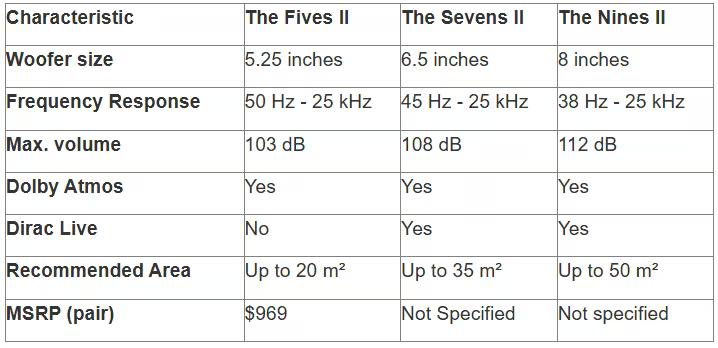
The Fives II is an ideal choice for desktop installations, small rooms, or bedrooms. If the room is larger than 25 square meters (270 sq ft) or requires deeper bass without a subwoofer, consider The Sevens II.
The Nines II is already a reference system for studios or critical listening. Dirac Live automatically adjusts the frequency response to the room acoustics, which is especially important in untreated spaces.
Klipsch Sound Signature: Tractrix and Cerametallic Horn
Klipsch has been building speakers around the patented Tractrix horn since 1946. This technology is part of the brand's acoustic DNA, inherited from the flagship Klipschorn, which costs approximately $18,000 per pair.
Why use a horn?
Controlled dispersion—sound is directed toward the listening area, not all around.
High sensitivity—less power is required for the same volume.
Reduced distortion—the tweeter operates at a lower amplitude at the same SPL.
Cerametallic—a composite woofer material that combines the rigidity of ceramic with the damping of aluminum. The result: a fast attack, controlled roll-off, and minimal resonance in the midrange.
Audio Advice tested all three second-generation models and noted: the sound is not harsh, despite horn compression. This is thanks to Onkyo's DSP processing, which smooths out peaks at 2-4 kHz—a traditional problem with horn-loaded systems.
The Fives II sound signature:
Treble—detailed but not aggressive; suitable for long listening sessions.
Midrange—slightly retracted; vocals are natural but not prominent.
Low frequencies—up to 50 Hz—sufficient for most music. A subwoofer is desirable for a home theater.
Practical applications: music, cinema, studio
The Fives II is marketed as a universal solution. How true is this?
Music Listening
Suitable for all genres, but especially shines with dynamic music—rock, electronica, jazz. The horn system conveys the attack of drums and brass instruments with realistic energy.
Hi-res streams from Qobuz or Tidal via Chromecast sound noticeably clearer than Bluetooth aptX HD. The difference is especially noticeable with acoustic recordings with wide dynamics.
For critical listening of classical or chamber music, neutrality may be lacking—the midrange is slightly tinged with the characteristic "American" sound of Klipsch.
Home Theater
HDMI eARC simplifies connection: a single cable from the TV, and the speakers receive multichannel sound with automatic Atmos decoding.
The Fives II performs admirably for dialogue and sound effects. Explosions, car chases, and musical scores are all conveyed with plenty of volume and detail.
Limitation: a low-frequency roll-off of 50 Hz. For full LFE (channel 0.1 in 5.1 or Atmos), a subwoofer is required. The good news is that there's a subwoofer output, and it activates automatically when Atmos content is detected.
Studio Monitoring
The Fives II can be used for mixing demo tracks or podcasts, but it's not a replacement for studio monitors like the Neumann KH 120 or Genelec 8030.
Reason: the lack of Dirac Live (only available in the Sevens II and Nines II) and built-in DSP profiles that can't be completely disabled. The frequency response is optimized for pleasant listening, not analytical work. For producers looking for a reference system, The Sevens II with Dirac Live is a better choice, or even a more traditional setup: passive speakers + measurement microphone + Sonarworks.
Connectivity and Control: HDMI, USB-C, Analog
The Fives II offers virtually every input imaginable. Here's the full list:
HDMI 2.1 with eARC — priority input for a TV or console
USB-C (24/96) — for direct connection to a computer or laptop
RCA analog — for a turntable or older equipment
Optical (Toslink) — digital input for older TVs
Bluetooth 5.0 — for smartphones and tablets
Wi-Fi (2.4 + 5 GHz) — streaming services, multi-room
Subwoofer Out — RCA output for an active subwoofer
Switching between sources — via remote control or app. Automatic priority: if you start streaming via AirPlay, the speakers will automatically switch. One caveat: USB-C doesn't support Power Delivery. If you connect a MacBook, the sound will work, but the laptop won't charge. A separate adapter is required.
Comparison with competitors: KEF LSX II, Audioengine HD6
Active speakers with built-in streaming are a competitive niche. How do The Fives II compare to the alternatives?
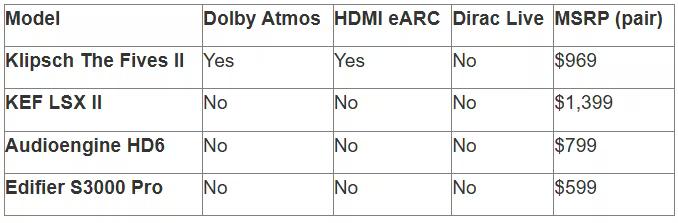
The KEF LSX II is more expensive, but offers a Uni-Q coaxial design for perfect phasing. However, without HDMI, they are less convenient for TV use.
The Audioengine HD6 are active speakers with built-in amplification; compared to The Fives II, they lack Atmos, eARC, and Hi-Res streaming.
The Edifier S3000 Pro is a budget alternative with a different acoustic platform.
The Fives II occupy the mid-price range, but offer a maximum of features: Atmos, eARC, streaming, and Hi-Res support. Competitors are either more expensive or offer fewer features.
Design and Materials: Red Oak and BMC Baffle
Klipsch has always prioritized aesthetics. The Fives II are available in two finishes:
Matt Black Ash – minimalist, suitable for modern interiors
Red Oak – classic finish in the style of Klipsch's Heritage line
The magnetic grilles are removable. Black grilles are included; beige grilles are available as an option.
New to the second generation is the one-piece BMC (Baffle Mounted Compression) baffle. Instead of separate covers around the drivers, the front panel is made from a single piece of composite. This minimizes resonance and simplifies acoustic matching between the woofer and tweeter.
Dimensions: 31.8 cm high, 18.4 cm wide, 26.7 cm deep. Each speaker weighs approximately 6.8 kg. This size is suitable for a shelf, TV stand, or studio rack.
DSP Profiles and EQ: Room Tuning
Three DSP modes are available through the Klipsch Connect Plus app:
Standard — balanced frequency response for all-around use
Music — expanded stereo image, emphasis on detail
Cinema — enhanced center for dialogue, virtual surround
The original The Fives supported several DSP modes for room tuning. In The Fives II, Klipsch has unified the platform—all three modes are present.
There's also a parametric EQ: five bands with ±6 dB gain adjustment. This is sufficient for correcting room resonances or tailoring to personal preferences.
What's missing is automatic microphone calibration. For that, you'll need The Sevens II or The Nines II with Dirac Live.
Should you upgrade from the original The Fives?
This is the question most often asked by owners of the first generation. Here are the criteria for an upgrade:
You have a TV with eARC – HDMI 2.1 greatly simplifies connection, especially for Atmos content from Apple TV or consoles
You actively stream – the built-in Onkyo platform is more convenient than an external Chromecast Audio or Bluetooth
Dolby Atmos is important to you – the original The Fives don't support surround sound at all
If you only listen to music from vinyl or a computer, the difference will be minimal. The acoustic platform (drivers, amplifiers) has been improved, but not radically.
The original The Fives had an MSRP of about $799 USD according to Audio Science Review (2021). The Fives II starts at $969. The $170 difference is the price for Atmos, Onkyo, and new materials.
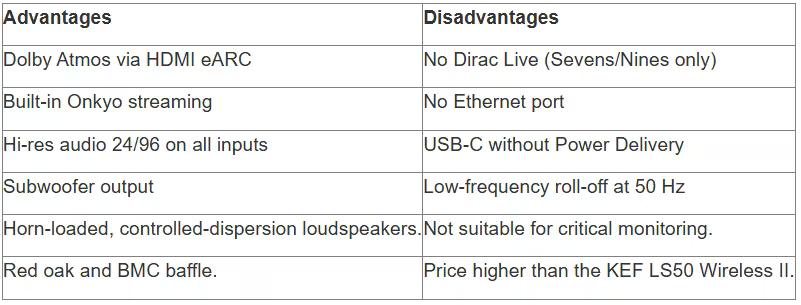
Pros and Cons of The Fives II
FAQ: Frequently Asked Questions about the Klipsch The Fives II
Does The Fives II require a subwoofer?
For music, no. The 50Hz-25kHz frequency range covers most genres. For a home theater with Dolby Atmos, adding a subwoofer is recommended to enhance the LFE channel with low-frequency effects below 50Hz. A subwoofer output is located on the rear panel.
Does Dolby Atmos work via Bluetooth or Wi-Fi streaming?
No. Dolby Atmos is only supported via HDMI eARC. Streaming services like Spotify, Tidal, and Apple Music deliver either stereo or compressed 5.1 without Atmos metadata. Surround sound requires an HDMI source: TV, Apple TV 4K, PlayStation 5, or Xbox Series X.
Can The Fives II be used as studio monitors?
Limited. The speakers are suitable for demo mixing or podcasts, but the lack of Dirac Live and built-in DSP profiles make them less accurate than reference monitors. For professional work, it's better to consider The Sevens II with auto-calibration or dedicated studio models.
What's the difference between The Fives II and The Sevens II?
Main differences: 5.25" woofer size; The Sevens II offers a 6.5" speaker size versus 6.5", a bass response of 50 Hz versus 45 Hz, a maximum volume of 103 dB versus 108 dB, and Dirac Live is only available on The Sevens II. The Sevens II is better suited for larger rooms up to 35 m² and critical listening with auto-calibration.
Do The Fives II support multi-room?
Yes, via AirPlay 2. You can create a stereo pair of two sets, for a total of four speakers, or sync them with other AirPlay 2 devices in your home. Chromecast also supports multi-room playback via the Google Home app. Klipsch doesn't have its own multi-room ecosystem like Sonos.
What cable do I need to connect to my TV?
HDMI 2.1 with eARC support. Regular HDMI 2.0 also works, but without Atmos—only stereo PCM or compressed 5.1. It's important that your TV has an HDMI port labeled eARC, not just ARC. Enable eARC in your TV settings and select Dolby Atmos or Auto as the sound format.
How much power do The Fives II consume?
The official specifications don't list exact power consumption, but similar active systems with Class D amplifiers and drivers of this size typically consume 80–120 watts at peak volume. In standby mode, power consumption drops to 1–2 W thanks to automatic switching to power-saving mode.
Ready to upgrade your home audio system? Visit the official Klipsch website for up-to-date information on availability and pricing in your region. The Fives II is now available to order from authorized dealers worldwide.
Summary: Who is The Fives II for?
The Klipsch Fives II is a versatile powered system for those who want a single solution rather than a bunch of components.
Best for:
Looking for a soundbar replacement with full stereo sound and Atmos
Want built-in streaming without external devices
Room size up to 20-25 m²
Budget around $1,000 per pair
Not suitable for:
Requiring Dirac Live auto-calibration – get The Sevens II
Looking for deep bass without a subwoofer – get The Nines II
Critical studio listening – consider Neumann or Genelec monitors
The Fives II is the evolution of a successful formula. Klipsch took the best of the Heritage line, added modern Onkyo technologies, and packaged it in a compact package. For most scenarios—music, movies, gaming—this is one of the best offerings in its class in 2026.