

Klipsch The Nines II Review 2026: A Complete Look at the Flagship Active Speakers
May 11, 2026
Summary: Klipsch The Nines II are flagship active speakers with 8-inch drivers, Dolby Atmos, Dirac Live correction, and built-in streaming. The new generation adds eARC, Wi-Fi, AirPlay 2, and expanded connectivity options compared to the original model. The Nines II combine Klipsch sound with electronics developed in collaboration with Onkyo.
Klipsch has released the second generation of its active speaker line, and The Nines II takes the flagship position. These 8-inch monitors combine the brand's signature horn-loaded sound with modern audio processing technologies and comprehensive connectivity options.
But is the upgrade from the original Nines worth it? And how does the new model compare to the smaller The Sevens II and The Fives II?
Let's break it down.
What are the Klipsch The Nines II?
The Nines II are premium powered bookshelf speakers that require no external amplifier or receiver. Everything you need is built in.
According to the official Klipsch website, the model features 8-inch woofers and 1-inch titanium tweeters with proprietary Tractrix horns. The built-in amplifier section was developed in collaboration with Onkyo, a Japanese brand renowned for its Hi-Fi electronics.
A key feature of the second generation is support for Dolby Atmos and the built-in Dirac Live room correction system. This elevates The Nines II beyond the realm of traditional powered speakers and into the category of full-fledged all-in-one audio systems.
Key Features
The technical specifications are impressive. Each speaker is equipped with separate amplifiers for high and low frequencies, ensuring optimal driver control.
The system supports high-resolution audio decoding up to 192 kHz/24-bit across all digital inputs. This means that studio master recordings can be played back without loss of quality.
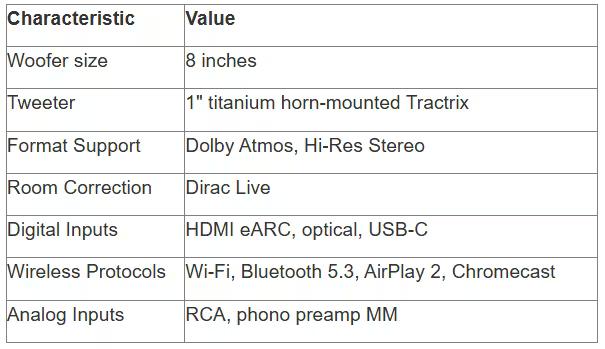
The built-in phono preamp makes The Nines II an excellent choice for turntable owners. You can connect a turntable directly, without the need for additional equipment.

Klipsch The Nines II and premium speakers at JustBuy
JustBuy is a convenient place to quickly find the right audio system without the hassle of searching. Our catalog features current models, including the Klipsch The Nines II and other solutions for music, movies, and gaming.
The flagship of the 2026 line features completely updated electronics from Onkyo, support for Dolby Atmos and Dirac Live, and HDMI 2.1 with eARC, allowing you to connect your TV with a single cable and get full cinema sound without a receiver.
Looking for where to buy speakers?
At JustBuy, you can:
Select current audio systems
Compare specifications and features
Check availability and price
Place an order or get a consultation
👉 Contact JustBuy to find the Klipsch The Nines II or system that best suits your needs.
Line History: From the Original Nines to the Second Generation
The original The Nines, The Sevens, and The Fives were released between 2020 and 2022 and quickly became some of the most recommended active speakers on the market. They combined Klipsch's signature horn-loaded sound with all-in-one versatility.
But they were missing something.
What the first generation lacked
The original models lacked HDMI eARC, which limited their integration with TVs. There was no built-in streaming—you had to rely on external sources or Bluetooth.
There was no room correction system. And sound acoustics depend as much on the room as on the speakers themselves. And, perhaps most importantly, there was no Dolby Atmos support. In an era where surround sound is becoming the standard for streaming services, this was a noticeable gap.
What changed in the second generation
Klipsch didn't just update the design. The company redesigned the entire electronics, joining forces with Onkyo.
All three second-generation models feature built-in streaming via Wi-Fi, AirPlay 2, and Chromecast Built-in. HDMI eARC was added for connecting to TVs with full multichannel audio support.
Dirac Live correction was added, which analyzes room acoustics and automatically adjusts the sound. This is a technology previously found only in expensive home theater processors.
And, of course, Dolby Atmos—The Nines II and The Sevens II received additional height speakers for reproducing a vertical sound layer.
A Detailed Review of The Nines II
Now let's get down to specifics. What does The Nines II get?
Design and Build
Externally, The Nines II retains the recognizable aesthetic of the Klipsch Heritage series—mid-20th-century retro style with modern details. The cabinet is available in walnut and black.
The front panel is protected by a removable magnetic grille. Removing it reveals the brand's signature copper horn and massive 8-inch woofer.
Build quality is top-notch. The cabinets are made of MDF with high-quality veneer. The rear panel houses all the connectors and controls, yet looks neat and logically organized.
Sound Drivers and Proprietary Technologies
The heart of any speaker is its drivers. The Nines II uses a 1-inch titanium tweeter mounted on a 90° x 90° Tractrix horn made of silicone composite.
Why use a horn? This proprietary Klipsch technology increases driver efficiency and improves high-frequency dispersion. The result is more detailed sound with less distortion and a better soundstage.
The horn extends virtually from edge to edge of the front panel, providing a wide listening area. The sweet spot isn't limited to a single point—the sound remains balanced even when offset.
An 8-inch woofer handles mid- and low-frequency frequencies. Combined with a bass reflex port on the rear panel, it delivers deep, powerful bass without the need for a subwoofer. A subwoofer output is included, however, for those who want even more bass.
Dolby Atmos: How It Works in a Stereo Pair
This naturally raises the question: how do two speakers reproduce surround sound, which typically requires a multichannel system?
The Nines II features additional upward-firing speakers. Their sound bounces off the ceiling, creating the illusion of a vertical sound layer—the "sound from above" effect characteristic of Dolby Atmos. This isn't a full-fledged Atmos system with discrete channels, but for a stereo pair, the results are impressive. Watching movies with Atmos sound creates a sense of height and spaciousness that's missing from standard stereo.
Important: Atmos requires a source with HDMI eARC. Connect The Nines II to your TV via eARC, and everything works automatically. The TV transmits multichannel audio from streaming services directly to the speakers.
Dirac Live: Room Correction
Even the best speakers sound different depending on the room. Wall reflections, resonances, and uneven frequency response all affect the final sound.
Dirac Live solves this problem.
How Calibration Works
The system uses a microphone (usually a smartphone microphone via the Klipsch Connect Plus app) to measure the room acoustics at several points. An algorithm then calculates correction filters that compensate for the negative effects of the room.
The process takes about 15 minutes. The result is a more linear frequency response, clear bass without boominess, and detailed highs without harshness.
According to user reports on AudioScienceReview, even the original The Nines performed quite well. But Dirac Live takes the sound to a new level, especially in less-than-ideal rooms.
Free vs. Paid Version
The Nines II includes a free, basic version of Dirac Live. It corrects the frequency range down to 500 Hz—that is, the bass and lower midrange.
There's a paid full-range version of Dirac Live, which covers the entire spectrum. An upgrade requires a separate license purchase. For most listeners, the basic version is sufficient, as the main room problems lie in the low-frequency range.
Connectivity
The Nines II are among the most versatile speakers in terms of connectivity. Whatever you want to connect, there's likely a suitable input.
Digital Inputs
HDMI eARC is the star of the second generation. A single cable from the TV provides access to all content: streaming services, game consoles, and set-top boxes.
Optical Input (Toslink) – for sources without HDMI. Computers, older CD players, and some TVs.
USB-C – for direct computer connection. The speakers are detected as USB audio devices, providing lossless digital transmission.
Wireless Protocols
Wi-Fi enables built-in streaming. The Nines II support major music services via the Klipsch Connect Plus app: Spotify, Tidal, Qobuz, Amazon Music, and more.
AirPlay 2 – for Apple device owners. You can stream music from your iPhone, iPad, or Mac directly to the speakers at up to 24-bit/48 kHz. Chromecast Built-in — similar to the Google ecosystem. Works with Chromecast-enabled apps.
Bluetooth 5.3 — for quick connection to any device. The aptX codec is supported for improved transmission quality.
Analog Inputs
RCA input for any analog sources. Connect CD players, cassette decks, and external DACs.
Built-in phono preamplifier for MM turntables. A Phono/Line switch on the rear panel activates it when needed.
Subwoofer output (RCA) for adding a powered subwoofer. Adjustable crossover frequency allows you to tailor the bass response between The Nines II and the subwoofer.

Klipsch Connect Plus App
All the modern features of The Nines II are controlled via the Klipsch Connect Plus app for iOS and Android.
This isn't just a remote control. The app is the central control center for all the speaker's capabilities.
Main Features
Input source selection – switch between HDMI, optical, USB, Wi-Fi, Bluetooth, and analog inputs.
Adjust volume, balance, and tone (treble/bass). Bass adjustment is especially useful when using a subwoofer.
Launch Dirac Live calibration and manage correction profiles. You can save multiple profiles for different listening scenarios.
Access built-in streaming services. Spotify Connect, Tidal Connect, and others are integrated directly into the app.
Multi-room audio – if you have multiple sets of second-generation Klipsch active speakers in your home, you can group them for synchronized playback.
Stability and Convenience
According to user reviews, the app is stable. The Wi-Fi connection is reliable, and there are no control delays. The interface is intuitive. All key functions are accessible with just a few taps. For those who don't want to fiddle with the app, basic volume and source control is available with the included remote.
The Nines II vs. The Sevens II vs. The Fives II
Klipsch released three second-generation models simultaneously. Which one should you choose?
Size and Power
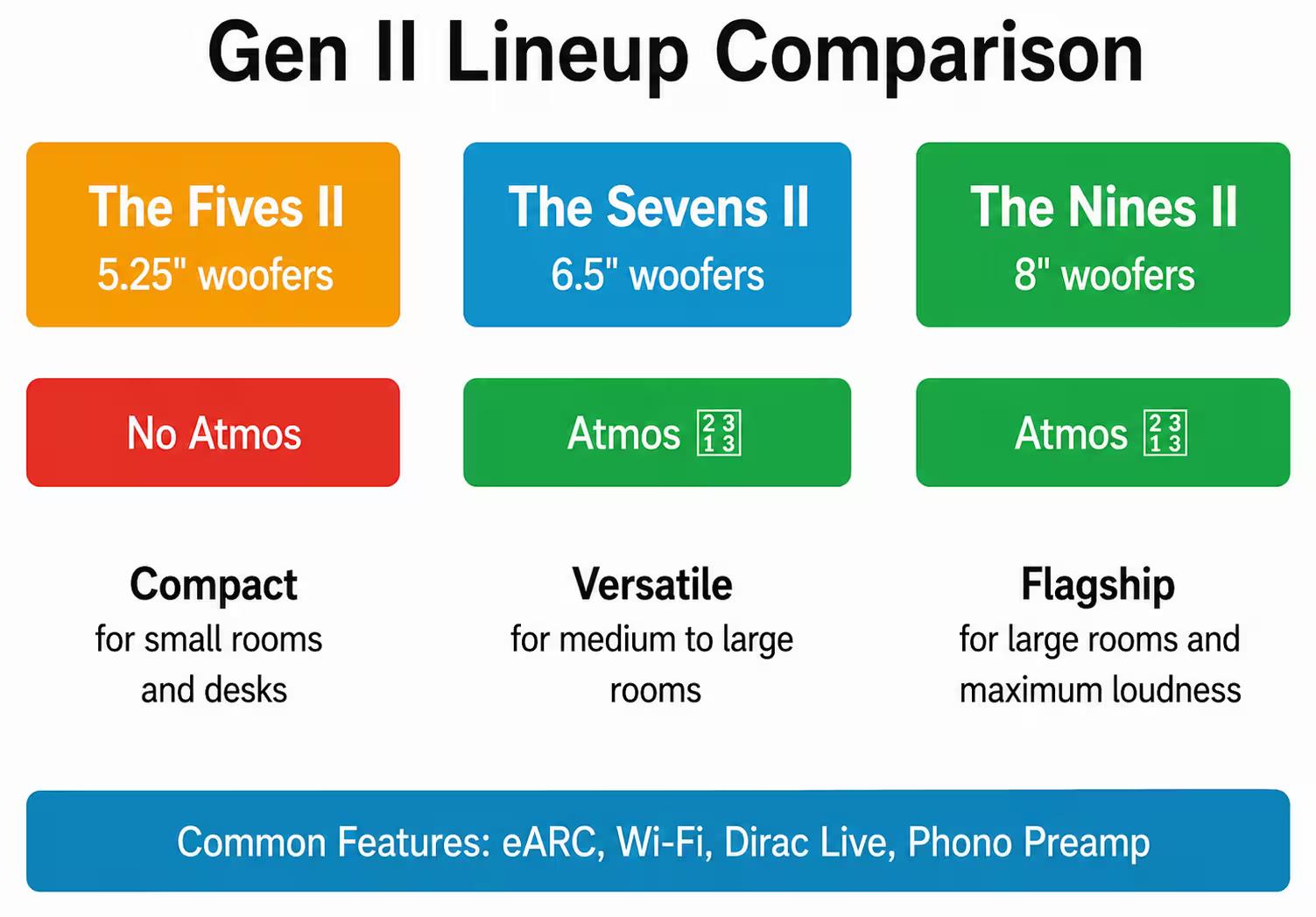
The Fives II is the most compact in the second-generation lineup. Ideal for small rooms or tabletop use.
The Sevens II is the mid-range option with 6.5-inch woofers and Dolby Atmos support. It strikes a balance between size and power.
The Nines II is the flagship with 8-inch woofers and Atmos support. It offers maximum volume, deepest bass, and the most dynamic performance.
General Features
All three second-generation models have an identical feature set: HDMI eARC, Wi-Fi, AirPlay 2, Chromecast, Dirac Live, and a built-in phono preamp. The only difference is the driver size, the presence of Atmos (the Fives II does not), and, consequently, the soundstage.
Price and Positioning
The original The Sevens launched at $1,299. The Sevens II features an updated configuration—it's best to check the current price on the official Klipsch website or with authorized retailers.
The Nines II, as the flagship model, is more expensive than the Sevens II. Exact prices may vary by region and retailer—it's best to check the current price on the official Klipsch website or with authorized retailers.
The Sevens II is sufficient for most rooms up to 25–30 sq m. The Nines II is best suited for larger rooms, high volume levels, or if you need maximum bass without a subwoofer.
Sound Quality: What Measurements and Reviews Reveal
Theoretical specifications are one thing. How do The Nines II sound in practice?
Objective Measurements
AudioScienceReview published detailed measurements of the original The Nines, taken by Erin's Audio Corner. The results were unexpectedly good for Klipsch, a brand often criticized for its bright, sometimes harsh, highs.
The frequency response of The Nines showed a fairly linear frequency response with a slight peak in the 10-12 kHz region. Some users noted that this peak can create a feeling of excess energy in the upper range.
However, this is easily corrected with an equalizer—or Dirac Live in the second generation.
One forum user shared their in-room measurements of the original The Nines using REW. Without equalization or a subwoofer, the frequency response was fairly flat with slight dips at 120 and 180 Hz—typical room resonances. After adding a subwoofer and minimal equalization, the results were very good.
The Nines II with built-in Dirac Live should perform even better, as room correction eliminates most of the issues visible in the measurements.
Subjective Impressions
According to Audio Advice, all three second-generation models offer dynamic and powerful sound.
The Nines II are characterized by deep, powerful bass and a wide soundstage. Horn-loaded tweeters provide detail and air in the highs without the harshness that was typical of some older Klipsch models.
Dolby Atmos adds a vertical dimension to movie playback. The effect isn't as impressive as in a discrete 5.1.2 system, but for a stereo pair, the results exceed expectations.
The Nines II proves versatile in music. Jazz, classical, rock, electronica—the speakers handle all genres. They are especially good with dynamic content: concert recordings, soundtracks, modern pop and electronic music sound large-scale and impressive.
Who are The Nines II for?
These aren't cheap speakers. And they're not for everyone. Who are they for?
Ideal Use Cases
For those who want high-quality sound without the complexities of a home theater. No receivers, processors, or miles of wires. A single cable from the TV—and it works.
For music lovers with a diverse collection of sources. Vinyl, CDs, streaming, Hi-Res files—The Nines II connects and plays them all without compromise.
For those with large living rooms (25+ sq m) who demand volume and scale. 8-inch woofers and powerful amplifiers provide ample headroom.
For those who value design as much as sound. The retro aesthetic of the Heritage series will fit into mid-century modern interiors, lofts, and classic living rooms.
When to choose a different model
For rooms up to 20 sq m, The Sevens II is a more balanced choice. It's smaller and cheaper, but offers the same features and Atmos.
For desktop use or even more compact spaces, The Fives II is a great choice. It lacks Atmos, but offers true versatility.
If you need a true multichannel system with discrete rear channels, consider a traditional receiver with passive speakers. The Nines II provides a surround effect, but doesn't replace a full 5.1 or 7.1 surround system.
Upgrading from the original The Nines: Is it worth it?
Let's say you already have the first generation. Does upgrading to The Nines II make sense?
The answer depends on which features are most important.
Key pros
HDMI eARC – If The Nines is used with a TV, it's incredibly convenient. No fiddling with optical cables or format limitations.
Dolby Atmos – for those who watch a lot of movies from streaming services. Netflix, Apple TV+, and Disney+ are actively using Atmos in their releases.
Dirac Live is the most significant improvement in terms of sound. Room correction really works and significantly improves sound quality.
Built-in streaming – no need for external streamers or Bluetooth tethering. Direct access to services via Wi-Fi.
Cons
If the original The Nines are used primarily with analog sources (vinyl, CD), most of the new features will be unneeded.
If the room is acoustically perfect or already has external correction (for example, via a DSP or processor), Dirac Live will provide less benefit.
Price – the difference between generations is noticeable. For some buyers, adding an external streamer to an older model may be more economical than upgrading.
The original The Nines continue to sound great. If the current functionality is sufficient, there's no need to rush to upgrade.
Competitors and Alternatives
The Nines II doesn't exist in a vacuum. There are worthy competitors in the premium active speaker market.
KEF LSX II and LS50 Wireless II
KEF offers active speakers with similar features: built-in streaming, Dirac Live, and HDMI eARC (in the LS50 Wireless II).
KEF's sound philosophy is different. The Uni-Q coaxial driver delivers very accurate imaging and localization, but can sound more "studio-like" and less emotional than the Klipsch.
The LS50 Wireless II is comparable in price to the Nines II, but with smaller woofers (5.25 inches). The bass isn't as deep—a subwoofer will almost certainly be required.
Dynaudio Xeo and Focus XD
Danish Dynaudio is known for its natural, neutral sound. The active models in the Xeo family offer wireless connectivity and built-in amplification.
But the functionality is more limited: there's no HDMI eARC, no Dolby Atmos, and no Dirac Live. This is more of a Hi-Fi solution for music than a versatile system for everything.
The price is higher than The Nines II.
Edifier S3000 Pro and others
At a more affordable level is the Edifier S3000 Pro. These active speakers offer good sound, Bluetooth, and optical audio. But they're in a completely different class: they lack eARC, Atmos, Dirac Live, and built-in streaming.
Edifier is an excellent budget option, but it doesn't compete with The Nines II in terms of functionality.
Warranty and Support
According to the official Klipsch website, active speakers are covered by a limited warranty, which may vary by model. For specific warranty terms for The Nines II, please refer to the product specifications or contact Klipsch support.
For specific warranty terms for The Nines II, please refer to the product specifications or contact Klipsch support. Refurbished models are sold with a reduced warranty of 90 days from the date of purchase.
Frequently Asked Questions
Do The Nines II require an external amplifier?
No. The Nines II are active speakers with built-in amplifiers. Simply connect the signal source directly, and the system is ready to use. No additional amplifier or AV receiver is required.
Can I connect a turntable?
Yes. The Nines II is equipped with a built-in phono preamp for MM (Moving Magnet) cartridges. The turntable is connected via the RCA inputs, with a Phono mode switch on the rear panel. Moving Coil (MC) cartridges require an external phono preamp.
Does Dolby Atmos work with all sources?
Dolby Atmos works when connected via HDMI eARC from a TV or other device capable of transmitting a multichannel Atmos audio signal. When playing music via Bluetooth, AirPlay, or regular stereo streaming, Atmos is not used—the speakers operate in standard two-channel mode.
Can The Nines II be used with a subwoofer?
Yes. The rear panel has an RCA output for connecting a powered subwoofer. The cutoff frequency can be adjusted via the app or system menu to send the lowest frequencies to the subwoofer and reduce the load on the speaker drivers.
What is the appropriate distance between the speakers and the wall?
It is recommended to leave at least 30–50 cm from the rear wall for proper bass reflex operation and more accurate bass. Positioning too close can result in excessive bass boost and boom. Dirac Live helps correct for the effects of room and speaker placement.
What is the difference between the basic and full versions of Dirac Live?
The basic version of Dirac Live, included in the package, corrects the range down to 500 Hz—the bass and lower midrange region where room influence is most noticeable. The full version works with the entire frequency range, including midrange and high frequencies. For most users, the basic version is sufficient.
Do The Nines II support MQA playback?
No, not via built-in wireless sources. MQA is not directly decoded via Wi-Fi, Bluetooth, or AirPlay. However, playback is possible using an external MQA-enabled DAC and connecting via the analog inputs. For Tidal, Tidal Connect and Hi-Res FLAC streaming are recommended.
Conclusion: A flagship that lives up to its name
The Klipsch The Nines II is a mature, well-designed system for those who want high-quality sound without compromising on convenience.
The second generation has addressed all the weaknesses of the original. HDMI eARC is now available for TV integration. Dolby Atmos has been added for surround sound in movies. Wi-Fi and full streaming are built-in. And most importantly, Dirac Live adapts the sound to any room.
The Nines II sound is large-scale, dynamic, and detailed. This is the signature Klipsch sound – recognizable, emotional, but without the harshness of older models. Horn tweeters provide air and soundstage. 8-inch woofers deliver powerful, deep bass.
Yes, it's not cheap. And for rooms smaller than 25 square meters, The Sevens II may be sufficient. But if you need maximum functionality, volume, and scale, The Nines II delivers. These active speakers can truly replace the traditional receiver and passive speaker setup. What's more, they're easier, faster, and offer more modern features.
Recommendation: If your budget allows and you need a versatile system for music, movies, and gaming, The Nines II are worth considering. Visit our showroom, listen to them live, and appreciate the sheer scale of the sound. Afterward, the decision will be clear.
Want to learn more about the world of Hi-Fi and home audio? Follow our reviews and comparisons—we talk about technology that truly changes sound quality.