

Klipsch The Sevens II review 2026: Dolby Atmos and Dirac Live
May 11, 2026
Briefly summarized: Klipsch The Sevens II are second-generation active speakers with Dolby Atmos, Dirac Live, and 106 dB of power. The new model features HDMI 2.1, improved acoustics with 6.5-inch Cerametallic drivers, and premium sound correction. It's a perfect choice for those looking for a complete Hi-Fi solution without a receiver.
At CES 2026, Klipsch unveiled an updated generation of its active speakers—The Fives II, The Sevens II, and The Nines II. These models continue the all-in-one design that made the originals popular since their 2022 launch. The Sevens II occupy the middle position in the lineup and feature the most noticeable improvements.
Over 80 years, Klipsch has developed a recognizable signature—horn-loaded drivers, powerful sound, and American engineering. The Sevens II embodies this expertise in a compact design that requires no external amplifier or AV receiver. We'll explore what's changed in the second generation and whether the upgrade is worth it for those who already own the original Sevens.
Line History: Why Klipsch Made Active Speakers
Klipsch launched The Fives, Sevens, and Nines line between 2020 and 2022, according to official sources. The idea was simple: to give buyers Hi-Fi sound without the need to assemble a separate system with an amplifier, DAC, and a bunch of wires.
The models received positive reviews for their combination of classic design, good detail, and easy connectivity.
But there were also drawbacks. The lack of HDMI ARC complicated TV integration. There's no built-in room correction—a serious drawback for active speakers of this level. And most importantly, there's the lack of spatial sound, which has become standard by 2024.
What's New in The Sevens II: Key Improvements
The second generation received four critical upgrades that change the product's positioning.
Dolby Atmos and HDMI 2.1
The Sevens II are the first active speakers in the Klipsch lineup to feature full Dolby Atmos. This is achieved through built-in upward-firing drivers and signal processing in partnership with Onkyo.
HDMI 2.1 with eARC lets you connect your TV with a single cable and enjoy uncompressed multichannel audio. 4K at 120Hz and VRR are supported – important for PlayStation 5 and Xbox Series X consoles.
Dirac Live and DLBC
A built-in license for Dirac Live, a room acoustic correction system, is included. DLBC (Dirac Live Bass Control) is available as a paid option and provides precise bass adjustments – critical for active speakers without a subwoofer.
Setup is done via a mobile app using your smartphone's microphone. The process takes 10-15 minutes and truly transforms the sound, as confirmed by discussions on Audio Science Review.
Improved Drivers and Power
The 6.5-inch woofer features a Jet Cerametallic composite cone—a proprietary Klipsch technology that combines the lightweight nature of aluminum with the rigidity of ceramic. This delivers deeper bass and lower distortion at high volumes.
The tweeter remains a 1-inch titanium LTS vented tweeter, but is now mounted on a 90° x 90° Tractrix horn. The horn is a proprietary Klipsch technology that ensures even high-frequency distribution and high sensitivity.
The system's maximum volume is 106 dB at 1 meter (in stereo pairs). This is louder than The Fives II (103 dB) and is sufficient for a 38 m² room, according to user reviews on Audio Science Review.
Amplifier by Onkyo
Klipsch partnered with Onkyo to develop the integrated amplifier. This partnership brings together hundreds of years of combined audio expertise. The amplifier class isn't officially disclosed, but judging by the low noise floor (noted in the comments), it uses a Class D design with high-quality filtering.

Klipsch The Sevens II and audio systems at JustBuy
JustBuy is a convenient place to quickly find speakers without the hassle of searching. The catalog features current models, including the Klipsch The Sevens II and other solutions for music, movies, and gaming.
Here you can compare specifications, check availability, and immediately choose the right option.
Looking for where to buy speakers?
At JustBuy, you can:
Select current audio systems
Compare specifications and features
Check availability and price
Place an order or get a consultation
👉 Contact JustBuy to find the Klipsch The Sevens II or the right speakers for your needs.
The Sevens II Specifications
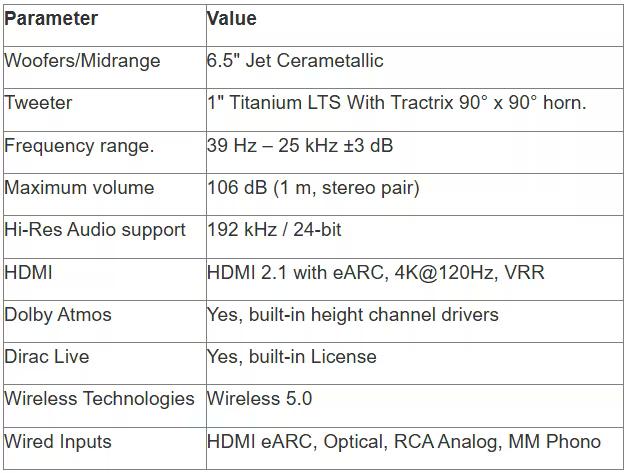
A frequency range of 39 Hz – 25 kHz ±3 dB means the speakers reproduce lower frequencies deeper than The Fives II (50 Hz – 25 kHz). This is noticeable in bass lines and movie soundtracks.
Support for 192 kHz/24-bit audio enables Hi-Res audio playback through all digital inputs. This satisfies the most demanding streaming service formats and studio recordings.
The Sevens II Sound: What's Changed
The original The Sevens received positive measurements from Audio Science Review (2023-09-04). The horn-loaded design delivers the signature Klipsch sound – detailed highs, energetic delivery, and high sensitivity.
However, testing revealed uneven frequency response in the midrange and sensitivity to room placement. These are precisely the issues Dirac Live is designed to address.
Tactile Pleasure and Detail
Reviews on Stereo.ru note the speakers' "tactile pleasure"—the ability to convey the physical presence of instruments. This is a result of the horn drivers' high sensitivity and fast attack.
High-frequency detail is excellent—the titanium tweeter performs without harshness or fatigue. This is confirmed by the experience of a user on Audio Science Review, who filled a 38 m² room with -2 dB on the speakers and 4% on the source.
Low frequencies: only a couple of inches, but the difference
a 6.5-inch driver versus a 5.25-inch one in The Fives II—it seems small. But this results in a ~10 Hz boost down low (39 Hz versus 50 Hz) and noticeably more punch at medium volumes.
This is sufficient for music. Not so for movies with deep bass effects. Klipsch honestly states in its specifications that it is possible to connect an active subwoofer via a separate output.
Dolby Atmos: How It Works in Stereo Speakers
Dolby Atmos in a two-channel system isn't full-fledged home theater surround sound, but rather a virtualization of height channels. Built-in drivers direct sound toward the ceiling, and the reflection creates the illusion of sound coming from above.
Effectiveness depends on the height and material of the ceiling. A low ceiling (up to 2.7 m) and a hard surface are ideal. A high ceiling with acoustic panels has minimal effect.
However, the presence of Atmos expands the speakers' applications. They're no longer just for music, but also a full-fledged front-facing speaker for a TV or projector.
Connection and Setup: Life Made Easier
The Sevens II retains the plug-and-play philosophy, but is more flexible.
Inputs and Connections
HDMI eARC – the main TV input, supports uncompressed Dolby Atmos
Optical Input (Toslink) – for older TVs and sources
Analog RCA – for any source with a line-level output
MM Phono – direct connection of a turntable without an external preamp
USB Type-B – for directly connecting a computer as a DAC
Bluetooth 5.0 – for smartphones and tablets
Wi-Fi – for streaming services via the Klipsch Connect app
The right speaker is active, the left is connected via a non-detachable cable. All inputs are on the rear panel of the active speaker, and can be switched via the remote or app.
Dirac Live Setup
The calibration process is done through the Klipsch Connect app:
Download the app and create an account
Connect the speakers to Wi-Fi
Launch the Dirac Live setup wizard
Place your smartphone with the microphone at the listening positions (usually 3-5 positions)
Automatic analysis and creation of a correction profile
Applying the profile (you can save several for different scenarios)
Users on Audio Science Review confirm that calibration truly evens out the frequency response and improves balance. This is especially noticeable in rooms with problematic acoustics.
Comparison: The Fives II vs. Sevens II vs. Nines II
Klipsch released three models simultaneously. Let's explore the differences and which is best for each.
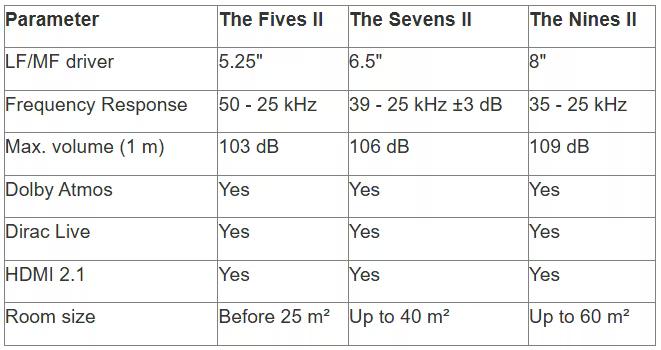
The Fives II is a compact option for smaller rooms, bedrooms, and offices. The bass is more modest, but sufficient for nearfield and music.
The Sevens II is the golden mean. It offers the best balance of size, sound, and price. Suitable for most living rooms and as the front speaker of a mid-sized home theater.
The Nines II is the flagship with 8-inch drivers. It delivers maximum volume and the deepest bass in the line. It's the perfect choice for larger rooms or those who want to do without a subwoofer.
Who is The Sevens II for: usage scenarios
Active speakers of this level perform several tasks simultaneously. Here are some real-world scenarios.
Soundbar Replacement
Soundbars are convenient, but don't expect Hi-Fi sound from them. The Sevens II deliver a true stereo image, detail, and dynamics that soundbars simply don't have.
HDMI eARC makes connection just as simple—a single cable from the TV. Dolby Atmos provides spaciousness, though not comparable to a full-fledged 5.1.4 system.
Recording Studio and Production
The official Klipsch website positions The Sevens II as suitable for studio work. Dirac Live ensures precise monitoring, and the built-in amplifier provides ample headroom.
However, critical mastering requires studio monitors with a linear frequency response. The Sevens II retain the signature Klipsch feel – elevated highs and a punchy presentation.
All-in-One Hi-Fi System
Connect a turntable via the phono input, stream via Wi-Fi, or connect to a computer via USB – and you're all set. No receiver, no separate DAC, no clutter of boxes and wires.
For many, this is the ideal option. The sound quality is superior to budget component systems, and the ease of use is comparable to a wireless speaker.
Disadvantages and Limitations
No system is perfect. The Sevens II also has its compromises.
Second-Generation Price
Discussions on Audio Science Review in January 2026 confirm that prices for the new generation are higher. The new generation is noticeably more expensive than its predecessors.
For this price, buyers get Dolby Atmos, Dirac Live, HDMI 2.1, and improved drivers. However, for those who don't need Atmos or room correction, the first generation may be a better value.
Bass Depth
39 Hz is good for speakers of this size, but not enough for movie explosions and organ music. Really noticeable bass begins at 30 Hz and below.
Klipsch has included a subwoofer output, but this adds expense and complexity to the system. For those who need maximum bass without a subwoofer, consider The Nines II or floorstanding speakers.
Atmos as a Compromise
Height channel virtualization is not a replacement for physical ceiling speakers. It has an effect, but it's not comparable to a discrete 5.1.4 system. If home theater is a priority, it's better to consider an AV receiver and a full speaker setup. The Sevens II are a good compact solution, but not a cinema reference.
Where to buy and price in 2026
As of the end of April 2026, The Sevens II are available from authorized dealers. SkyFi Audio lists the price at $1,999.99 with shipping within the continental US.
The price has increased significantly compared to the original Sevens, but the added features should be taken into account: a Dirac Live license starts at $99, HDMI 2.1 requires expensive components, and Dolby Atmos requires separate drivers and processing.
The market will offer first-generation refurbished speakers at reduced prices – the official Klipsch website already sells certified refurbished The Sevens with a full warranty. For those who don't need Atmos, this is a reasonable savings.
Current prices and availability are recommended to be checked on the official Klipsch website or at authorized dealers.
Alternatives: What Else to Consider
The Sevens II aren't the only premium active speakers. Here are some worthy competitors.
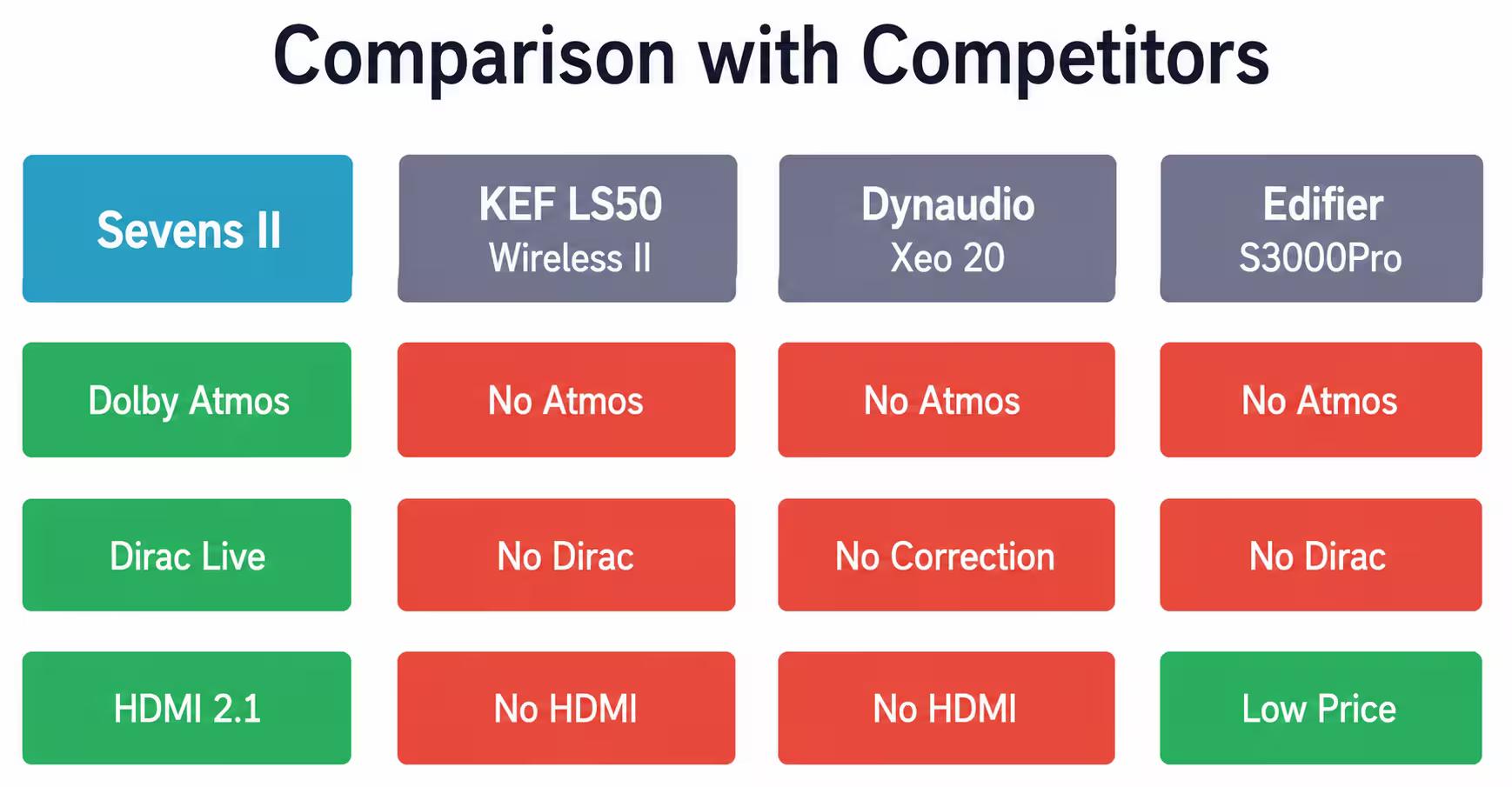
KEF LS50 Wireless II – a British classic with Uni-Q concentric drivers. It has a more linear frequency response, but lacks Dolby Atmos and fewer inputs.
Dynaudio Xeo 20 – Danish quality, lossless wireless audio. However, it lacks HDMI and built-in room correction.
Audioengine HD6 – an American brand, lower priced. A simple system without Atmos or Dirac, but with good sound for music.
Edifier S3000Pro – a Chinese manufacturer, active speakers with planar tweeters. They offer interesting sound and a low price, but build quality and reliability are questionable.
Each alternative has its advantages. The Sevens II wins with their versatility – a combination of music, movies, simplicity, and the signature Klipsch sound.
Frequently Asked Questions
What are the main differences between The Sevens II and the original The Sevens?
The main improvements are the addition of Dolby Atmos, built-in Dirac Live correction, HDMI 2.1 with eARC, and improved drivers. The original The Sevens did not have any of these features. The amplifier was also developed in collaboration with Onkyo, providing cleaner sound and better bass control.
Do The Sevens II need a subwoofer?
For music, in most cases, no. The frequency range of 39 Hz – 25 kHz ±3 dB provides deep, rich bass. For a home theater with full-bodied low-frequency effects, a subwoofer will enhance the experience. The Sevens II have a separate output for connecting a powered subwoofer.
Does Dolby Atmos work in stereo speakers?
Yes, but it's virtualization, not discrete height channels. The Sevens II use built-in upward-firing drivers that reflect sound off the ceiling. The effect depends on the height and material of the ceiling—a low, hard ceiling produces the best results. It's not a replacement for a full 5.1.4 system, but it does provide a noticeable wider soundstage than a standard stereo system.
Can The Sevens II be used as computer speakers?
Yes. The USB Type-B input allows you to connect a computer directly, and The Sevens II functions as an external DAC. Support for 192 kHz/24-bit ensures Hi-Res quality. Dirac Live corrects the sound for your room acoustics. However, their size and price make them more of a solution for producers, audiophiles, and premium workstations.
How to set up Dirac Live—is it complicated?
The process is fully automated and takes about 10-15 minutes. Download the Klipsch Connect app, connect the speakers to Wi-Fi, run the calibration wizard, and place your smartphone at several listening positions. The app will automatically perform measurements and create a sound correction profile.
What's the difference between The Fives II, Sevens II, and Nines II?
The main differences are driver size, bass level, and maximum volume. The Fives II with 5.25" drivers are suitable for rooms up to 25 m², while The Sevens II with 6.5" drivers is suitable for rooms up to 25 m². — up to 40 m², and The Nines II with 8" — up to 60 m². All models support Dolby Atmos, Dirac Live, and HDMI 2.1 with eARC. The choice depends on the room size and low-frequency requirements.
Are The Sevens II compatible with a turntable?
Yes. The speakers have a built-in MM (Moving Magnet) phono preamplifier, so a turntable can be connected directly to the phono input without additional equipment. MC (Moving Coil) cartridges require an external MC preamplifier or a step-up transformer.
Final Review: Are The Sevens II Worth the Price?
The Klipsch The Sevens II is an evolution, not a revolution. The company took the successful formula of the original Sevens and added precisely the features that were missing – Dolby Atmos, HDMI 2.1, room correction.
The result is a versatile system that works equally well for music, movies, and even studio work. The sound remains signature Klipsch – dynamic, detailed, with a distinctive horn-loaded delivery. Dirac Live solves the main problem of compact active speakers – their dependence on room acoustics.
The price has increased significantly, but the feature package justifies it for the target audience. This is not a budget solution, but a well-thought-out tool for those who want high-quality sound without assembling a component system.
Who is The Sevens II ideal for? Audiophiles who value simplicity. Movie lovers who want a compact front speaker with Atmos. Producers who need monitors with room correction. Vinyl owners who want a modern system with a classic sound.
Who isn't it for? Those looking for the most linear studio sound possible – The Sevens II has character. Those who need deep bass without a subwoofer should check out The Nines II. For those on a budget, the original The Sevens or cheaper alternatives are a good choice.