

NIKKOR Z 24-105mm f/4-7.1: A New Standard Among Lenses
May 7, 2026
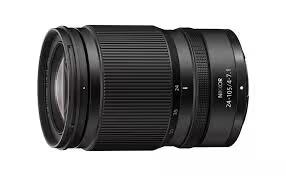
Brief summary: The NIKKOR Z 24-105mm f/4-7.1 is an affordable standard zoom lens for Nikon full-frame Z-mount cameras, introduced in January 2026. Weighing just 350 grams, it covers a wide-angle to medium-telephoto range (24-105mm) with a minimum focusing distance of 0.2 meters, making it an ideal kit lens for travel and everyday photography.
In January 2026, Nikon expanded its Z-mount lens lineup with a new lens aimed at the mainstream market. The NIKKOR Z 24-105mm f/4-7.1 is a logical complement to the affordable full-frame Nikon Z5 II camera and is designed to compete with other budget-friendly all-round zoom lenses. According to Nikon Corporation's official press release, the new lens allows photographers to "make the most of the wide focal length range of 24-105mm—from wide-angle to medium telephoto," opening up possibilities for capturing a variety of scenes, from expansive landscapes to distant subjects, tabletop photography, and portraits.
But the main question for Ukrainian photographers is: is this lens worth the money? Let's find out.
Key Features of the NIKKOR Z 24-105mm f/4-7.1
According to Nikon's official website, the new zoom lens boasts a number of technical features that make it an attractive option for beginners and enthusiasts.
Focal Length Range and Aperture
The lens covers a versatile 24-105mm focal length range (a zoom ratio of approximately 4.4x). This allows for shooting everything from architecture and group portraits at wide angles, to closer shots of people or objects at medium telephoto. The variable f/4-7.1 aperture is a compromise typical of budget zoom lenses. At the wide end, the maximum aperture is f/4, which narrows to f/7.1 at the telephoto end.
This means that shooting in low light will require either increasing the ISO or using slower shutter speeds. For dynamic indoor scenes or evening photography, this lens may not be the best choice.
Weight and Size: Portability Above All
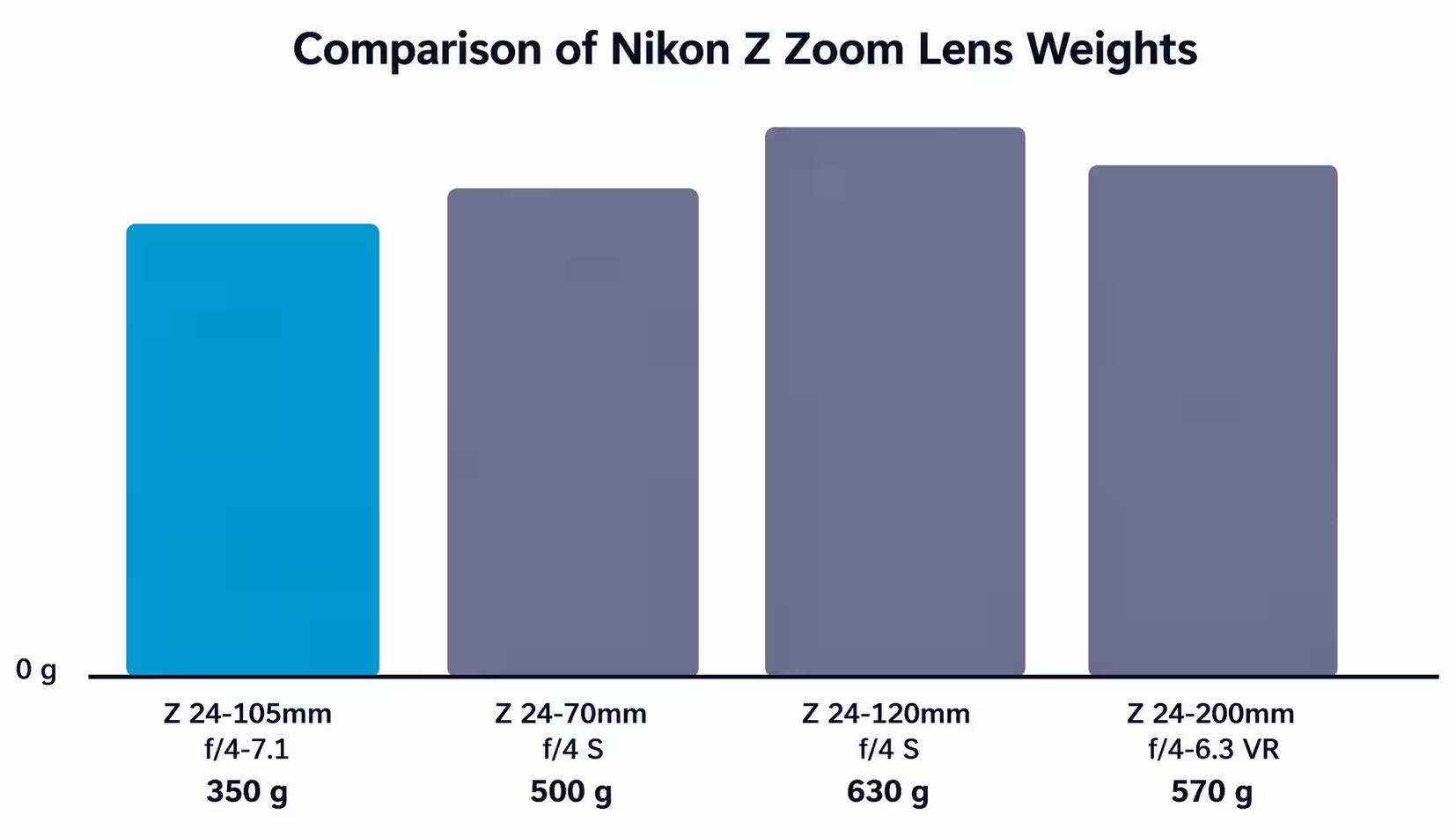
This is where the NIKKOR Z 24-105mm f/4-7.1 truly impresses. According to the official specifications, the lens weighs just 350 grams. By comparison, the more serious NIKKOR Z 24-120mm f/4 S weighs 630 grams—almost twice as much.
This lightweight design makes the new zoom ideal for long walks, travel, and situations where every gram counts. The official press release emphasizes that "its lightweight portability makes it ideal for extended shoots and travel."
Minimum Focusing Distance
One of the lens's strengths is its close focusing. According to Nikon's official press release, the minimum focusing distance is 0.2 m at the wide end and 0.28 m at the telephoto end.
This allows for close-up shots of objects, creating stunning, detailed images of flowers, food, and small objects. While not a true macro lens, its close-up capabilities significantly expand creative horizons.
Optical Design and Image Quality
Nikon's official press release doesn't fully reveal the lens's optical design. Unlike Nikon's S-series (professional lenses), the new lens isn't part of that premium category.
Standard Lenses Without S-Status
The NIKKOR Z 24-105mm f/4-7.1 isn't part of Nikon's prestigious S-series, meaning it lacks special coatings like Nano Crystal Coat or ARNEO Coat, which are used on more expensive models to combat flare and ghosting.
By comparison, the professional NIKKOR Z 24-120mm f/4 S features a 16-element design in 13 groups, including three ED glass elements, one aspherical ED element, three aspherical lens elements, and special coatings. All this sophisticated optics ensures high sharpness across the frame and minimizes chromatic aberrations. The new 24-105mm likely uses a simpler design, which may impact edge sharpness, contrast, and bokeh. However, for most amateur applications, image quality should be more than sufficient.
Chromatic Aberrations and Vignetting
Budget zoom lenses with variable apertures often exhibit noticeable chromatic aberrations (color fringing at high-contrast edges) and vignetting (darkening of the corners of the frame), especially at wide-open apertures.
Modern Nikon Z cameras feature powerful image processors that can correct some optical imperfections in software. When shooting in JPEG format, the camera will likely automatically correct distortion, vignetting, and chromatic aberrations.
When shooting in RAW, photographers will need to apply manual corrections in programs such as Adobe Lightroom or Capture One. Fortunately, lens profiles for modern models are available in programs fairly quickly.
Autofocus System
Nikon hasn't disclosed the type of autofocus motor used in the NIKKOR Z 24-105mm f/4-7.1, but we can expect a stepping motor (STM), as found in most modern Z lenses.
Stepping motors ensure fast, quiet, and smooth focusing, which is especially important when recording video. The lens should handle autofocus well on modern Z system cameras thanks to their hybrid phase-detection system.
Video and Focus Breathing
Focus breathing—the change in angle of view when refocusing—is an important parameter for videographers. Professional Nikon S lenses often have minimal focus breathing due to their special optical design.
Budget lenses typically exhibit more noticeable focus breathing, which can be critical for professional videography, but is perfectly acceptable for amateur videos and vlogs.
Who is this lens designed for?
The NIKKOR Z 24-105mm f/4-7.1 is clearly positioned as an affordable, versatile lens for beginner photographers and enthusiasts, especially when paired with budget full-frame cameras like the Nikon Z5 II.
An ideal kit lens for travel
Its light weight and versatile focal length range make this lens an excellent choice for travel. You can stroll around the city all day without getting tired of a heavy backpack, yet still be able to capture both a panoramic view of the city at 24mm and architectural details at 105mm.
By comparison, carrying two prime lenses (for example, a 24mm and 85mm) or a heavy professional zoom like the 24-70mm f/2.8 would be much less comfortable.
Limitations for Professionals
However, this lens is unlikely to be suitable for professional photographers. The variable aperture of f/4-7.1 is too slow for many commercial applications. Wedding, event, and reportage photographers require fast lenses with a constant f/2.8 aperture or wider.
The lack of image stabilization (VR) can also be a drawback, although full-frame Nikon Z cameras feature in-body image stabilization (IBIS), which partially compensates for this deficiency.
Price and availability in the Ukrainian market
The NIKKOR Z 24-105mm f/4-7.1 lens in a kit with the camera costs approximately $350, and separately, approximately $550.
For the Ukrainian market, these prices should be adjusted for logistics, taxes, and exchange rates. At the time of publication (March 2026), Ukrainian photo stores were updating their catalogs; the retail price is expected to be in the range of approximately 18,000–22,000 UAH for a single lens.
Price comparison with competitors
To understand the value of this offer, it's worth comparing it with alternatives in the Nikon Z ecosystem:
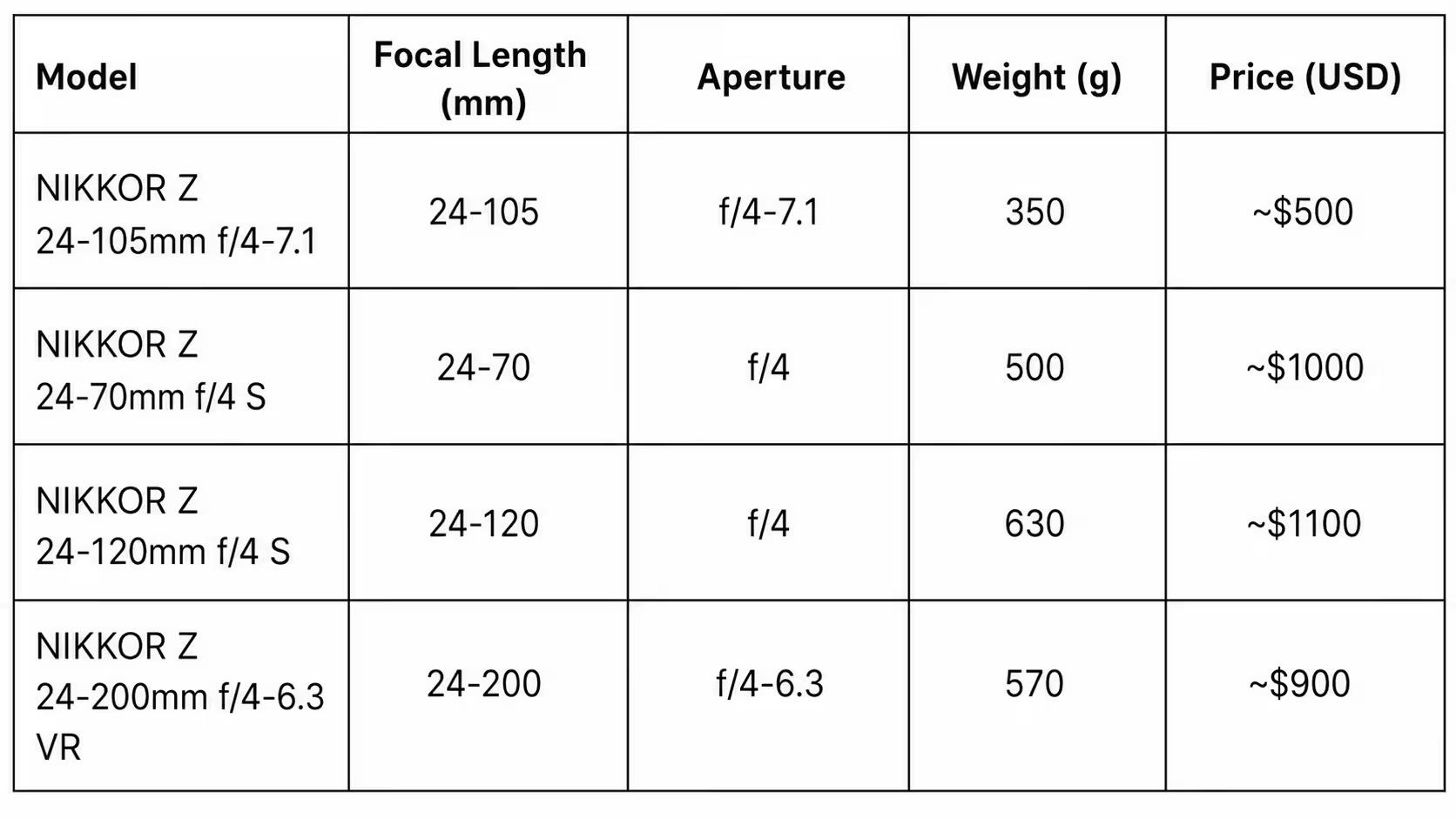
As you can see from the table, the new 24-105mm is the most affordable full-frame standard zoom in the Nikon Z series. It costs half as much as its closest S-series competitors.
The NIKKOR Z 24-200mm f/4-6.3 VR lens offers a longer zoom range and image stabilization, but is heavier and more expensive. The choice between the two will depend on your priorities: maximum portability and budget (24-105mm) or versatility and image stabilization (24-200mm).
Practical Use Cases
Let's look at specific situations where the NIKKOR Z 24-105mm f/4-7.1 will demonstrate its strengths and weaknesses.
Landscape Photography
The 24mm wide-angle is ideal for capturing expansive landscapes, architecture, and interiors. In good light (golden hour or bright daylight), the variable aperture won't be a limitation. However, landscapes typically require maximum depth of field, which means stopping down the aperture to f/8–f/11. At the telephoto end, with a native aperture of f/7.1, there's not much headroom, but this is rarely a problem in landscape photography.
The lens's light weight is a huge advantage when hiking in the mountains or taking long photo walks.
Street Photography and Reportage
The versatile 24-105mm range allows you to quickly respond to situations without changing lenses. Shooting a wide shot of a street at 24mm and then immediately switching to a portrait of a random passerby at 105mm is exactly what a street photographer needs.
But there's a catch: the dark f/7.1 aperture at the long end can be a problem in low light. In the evening in the city, you'll either have to raise the ISO (which leads to noise) or use slower shutter speeds (which makes it difficult to photograph moving subjects).
Portrait Photography
The 105mm focal length is perfectly suitable for portraits with a natural perspective. However, the f/7.1 aperture at this end greatly limits the ability to achieve beautiful background blur (bokeh).
By comparison, a classic 85mm f/1.8 portrait lens produces several stops more background blur and allows shooting in much lower light. Therefore, for serious portrait work, it's better to consider a dedicated portrait lens.
Family Events and Travel Photography
This is precisely the niche where the NIKKOR Z 24-105mm f/4-7.1 really shines. A family holiday at the dacha, a tour of the old town, a children's game in the park—all can be captured with this versatile lens, without lugging around a heavy bag.
The close focusing of 0.2m allows you to capture details, flowers, and close-up objects. And the 350g weight is comfortable even with all-day wear.
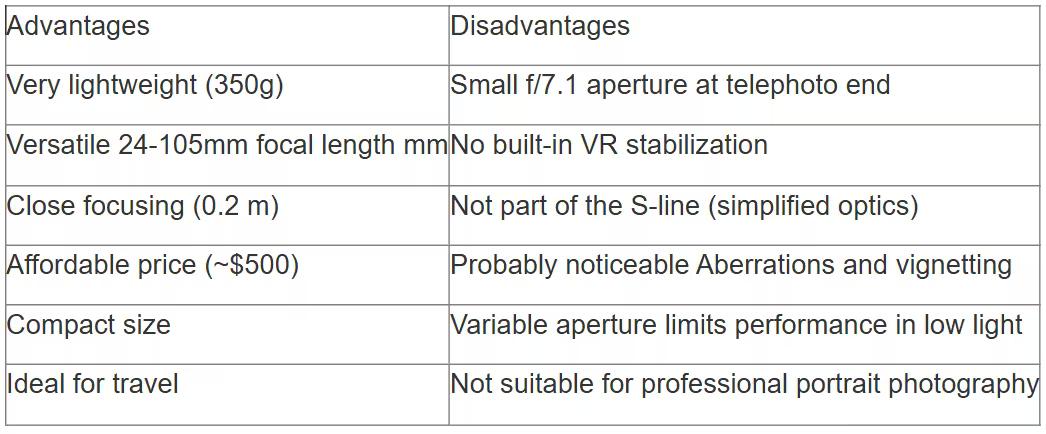
Pros and Cons of the NIKKOR Z 24-105mm f/4-7.1
Let's summarize the lens's strengths and weaknesses based on official specifications and a comparison with competitors.
Usage Recommendations
To get the most out of the NIKKOR Z 24-105mm f/4-7.1, it's important to understand its features and apply appropriate shooting techniques.
Working with High ISOs
Since the lens's aperture is limited, it's helpful to familiarize yourself with your camera's high ISO capabilities. Modern full-frame Nikon Z5, Z6 III, and Z8 cameras demonstrate excellent image quality at ISO 3200–6400, which compensates for their limited aperture.
Don't be afraid to raise the ISO in low-light conditions. A little noise in a photo is better than a blurry shot due to a slow shutter speed.
Using In-Camera Image Stabilization
Full-frame Nikon Z cameras are equipped with in-body image stabilization (IBIS), which compensates for shake when shooting handheld. This allows you to shoot handheld at longer shutter speeds than would otherwise be possible.
However, IBIS is not helpful when photographing moving subjects. Freezing motion will require a faster shutter speed or higher ISO.
Correcting Optical Imperfections in Post-Processing
When shooting in RAW, use the built-in lens correction profiles in Lightroom or Capture One. They will automatically correct distortion, vignetting, and chromatic aberrations that may be present in photos taken with a budget zoom.
It's also helpful to slightly increase sharpening in post-processing, especially for photos taken at wide apertures or at the edges of the frame.
Is the NIKKOR Z 24-105mm f/4-7.1 worth buying in Ukraine?
The answer depends on your needs, budget, and the camera you're using.
It's worth buying if:
You're a beginner photographer with a full-frame Nikon Z camera and are looking for an affordable, all-purpose lens to learn with.
Lightweight and compact for travel and hiking are important to you.
You shoot primarily in good light (landscapes, daytime street photography, travel).
Your budget is limited, and professional S-series lenses are not yet affordable.
You're looking for a versatile "one lens for everything" and are willing to accept compromises in aperture.
It's not worth buying if:
You're a professional photographer shooting weddings, events, and reportage (you need an f/2.8 aperture and a constant aperture).
You often shoot in low light or indoors without flash.
Portrait photography is your main genre (it's better to get a specialized portrait lens like the 85mm f/1.8).
You value maximum image quality and professional optics (consider the S-series).
You shoot a lot of video and are critical of your work. Focus breathing (it's better to choose a dedicated video lens)
Frequently Asked Questions (FAQ)
Is the NIKKOR Z 24-105mm f/4-7.1 weather-sealed?
The available specifications do not indicate weather-sealing. This is typical for budget lenses. For shooting in adverse weather conditions, it's better to use a protective case or choose professional S-type lenses with full weather sealing.
Can this lens be used on APS-C Nikon Z cameras?
Yes, the NIKKOR Z 24-105mm f/4-7.1 is compatible with APS-C cameras such as the Nikon Z50, Z50 II, and Z30. However, on a crop sensor, the effective focal length is 36-158mm (taking into account the 1.5x crop factor), which makes the lens less versatile—the wide angle is lost.
Does the lens have image stabilization?
There is no in-body image stabilization (VR). However, full-frame Nikon Z cameras are equipped with in-body image stabilization (IBIS), which compensates for camera shake when shooting handheld.
What is the minimum aperture of the lens?
The minimum aperture (when stopped down) is typically f/22–f/32 for most zoom lenses. The official specifications for the NIKKOR Z 24-105mm f/4-7.1 don't specify a precise aperture, but you might expect f/22 or so.
Is this lens suitable for astrophotography?
Astrophotography typically requires fast, wide-angle lenses (f/2.8 or wider) to capture starry skies at acceptable ISO and shutter speeds. The NIKKOR Z 24-105mm f/4-7.1, with an f/4 aperture at the wide end, is on the edge of what's possible, but not optimal. For serious astrophotography, the NIKKOR Z 20mm f/1.8 S or 24mm f/1.8 S are better options.
How many aperture blades does this lens have?
Official information on the number of aperture blades is not yet available. Budget lenses typically have 7 aperture blades, which produces a less rounded bokeh compared to the 9-11 blades found in professional models.
Can I use filters on this lens?
Yes, the lens has a standard screw-on filter thread. The thread diameter for screw-on filters is not specified in available sources. You can use protective UV filters, polarizing filters, or neutral density filters for creative effects.
Conclusion
The NIKKOR Z 24-105mm f/4-7.1 is a compromise lens designed for a specific audience: beginner photographers and amateurs looking for a lightweight, versatile, and affordable zoom for full-frame Nikon Z cameras.
It doesn't claim to be a professional tool. Its fast aperture, optical design, and lack of dust and moisture sealing make it unsuitable for commercial photography or harsh conditions.
But within its niche, the lens is appealing. Weighing 350 grams, its 24-105mm range, and close focusing make it an excellent companion for travel, family photo shoots, and learning the basics of photography.
In terms of price/features, the NIKKOR Z 24-105mm f/4-7.1 could become a bestseller in Ukraine, especially when paired with the affordable Nikon Z5 II camera. For those taking their first steps in full-frame photography and not ready to invest thousands of dollars in an S-type lens, this lens offers a reasonable balance of features, quality, and price.
Before purchasing, it's recommended, if possible, to test the lens in a store or rent it for a couple of days to ensure its performance meets your expectations and shooting style.
Ready to expand your optics arsenal? Compare prices for the NIKKOR Z 24-105mm f/4-7.1 at leading Ukrainian photo stores and choose the best deal with a guarantee and fast delivery. Happy shooting!