

Oukitel Power Station: Key Features and Off-Grid Power Capabilities
February 18, 2026
Portable power stations have long moved beyond being just a "backup option". Today they are a full-fledged source of autonomous energy - for an apartment, a private house, a workshop, or trips outside the city. Oukitel focuses on practicality: high-capacity LiFePO4 batteries, high output power, and stable performance under load without unnecessary visual noise and marketing promises.
Oukitel Power Stations
Oukitel power stations are designed for autonomous power supply in household and outdoor conditions. At their core is a LiFePO4 battery with an extended cycle life, designed for long-term use. The construction is engineered for stable operation under load - from everyday electronics to household appliances.
The models feature pure sine wave outlets, various types of USB ports, DC outputs, and the ability to connect solar panels. They support fast charging from the grid and alternative power sources. A UPS function with automatic switchover during power outages is also provided.
Parameter monitoring is carried out via the built-in display; in some models, control via WiFi and Bluetooth is available. For tasks requiring higher power and long autonomous operation, the lineup includes the Oukitel P2001 Plus model.
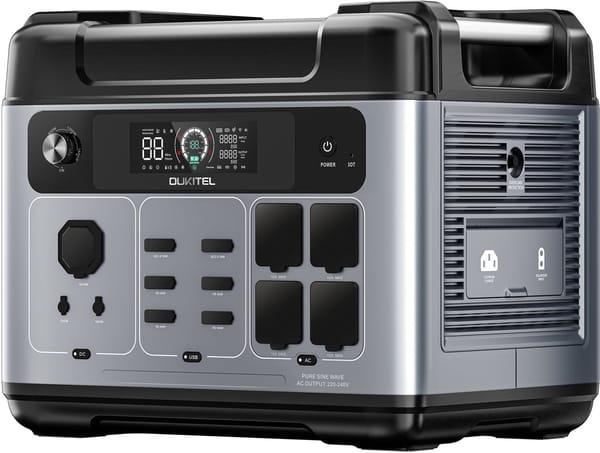
Oukitel P2001 Plus - model for home and off-grid use
Oukitel P2001 Plus is a portable power station for home, fieldwork, and situations where grid power is unavailable. It uses a LiFePO4 battery with an extended cycle life, designed for long-term operation. The model is suitable for both everyday electronics and more demanding equipment where stable power delivery is critical.
Connections are organized without unnecessary complications: there are AC outlets with pure sine wave, several USB ports of different types, DC outputs, a car socket, and an input for solar panels. The station supports fast charging from the grid and alternative power sources. It features a UPS function with automatic switchover during power outages, and current parameters are shown on the built-in display. Control via WiFi and Bluetooth is also available.
Key features:
LiFePO4 battery with extended cycle life
Support for household appliances and electronics
AC outlets with pure sine wave
USB Type-C with Power Delivery support
Fast charging from the grid
Ability to connect solar panels
UPS function with automatic switchover
Specifications:
Battery capacity: 2048 Wh
Continuous power: 2400 W
Battery type: LiFePO4
Device connections: AC 230 V, USB-A, USB-C, DC, car socket, XT60
How to choose an Oukitel power station
The choice starts not with the model, but with understanding the task. Some need a compact station for basic equipment, others need stable power for home or off-grid work. The Oukitel lineup differs in power, capacity, and port selection, so it makes more sense to start from the usage scenario rather than the device's appearance. The main parameters to consider when choosing:
1. Define the usage scenario
First, determine exactly what will be connected.
For an apartment during outages:
Lighting
Router
Laptop
TV
Refrigerator
For a private house:
Gas boiler
Pump
Several household appliances simultaneously
For fieldwork or camping:
Power tools
Photo and video equipment
Charging gadgets
If only small electronics are involved, high power is not required. For household appliances, it is important to consider both nominal and peak load.
2. Evaluate battery capacity
Capacity determines the duration of autonomous operation.
When choosing, consider:
Total consumption of connected devices
Planned operating time without recharging
Possibility of fast recharging
For short-term outages, medium capacity is sufficient. For long-term autonomy, models with a reserve are better.
3. Battery type
Most Oukitel stations use LiFePO4.
This provides:
Increased charge cycle lifespan
Stable performance under load
More predictable long-term behavior
If the station is purchased for several years, this parameter has practical importance.
4. Set of ports and connections
Before purchasing, check compatibility with your equipment.
Pay attention to:
Number of AC outlets
Presence of USB Type-C with fast charging support
DC outputs
Car socket
Solar panel connection support
If solar generation is planned, compatibility with panels is mandatory.
5. Station charging speed
Recharge time affects ease of use.
Consider:
Grid charging power
Solar panel charging support
Combined charging capability
Fast charging is relevant if the station is used regularly.
6. Presence of UPS function
For connection to home wiring, the automatic switchover function is useful.
It allows you to:
Keep computers running
Avoid router restarts
Prevent abrupt shutdown of equipment
For constant backup power, this parameter is important.
7. Size and mobility
More powerful models are usually larger and heavier.
When choosing, consider:
Installation location
Frequency of movement
Presence of carrying handles
If the station will remain stationary, dimensions are less critical. For frequent movement, compactness matters.
Conclusion
An Oukitel power station is primarily about practicality. No complicated solutions for a flashy look, no overloaded features. The main emphasis is on stable performance, straightforward connectivity, and a battery lifespan designed to last well beyond one season.
Such equipment is chosen not out of interest in specifications, but out of necessity. When it is critical that the refrigerator does not turn off, the internet keeps working, and tools start without interruption. When tasks are clear in advance - choosing the right model becomes much easier. Everything here is built around load, runtime, and charging method.
In the end, an Oukitel power station is perceived not as an extra gadget, but as part of the infrastructure of a home or workspace. And that is exactly its logic - to provide power where it might otherwise be unavailable.