

Samsung Galaxy S26, S26 Plus, and S26 Ultra: A Complete 2026 Review
May 12, 2026
Summary: The Samsung Galaxy S26, S26+, and S26 Ultra are the 2026 flagship lineup with improved processors (39% increase in NPU, 24% increase in GPU), a 200MP camera on the Ultra, Privacy Display, batteries up to 5000 mAh, and Galaxy AI. All models are powered by the Snapdragon 8 Elite Gen 5 (US) or Exynos 2600, run Android 16 with One UI 8.5, and receive seven years of updates. Prices range from $899.99 for the S26 to $1,299.99 for the S26 Ultra.
On February 25, 2026, Samsung unveiled the next generation of flagship smartphones—the Galaxy S26, S26+, and S26 Ultra. Following the success of the S25 series, expectations were high, but market reaction was mixed.
Critics call the update cosmetic, while defenders point to significant gains in AI performance and camera improvements. Let's figure out what's really changed and which model is best for 2026.
What's new in the Galaxy S26: key generational changes
The 2026 lineup consists of three models with a common design, but different sizes and capabilities. All smartphones run Android 16 with One UI 8.5 and are guaranteed seven years of updates, up to and including Android 23.
The main improvements are focused on processors and AI features. The Galaxy S26 Ultra in all regions gets the Snapdragon 8 Elite Gen 5 for Galaxy, an exclusive version with higher clock speeds. The lower-end models use the same chip in the US and China, while other regions get the new Exynos 2600.
Official Samsung data shows a 39% increase in NPU, 24% in GPU, and 19% in CPU performance compared to the Galaxy S25 Ultra. This is a significant leap for machine learning tasks, real-time video processing, and heavy gaming.
Unified Design and New Colors
All three models feature a unified visual design. Four base colors are available: Cobalt Violet, Sky Blue, Black, and White. Silver Shadow and Pink Gold are available exclusively on Samsung.com.
Case thickness: 7.2 mm (S26), 7.3 mm (S26+), and 7.9 mm (S26 Ultra). Weight: 167 g, 190 g, and 214 g, respectively. The Galaxy S26 Ultra is protected by Corning Gorilla Armor 2 and a reinforced Armor Aluminum frame.
Specification Comparison: S26 vs. S26+ vs. S26 Ultra
The differences between the models are more focused on size, cameras, and additional features. Let's take a look at the key specifications.
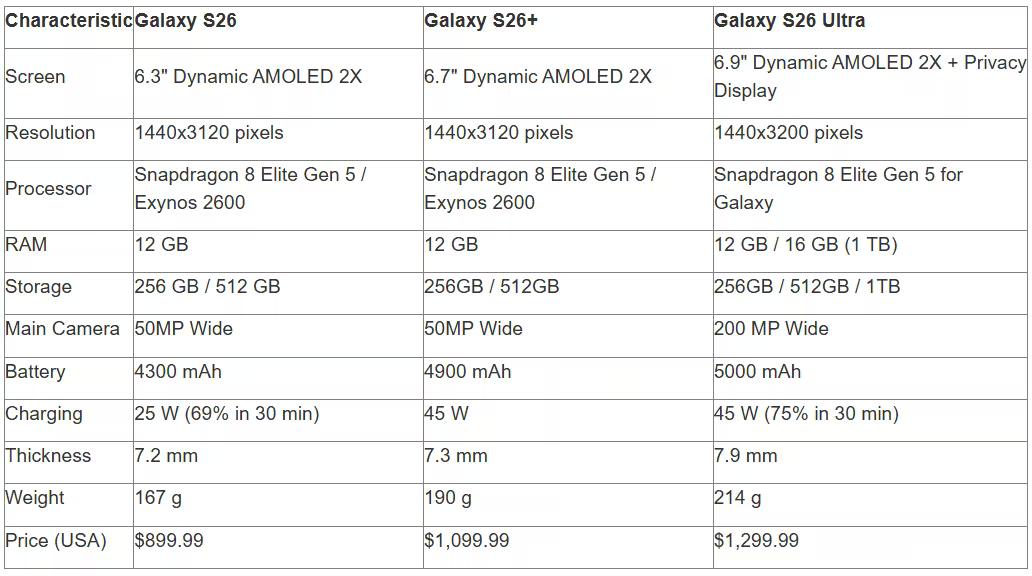
As you can see from the table, the Galaxy S26 is the most compact and affordable, the S26+ adds size and battery capacity, and the S26 Ultra gets a top-end camera, S Pen, and the exclusive Privacy Display.

Samsung Galaxy S26 and flagships at JustBuy
JustBuy is a convenient place to quickly find a smartphone without the hassle of searching. Our catalog features current models, including the Galaxy S26 series and other flagships with a focus on camera, performance, and AI features.
Here you can compare specifications, check availability, and immediately choose the right model.
Looking for where to buy a smartphone?
At JustBuy, you can:
Select current flagship models
Compare specifications and cameras
Check availability and price
Place an order or get a consultation
👉 Contact JustBuy to find the Galaxy S26, S26+, or S26 Ultra that best suits your needs.
Screens: Brightness, Refresh Rate, and Privacy Display
All displays are Dynamic AMOLED 2X with an adaptive refresh rate of 1-120Hz. Resolution: 1440x3120 (S26 and S26+) and 1440x3200 (S26 Ultra).
Maximum brightness with manual adjustment reaches 751 nits. In automatic mode, the panels produce approximately 1400-1500 nits across 75% of the screen area in bright sunlight. Peak brightness at 10% of the screen area reaches 2552 nits—enough for comfortable reading on a sunny day.
The Galaxy S26 Ultra features the unique Privacy Display feature—the world's first display on a mobile device with hardware privacy protection. Activating this feature limits viewing angles, making the screen readable only to the user.
The S26 and S26+ are protected by Corning Gorilla Glass Victus 2, while the Ultra is protected by Gorilla Armor 2 with an anti-reflective coating.
Brightness and Quality Tests
Independent measurements by GSMArena confirmed the official figures. In manual mode, it's 751 nits; in automatic mode, with a large white area, it's 1400 nits. Peak brightness in a small area (10%) is 2552 nits.
Contrast is infinite thanks to OLED technology. Color reproduction is accurate, with support for HDR10+ and Natural and Vivid modes.
Performance: Snapdragon 8 Elite Gen 5 and Exynos 2600
Here's where the main difference begins. The Galaxy S26 Ultra uses the Snapdragon 8 Elite Gen 5 for Galaxy everywhere—a custom version with overclocked cores.
The S26 and S26+ get Snapdragon in the US and China, and the Exynos 2600 in other regions. Samsung claims the Exynos 2600 is manufactured using a 2nm process and features an atypical architecture: instead of the traditional big-middle-little design, it uses a 1+3+6 configuration with one ultra-powerful Cortex-X1 Ultra core (3.80 GHz), three high-performance C1-Pro cores (3.25 GHz), and six efficient C1-Pro cores (2.75 GHz).
This provides better sustained performance under medium loads. The NPU is improved by 39%, the GPU by 24%, and the CPU by 19% compared to the Galaxy S25 Ultra.
Benchmarks and Games
The Snapdragon 8 Elite Gen 5 scores around 2.1 million points in AnTuTu. The Exynos 2600 lags behind by 10-12%, but still outperforms the previous-generation Snapdragon 8 Gen 3. In Genshin Impact and Honkai: Star Rail, both versions maintain a stable 60 FPS at high settings. Thanks to an improved cooling system with a larger Vapor Chamber and Thermal Interface Material (TIM), throttling is reduced by 29%.
The Galaxy S26 Ultra features the largest Vapor Chamber in the lineup—the cooling system operates more efficiently thanks to the larger Vapor Chamber. This is critical for long gaming sessions and 8K video editing.
Cameras: 200 MP in the Ultra and improved Nightography
The camera system is one of the main differences between the models. The Galaxy S26 and S26+ have identical units:
50 MP main camera (Wide)
12 MP ultra-wide (Ultra Wide)
10 MP telephoto with 3x optical zoom (up to 30x Space Zoom)
12 MP front camera
Video recording: FHD/4K at 60 fps, 8K at 30 fps.
Galaxy S26 Ultra:
200 MP main camera (Wide) with an improved aperture - 47% more light in low-light scenes
50 MP ultra-wide (Ultra Wide)
10 MP telephoto 3x
50 MP periscope telephoto with 5x optical zoom (up to 100x Space Zoom)
12 MP front camera
Video recording: FHD/4K at 120 fps, 8K at 30 fps. Nightography Video support – noise reduction and detail in low-light conditions.
Camera Tests
In daylight, all three models demonstrate excellent detail, accurate color reproduction, and HDR. The difference is minimal in good light.
At night, the Galaxy S26 Ultra takes the lead. The wide 200MP sensor aperture captures 47% more light. NPU-powered noise reduction algorithms operate in real time, even when shooting 4K@60fps.
The Ultra's zoom capabilities are significantly broader: 100x Space Zoom versus 30x on the lesser models. Quality at 10x and 20x is superior to the competition thanks to the 50MP periscope module.
Battery Life and Charging
The batteries have increased compared to the S25:
Galaxy S26 — 4300 mAh (25W charging, up to 55% in 30 minutes)
Galaxy S26+ — 4900 mAh (45W charging)
Galaxy S26 Ultra — 5000 mAh (45W charging, up to 75% in 30 minutes)
Official figures indicate 31 hours of video playback for the S26+. GSMArena confirmed approximately 28-30 hours for the S26 and up to 31 hours for the S26+.
All models support wireless charging up to 25W and reverse charging for accessories.
Software optimization and processor efficiency allow these smartphones to easily last a day of active use. With moderate use, they last for one and a half to two days.
Galaxy AI: What Features Are New in the S26?
Samsung has strengthened its artificial intelligence integration. Galaxy AI now handles tasks proactively, anticipating user actions and automating routine tasks.
New Features:
Circle to Search – Search by circling an object on the screen (available on all models, requires the Google app)
Live Translate – Real-time call translation into 16 languages
AI Image Enhancer – Sharpening and smoothing visual content in apps on the fly (exclusive to the S26 Ultra thanks to a powerful NPU)
Photo Assist – Smart photo editing: object removal, lighting correction, and stylization
Note Assist – Automatic formatting and summarizing of notes
All AI functions are processed both locally (on the NPU) and in the cloud, depending on the complexity of the task. Samsung guarantees privacy: data is encrypted, and most operations are performed on the device.
S Pen and Privacy Display: Ultra Exclusives
The Galaxy S26 Ultra retains support for the S Pen, a stylus with 4096 levels of pressure sensitivity. The pen is integrated into the body and does not require charging.
The stylus provides low latency, providing a sensation as close to writing on paper as possible. Compatibility with Samsung Notes, Adobe, and Microsoft OneNote.
Privacy Display is the key innovation of 2026. Activating this mode via the Quick Settings panel limits viewing angles. The screen is only readable from a perpendicular position; the sides are black. This is useful for commuting, cafes, and meetings.
This technology operates at the hardware level and does not affect brightness or color rendering, unlike software filters.
Pricing and Availability
Official Samsung pricing in the US (March 2026):
Galaxy S26 (256GB) — $899.99
Galaxy S26+ (256GB) — starting at $1,099.99 (base price of the S26)
Galaxy S26 Ultra (256GB) — $1,299.99
The 512GB and 1TB (Ultra only) versions are $100-200 more expensive. Trade-in your old device for a discount of up to $720 (Ultra) or up to $480 (S26/S26+).
Which Galaxy S26 to choose: recommendations
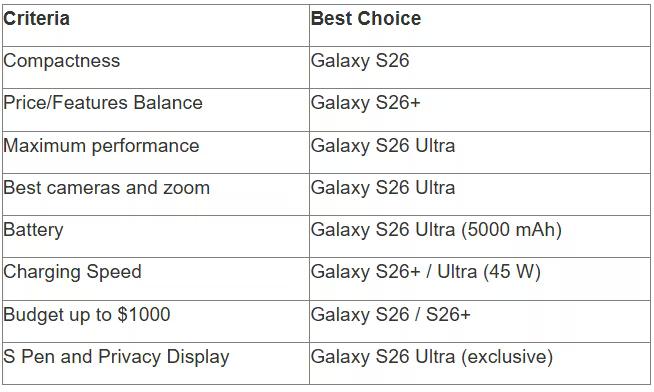
The choice depends on your priorities and budget.
The Galaxy S26 is for those who value compactness. The 6.3" screen weighs 167g and is the most comfortable to hold in one hand. The cameras are good, and the performance is top-notch. The downside is a smaller battery (4300 mAh) and slow 25W charging.
The Galaxy S26+ is the happy medium. It has a 6.7" screen, a 4900 mAh battery, and 45W charging. It has the same cameras as the S26, but lasts longer. It's ideal for most users who don't need the S Pen or extreme zoom.
The Galaxy S26 Ultra is a flagship without compromise. It features a 200 MP camera, 100x zoom, Privacy Display, S Pen, the largest cooling system, and 16 GB of RAM in the top version. However, it's heavier (214g), thicker (7.9mm), and more expensive. It's perfect for professionals, photographers, and business users.
Is it worth upgrading from the Galaxy S25?
For Galaxy S25 owners, the upgrade may seem insignificant. The design is virtually unchanged, the screens are identical, and the cameras on the S26 and S26+ are similar to those on the S25.
But there are compelling arguments:
Performance gains of 19-39% (depending on the component) – noticeable in AI tasks, games, and video editing.
Improved cooling – less throttling under sustained loads.
Galaxy AI with new features: AI Image Enhancer, improved Live Translate.
Privacy Display (Ultra only) – a unique security feature.
If you're a heavy user – gaming, editing content, and actively using AI – the upgrade is worth it. For basic use cases (calls, social media, photography), the S25 remains relevant for another year or two.
Samsung's trade-in programs make the upgrade more accessible – if you have an existing device, you can get a discount of up to $720 on the S26 Ultra.
Competitors: Galaxy S26 vs. iPhone 17 vs. Pixel 10
In 2026, the main competitors are the Apple iPhone 17 Pro and Google Pixel 10 Pro.
The iPhone 17 Pro offers the A19 Bionic, 120Hz ProMotion, 48MP cameras, and LiDAR. It also features the Apple ecosystem, iMessage, and optimized iOS. Prices start at $1,199.
Pros of the Galaxy S26 Ultra: larger screen (6.9" vs. 6.3"), 200MP camera, 100x zoom, S Pen, Android flexibility, and is $100 cheaper.
Google Pixel 10 Pro: pure Android, Tensor G6, better AI photos, Magic Eraser, and Call Screening. Price starts at $999.
Pros of the Galaxy S26: more powerful processor, more RAM (up to 16GB), S Pen (Ultra), Privacy Display, and a more developed accessory ecosystem.
The choice depends on the ecosystem. Apple users will stick with the iPhone. Android enthusiasts will choose between a pure Google experience (Pixel) and the ultimate features (Samsung).
Frequently Asked Questions (FAQ)
How is the Galaxy S26 Ultra different from the S26 and S26+?
The Galaxy S26 Ultra features a 200MP main camera, a 50MP periscope telephoto lens with 100x zoom, a built-in S Pen, Privacy Display, an expanded Vapor Chamber cooling system, and up to 16GB of RAM. The Ultra also features the Snapdragon 8 Elite Gen 5 for Galaxy in all regions and a larger 6.9-inch display.
What processor is in the Galaxy S26?
The Galaxy S26 Ultra uses the Snapdragon 8 Elite Gen 5 for Galaxy in all regions. The Galaxy S26 and S26+ feature a Snapdragon SoC in the US and China, while other regions get an Exynos 2600 processor, manufactured using a 2nm process.
How long does the Galaxy S26 battery last?
The Galaxy S26+ offers up to 31 hours of video playback, the Galaxy S26 offers approximately 28-30 hours, and the S26 Ultra offers up to 30 hours. With normal use, these smartphones easily last a full day, and with moderate use, they can last up to two days without recharging.
Do the Galaxy S26 and S26+ support the S Pen?
No. S Pen support is only available on the Galaxy S26 Ultra. The stylus is integrated into the device's body and supports 4096 levels of pressure sensitivity with minimal latency.
What is Privacy Display and which models have it?
Privacy Display is a technology that limits screen viewing angles, making the display virtually unreadable when viewed from the side. This feature is available exclusively on the Galaxy S26 Ultra.
Which camera is better: the Galaxy S26 Ultra or the iPhone 17 Pro?
The Galaxy S26 Ultra offers higher resolution and significantly better zoom, making it superior for photography and capturing distant objects. The iPhone 17 Pro traditionally excels in video recording and native image processing.
Is the Galaxy S26 worth buying in 2026 or is it better to wait for the S27?
The Galaxy S26 remains a relevant flagship with long-term update support and high performance for years to come. If you need a smartphone now, it's a great buy. Waiting for the S27 only makes sense if you don't urgently need an upgrade.
Conclusions: The Galaxy S26 is an evolution, not a revolution
The Samsung Galaxy S26, S26+, and S26 Ultra represent a logical evolution of the lineup. While there are no revolutionary changes, the improvements are noticeable.
A 19-39% performance boost, a 200MP camera with improved aperture, Privacy Display, enhanced cooling, and next-generation Galaxy AI make the S26 Ultra the best Samsung flagship for 2026.
The S26 and S26+ are reliable devices for those who don't need the extreme features of the Ultra. The difference between them is size and battery. The S26+ is preferable thanks to its 4900 mAh battery and 45W charging.
Prices have increased slightly. Trade-in programs compensate for the difference. Availability from March 11, 2026, in all regions.
If you're choosing between the three models, decide on your priorities. Compactness is the S26. The S26+ offers balance. The S26 Ultra offers maximum features.
Want to learn more about Samsung's new flagships or compare them to competitors? Explore the official specifications on Samsung's website and read independent reviews from GSMArena and other tech publications. Make your decision based on real needs, not marketing hype.