

Sigma 17mm F4, 24mm F2, 24mm F3.5 for Sony E-mount – Review 2026
May 12, 2026
Summary: The Sigma Contemporary series for Sony E-mount offers three compact wide-angle lenses: the 17mm F4 DG DN (ultra-wide), the 24mm F2 DG DN (fast), and the 24mm F3.5 DG DN (ultra-compact). All three are part of the I-series lineup, featuring metal bodies, magnetic lens caps, and minimum focusing distances, but differ in angle of view, aperture, and size.
Sigma has dramatically expanded its lens lineup for the Sony E-mount in recent years. From a complete lack of full-frame options four years ago to over 30 models today, this is a remarkable leap.
Particularly interesting is the I-series (Contemporary) series—compact, premium prime lenses with metal bodies. In this review, we'll look at three wide-angle lenses from this line: 17mm F4, 24mm F2, and 24mm F3.5.
Each one serves its own purpose. But which one should you choose? Let's find out.
General Philosophy of the I-series
All three lenses are designed with a single concept in mind: compactness, a metal body, a magnetic lens cap, and a weather-resistant mount.
Sigma has eliminated the focus hold button (found in the ART series). This has resulted in weight and size savings.
The optical design of each lens includes aspherical and low-dispersion elements. Sigma has optimized its autofocus algorithms for high-speed operation with Sony mirrorless cameras.
And yes, all three are compatible with in-body stabilization and aberration correction. However, the availability of these features varies by camera model.

Sigma Lenses for Sony E at JustBuy
JustBuy is a convenient place to quickly find lenses without the hassle of searching. Our catalog features current Sigma models for Sony E, including the 17mm F4, 24mm F2, and 24mm F3.5—compact solutions for photo and video.
Here you can compare specifications, check availability, and choose the right option right away.
Looking for where to buy a lens for Sony?
At JustBuy, you can:
Select current Sigma and other brand lenses
Compare specifications and choose a focal length
Check availability and price
Place an order or get a consultation
👉 Contact JustBuy to find the right Sigma lens for your needs.
Sigma 17mm F4 DG DN Contemporary—Ultra-Wide Minimalist
Let's start with the widest angle. 17mm has a 103.7° angle of view. Almost fisheye-like, but without the characteristic fisheye distortion.
Design and Specifications
Optical design: 9 elements in 8 groups. Includes 2 low-dispersion (SLD) and 3 aspherical elements.
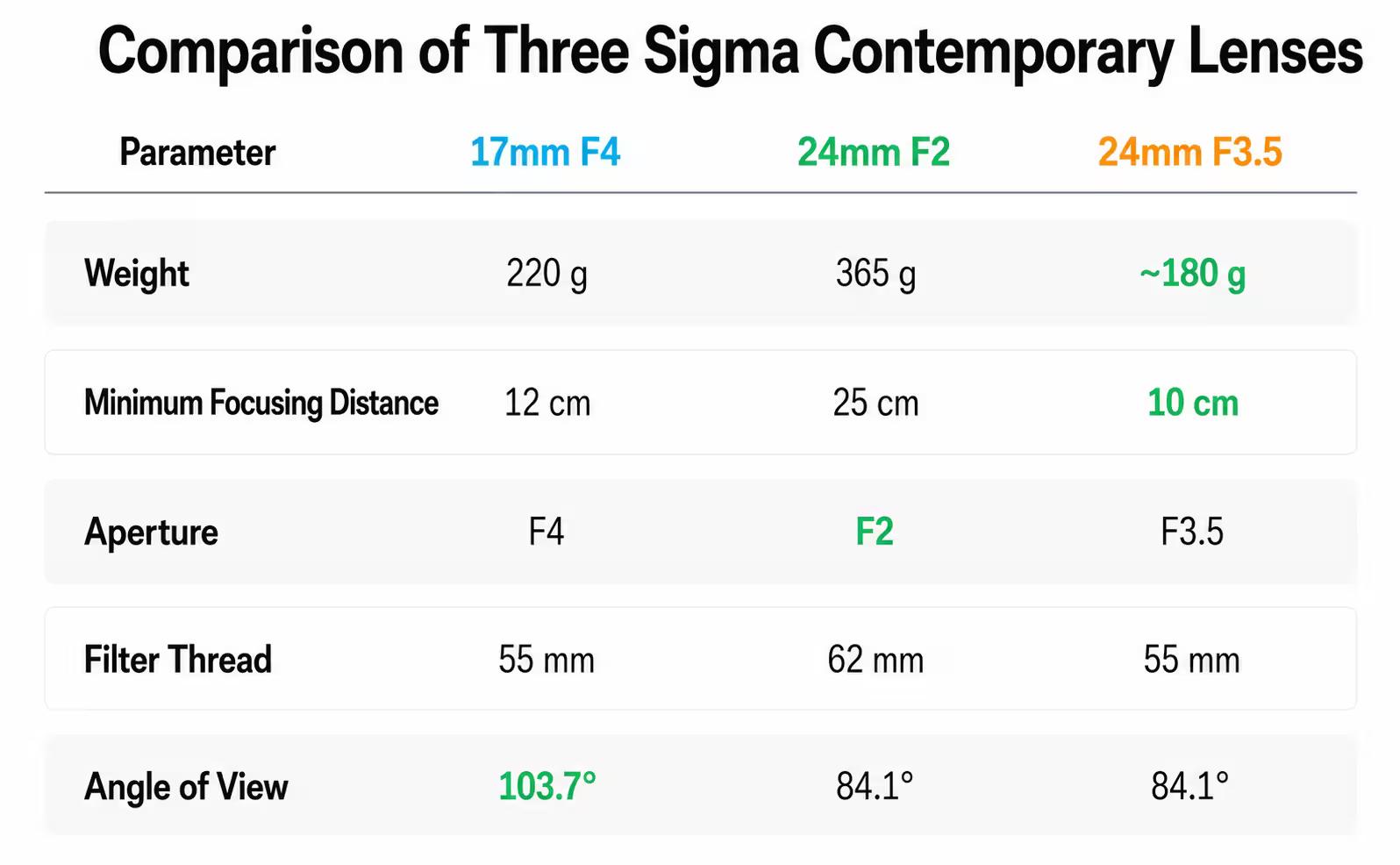
Dimensions: 64 mm in diameter, 48.8 mm in length (for Sony E-mount). Weight: only 220 grams.
Minimum focusing distance: 0.12 meters. Maximum magnification: 1:3.6. For an ultra-wide-angle lens, these are excellent macro performance.
Aperture: 7 rounded blades. Minimum aperture: F22. Filter thread: 55 mm.
Included: petal-shaped metal lens hood with magnetic bayonet mount, magnetic metal lens cap.
Optical Quality
According to independent tests, the lens exhibits 4.1% barrel distortion in RAW files. This is noticeable, but not critical for an ultra-wide-angle lens.
Sony's in-camera correction eliminates distortion almost completely. Sharpness from center to edge is high even wide open.
Chromatic aberrations are minimal thanks to low-dispersion elements. Vignetting is present at F4, but disappears when stopped down to F5.6.
Autofocus and Practical Use
Sigma has optimized the stepping motor control algorithm. Focusing is fast and quiet—suitable even for video shooting.
The minimum focusing distance of 12 cm opens up interesting creative possibilities. You can capture close-up subjects with dramatic perspective distortion.
The 220-gram weight makes pairing with compact cameras like the Sony A7C or ZV-E1 very balanced.
Sigma 24mm F2 DG DN Contemporary — a fast all-rounder
Let's move on to the 24mm F2. This focal length is considered a classic reportage wide-angle.
Design and Specifications
Optical design: 13 elements in 11 groups. More complex than the 17mm and 24mm F3.5.
Dimensions: Noticeably larger diameter due to the fast optics. Weight: 365 grams.
Minimum focusing distance: 0.245 meters (24.5 cm). Yes, longer than the other two lenses. But for an F2, this is normal.
Aperture: 9 blades (versus 7 for the others). Filter thread: 62 mm.
Angle of view: 84.1°. Narrower than the 17mm, but still wide for landscapes, interiors, and reportage.
The advantage of aperture
F2 versus F3.5 or F4 is a difference of one and a half to two exposure stops. This is critical for low-light photography.
Nightscapes, astrophotography, concert photography—anywhere where every photon of light counts.
Bokeh is softer on the F2 thanks to the 9-bladed aperture. However, at 24mm, background blur is still moderate—this isn't a portrait lens.
What you pay for
Weight: 360 grams (Sony E-mount)—that's 140 grams more than the 17mm F4 and noticeably heavier than the 24mm F3.5.
Filter thread: 62mm versus 55mm. You'll need to buy a separate filter kit if you already have 55mm filters.
Minimum focusing distance: 25cm—twice as far as the 24mm F3.5. Macro photography is practically out of the question.
But if you need fast aperture, there are no alternatives. This is the only F2 prime at 24mm in the Contemporary series.
Sigma 24mm F3.5 DG DN Contemporary – an absolute minimalist
But this is perhaps the most interesting lens of the trio.
Design and Specifications
Optical design: 10 elements in 8 groups. Simpler than the 24mm F2.
The dimensions are compact, but the exact weight for the 24mm F3.5 DG DN is listed as 225g (L-mount) or 230g (Sony E-mount).
The minimum focusing distance is 10 cm (only 10 centimeters!). The maximum magnification is 1:2. It's essentially a macro lens.
Aperture: 7 blades, F3.5–F22. Filter thread: 55 mm.
Practical Application
Sigma markets the 24mm F3.5 as a lens for street photography. And that makes sense.
Its compact size allows you to carry the camera around with you. The minimum distance of 10 cm opens up opportunities for capturing details, textures, and still lifes.
F3.5 isn't the fastest lens, but it's sufficient for daytime shooting and well-lit interiors.
However, for night photography or astrophotography, the 24mm F2.
Comparison: Which Lens to Choose
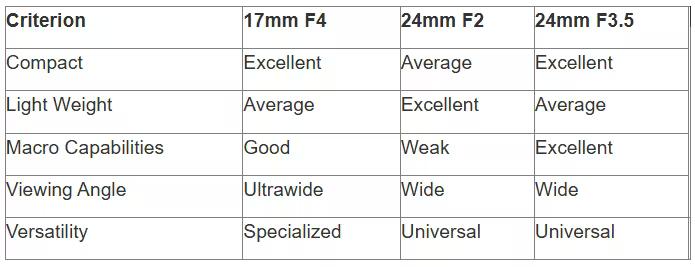
Now for the fun part. Each lens has its own niche.
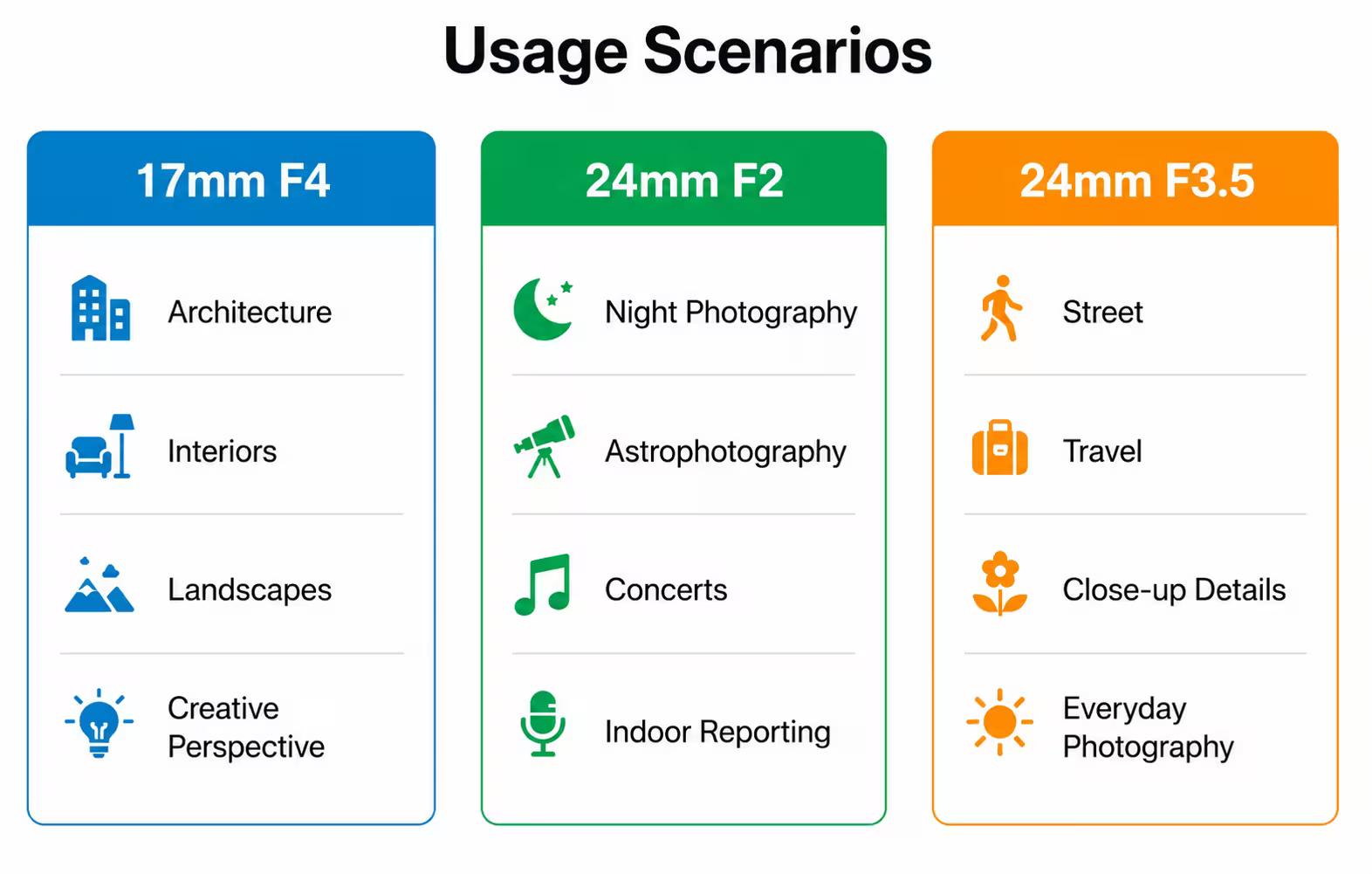
When to Choose the 17mm F4
Architectural photography. Interiors. Shooting in tight spaces.
Landscapes with dramatic foregrounds. Astrophotography (although F4 requires long shutter speeds or high ISO).
Creative experiments with perspective. The minimum distance of 12 cm allows you to capture objects with distortion that looks dramatic.
When to Choose the 24mm F2
Night photography. Concerts, indoor events.
Astrophotography – F2 collects twice as much light as F3.5 and three times as much as F4.
Low-light reportage. Night street photography.
If aperture is critical, this is the only choice of the three.
When to Choose the 24mm F3.5
Daytime street photography. Travel (minimum weight).
Macro photography of details, textures, and still lifes (1:2 magnification).
Everyday wear. The lens is so lightweight that you can keep it on your camera at all times.
Budget-conscious: the 24mm F3.5 is cheaper than the 24mm F2.
Build Quality and Ergonomics
All three lenses are built to the same standard. The all-metal body fits perfectly.
The aperture ring has clicky action (can be switched to a click-free mode for video). The focus ring has a pleasant damping.
The magnetic lens cap is a convenient feature. It attaches to the magnetic lens hood, eliminating the need to fiddle with latches.
All three lenses have weatherproofing. However, remember that this isn't completely sealed. You can shoot in the rain, but you can't submerge them in water.
Focus Mode Switch
Sigma uses an arc-shaped switch. It's compact, but some users may find it unusual.
AF (autofocus) and MF (manual focus) positions. Switching is precise, and there are no accidental releases.
Accessories and Additional Equipment
Sigma offers branded accessories for all three lenses.
Filters
For 17mm F4 and 24mm F3.5 (55mm thread):
AFB9A0 Protector - $32
AFB9B0 WR UV Filter - $63
AFB9D0 WR Protector - $57
WR CPL Filter - $97
For 24mm F2 (62mm thread):
AFD9A0 Protector - $36
AFD9B0 WR UV Filter - $69
AFD9D0 WR Protector - $62
WR CPL Filter - $110
WR (Weather Resistant) refers to the water-repellent coating on Sigma filters. Recommended for shooting in challenging conditions.
Additional Caps and Hoods
55mm Magnetic Metal Lens Cap - $16. CH-11 Lens Cap Holder - $34 (allows you to attach the cap to your camera strap).
A spare lens hood, the LH576-01 (for the 24mm F3.5), costs $39.
A regular 55mm front cap costs $7 (if the magnetic one gets lost).
Practical Shooting Scenarios
Now for a little practice. How do these lenses perform in real-world situations?
Landscape and Architecture
For wide panoramas and architecture, the 17mm F4 is the best choice. The 103.7° angle of view captures a huge space.
But you need to be careful with composition. An ultra-wide angle distorts proportions—the horizon must be perfectly centered, otherwise the buildings will "fall over."
A minimum distance of 12 cm allows you to include large foreground objects in the frame with dramatic zoom.
Street Photography
The 24mm F3.5 is the ideal street lens. Lightweight, compact, and discreet.
The 24mm focal length provides a wide context, but not the severe distortion of the 17mm. A minimum distance of 10 cm opens up opportunities for capturing details: shop windows, street art, textures.
Night photography and astrophotography
Here, the 24mm F2 is unrivaled. F2 versus F3.5 is a difference of one and a half stops. Against F4, it's two stops.
In practice, this means ISO 3200 instead of ISO 6400. Or a shutter speed of 15 seconds instead of 30 (critical for astrophotography, to prevent the stars from turning into mere streaks).
The 17mm F4 is also suitable for astrophotography thanks to its ultra-wide angle. However, you'll have to compensate for the lack of aperture with a higher ISO.
Alternatives from Sony and other manufacturers
To be fair, it's worth mentioning the competitors.
Sony FE 20mm F1.8 G
Even wider than the 17mm, and faster. But heavier and more expensive.
If your budget allows and you need maximum aperture, this is an excellent choice. However, you'll have to sacrifice compactness.
Sony FE 24mm F2.8 G
A direct competitor to the Sigma 24mm F3.5. Compact and lightweight, but F2.8 versus F3.5 makes almost no difference.
Sony's build quality is superior, but so is the price.
Tamron 20mm F2.8 and 24mm F2.8
Budget alternatives. Lighter and cheaper than the Sony, but the build quality is simpler.
Optical quality is good, but the Sigma I-series wins in terms of design and premium feel.
Pros and cons of each lens
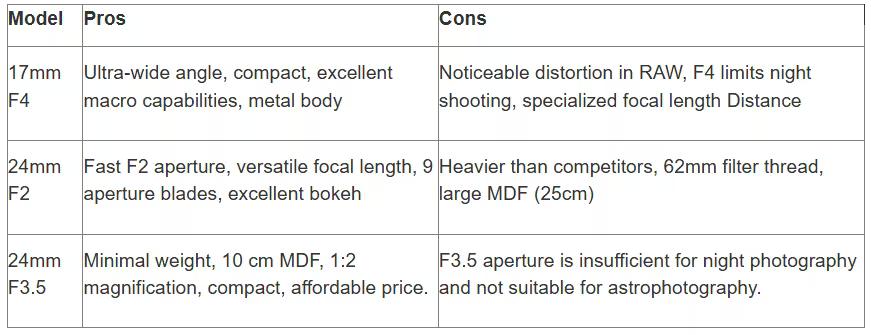
Let's summarize each lens separately.
Frequently Asked Questions (FAQ)
Which of the three lenses is best for a beginner?
It all depends on the shooting genre. For general use, the 24mm F3.5 is better – it's compact, lightweight, and more affordable. For night photography, the 24mm F2 is optimal thanks to its faster aperture. For architecture and interiors, the 17mm F4 is the best option.
Can these lenses be used on Sony APS-C cameras?
Yes. All lenses are compatible with Sony APS-C cameras, including the A6700 and ZV-E10. However, the equivalent focal length changes due to the crop factor: 17mm becomes approximately 25mm, and 24mm becomes approximately 36mm.
Do these lenses have optical stabilization?
No. There is no in-body optical stabilization, but the lenses are fully compatible with the IBIS in-body stabilization system in modern Sony cameras.
What is the difference between the DG DN versions and the new DG versions?
Updated versions of the Sigma DG typically feature improved lens coatings, refined mechanics, and minor design changes. Older versions of the DG DN have been discontinued, but remain very similar in image quality and capabilities.
Are these lenses suitable for video shooting?
Yes. The lenses feature a quiet stepping autofocus motor, minimal focus breathing, and a silent aperture ring. The 24mm F2 is particularly well suited for video due to its fast aperture.
Is it necessary to purchase a protective filter?
Yes, it is recommended. The front element of some models protrudes noticeably beyond the lens hood, especially the 17mm. Sigma's protective WR filters help prevent scratches and provide a water-repellent coating.
Can I buy just the magnetic lens cap separately?
Yes. Sigma sells magnetic lens caps in 55mm and 62mm diameters separately, as well as the CH-11 holder, which allows you to attach the cap to your camera strap.
Conclusion: Which lens to choose?
Three lenses, three different characters.
17mm F4 – for those who need an ultra-wide angle. Architecture, interiors, creative experiments.
24mm F2 – for low light. Night photography, astrophotography, concerts. Aperture is key.
24mm F3.5 – for everyday carry. Compact, lightweight, with macro capabilities. A versatile companion for street photography and travel.
And here's the kicker: you don't have to choose just one. These lenses complement each other perfectly.
A compact kit of 17mm F4 and 24mm F3.5 weighs approximately 450 grams (220g + 230g for the Sony E-mount version). It covers the range from ultra-wide to classic reportage. And it fits in a small bag.
Add a 50mm or 85mm to this, and you have a complete set of primes for all occasions.
The Sigma Contemporary I-series proves that compactness doesn't mean compromise. It features a metal body, sophisticated ergonomics, and high optical quality.
Check current prices and availability on the official Sigma website. Some models have been replaced by updated versions—check with your dealer to determine which version is available in your region.