

Sony FX3 II review: rumors, specifications, release date 2026
July 8, 2026
In short: Sony FX3 II - the successor to the legendary FX3 - has not been officially announced yet, but rumors and leaks point to major upgrades: a new BIONZ XR2 processor, longer-lasting batteries, possible 6K video support, improved low-light sensitivity thanks to a partially stacked sensor, 32-bit float audio, and upgraded cooling. The camera may be released in the second half of 2026 and set a new standard for compact Cinema Line cameras.
The world of professional filmmaking is waiting closely. Sony FX3, released in February 2021, became one of the most popular compact cinema cameras among content creators, documentarians, and independent filmmakers, and it may finally get a successor.
There has been no official announcement yet. But leaks, rumors, and Sony's update patterns give a fairly clear idea of what to expect from the FX3 Mark II. And if insiders are right - this could be a revolution in the compact Cinema Line camera segment.
Let's break down all the guaranteed upgrades, likely new features, and a few dream ideas about what could change the game forever.
Guaranteed upgrades: what the FX3 II will definitely get
There are things we can be almost 100% sure about. Sony has already shown its cards with the release of the Alpha a7R VI in May 2026. This camera became a technological showcase for what the company will introduce into its next lines - including Cinema Line.
New BIONZ XR2 processor
Sony a7R VI received the BIONZ XR2 processor. According to Sony, this chip is faster, more energy-efficient, and ready to process high-resolution data streams without overheating.
The FX3 II will almost certainly get the same processor. This opens the door to support for higher bitrates, better real-time processing, expanded AI-based object recognition and tracking features, as well as faster menu operation and preview performance.
The processor will also allow more efficient work with new codecs - including XAVC HS, which delivers higher quality with smaller file sizes thanks to HEVC/H.265.
NP-SA100 batteries: more shooting time
The NP-SA100 batteries, released with the a7R VI, replace the aging NP-FZ100, which served Sony faithfully for eight years.
The new batteries operate at 7.82 V instead of 7.2 V and, according to Sony, provide 17% longer operating time. This may not sound like a huge increase, but for videographers who spend full days on shoots without access to outlets, every extra 15-20 minutes is gold.
The higher voltage also gives more headroom for the processor, sensor, and cooling systems under load - especially when recording at high bitrates or during long sessions.
32-bit float audio
This feature also debuted in the a7R VI and became a real breakthrough for those who record sound directly in the camera.
The 32-bit float audio format records sound with such a wide dynamic range that it is practically impossible to "clip" the level - even if someone suddenly shouts or the sound unexpectedly becomes quiet, the full range will be captured correctly. This can simplify post-production in documentary and live video.
For documentarians, reporters, and solo operators, this is a huge advantage. And if Sony integrates it into the FX3 II together with the XLR module - it will become one of the camera's strongest sides.
Likely new features: what may appear in the FX3 Mark II
Now we move into an area where there are no guarantees, but the chances are very high. Rumors, Sony's development patterns, and competitor analysis give reasons to expect several major features.
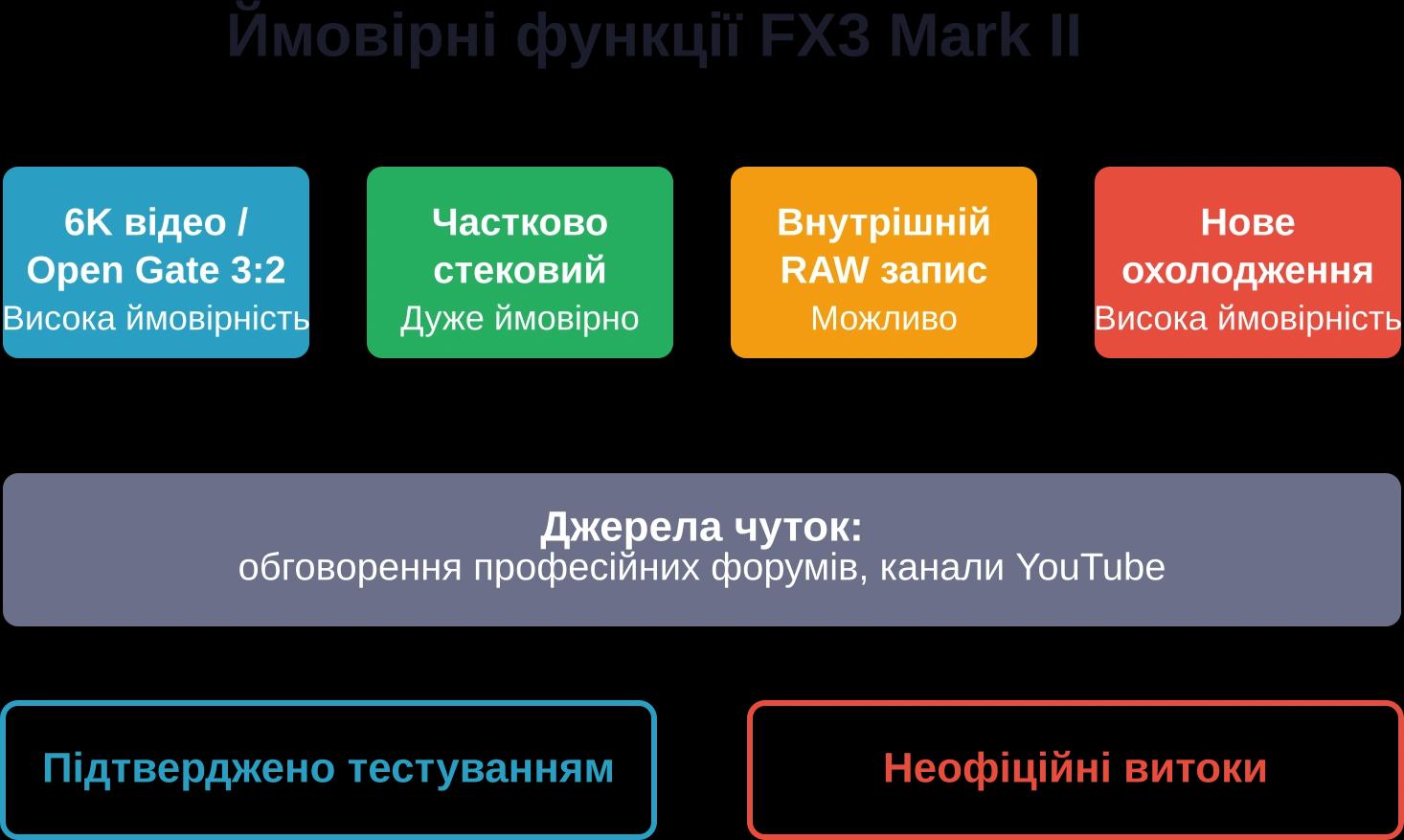
6K video or Open Gate 3:2 recording
Sony has already demonstrated 8K capabilities in the a7R VI. The FX3 II will most likely not go the 8K route - that would undermine the positions of the FX6 and FX9 in the lineup. But 6K video or Open Gate recording in a 3:2 aspect ratio is quite likely.
The Open Gate format allows video to be recorded using the full sensor area without crop, giving maximum flexibility for reframing and stabilization in post. This is especially useful for vertical formats (Instagram, TikTok, YouTube Shorts), when one take can produce both horizontal and vertical versions without quality loss.
6K recording also gives more freedom for post-processing, VFX overlays, and crops without losing resolution in the final 4K export.
Partially stacked sensor: speed and light
The most interesting rumor is a partially stacked sensor. Not a fully stacked one like in the a9 III, but a hybrid architecture that combines the benefits of fast readout and excellent low-light sensitivity.
A fully stacked sensor provides incredible speed - global shutter, no rolling shutter, and high-speed continuous shooting. But it is expensive to produce and often sacrifices dynamic range and low-light sensitivity.
A partially stacked sensor could offer balance: faster readout to reduce rolling shutter, improved autofocus, while preserving the excellent low-light performance that everyone loves the a7S series for (and the FX3, which is based on it).
According to analysts and professional forum discussions, Sony may take exactly this path - especially if they want to keep the FX3 II as a camera for documentary filmmaking, weddings, reporting, and solo shooting in difficult lighting conditions.
Internal RAW recording
The FX3 supports 16-bit RAW output via HDMI to external recorders (for example, Atomos Ninja V). But internal RAW recording is missing.
The FX3 II could change that. Internal 12-bit RAW or higher (as in the FX6 or FX9) would provide maximum flexibility in color grading and post-processing without requiring additional equipment.
This is especially relevant for those who work in ProRes RAW or Blackmagic RAW workflows and want mobility without compromising on quality.
Improved active cooling
Overheating is the Achilles' heel of many hybrid and compact cameras during long video recording. The FX3 already has active cooling with a fan, but it is not perfect - in hot weather and at high bitrates, the camera can still shut down.
According to rumors, the FX3 II will receive an improved system: possibly a new fan with three modes (Auto, Minimum, Off) - similar to the FX2, improved heat-conductive materials, and a new air duct design. Rumors suggest the new air duct design will provide better heat exchange even with the LCD closed.
This, according to speculation, will allow 4K 60p or 6K recording without time limits even in hot climate conditions.

Choose a camera for video shooting at JustBuy
Sony FX3 II still remains a camera in the category of expected new releases, so before buying it is worth waiting for confirmed specifications, pricing, and availability in Ukraine. But if you are already planning an upgrade for video shooting, you can look in advance at current cameras, lenses, memory cards, and other photo and video products at JustBuy.
For a videographer, the camera itself is not the only thing that matters. It is worth considering lenses, fast memory cards, stabilization, sound, power, and the work scenario right away: shooting for YouTube, commercial video, reporting, travel, or studio content.
Looking for a camera for video?
JustBuy can help with:
choosing a camera for your shooting format
comparing available models
selecting lenses, memory cards, and accessories
consultation on a setup for video shooting
👉 Contact JustBuy to choose a camera and accessories for your tasks.
What is known about the sensor and readout speed
One of the most important aspects of any cinema camera is the sensor. Not only megapixels, but also readout speed, dynamic range, low-light sensitivity, and the ability to handle motion without artifacts.
The FX3 uses a 12.1 MP sensor similar to the a7S III. This is a full-frame Exmor R CMOS sensor with back illumination (BSI - back-illuminated), which works excellently in the dark and provides wide dynamic range (15+ stops with S-Log3).
But the readout speed is not the fastest. Rolling shutter is noticeable during fast pans or when shooting fast-moving subjects. This is a compromise architecture designed to improve sensitivity at high ISO values.
Will the FX3 II have a global shutter?
Unlikely. A global shutter is a feature of top cameras such as the Sony a9 III or ARRI Alexa 35. It requires a fully stacked sensor with integrated memory, which is expensive and complex.
But a partially stacked sensor can significantly reduce the rolling shutter effect - to the point where it becomes practically unnoticeable in most scenarios. This would give the FX3 II smoother motion closer to a "cinematic" look without sacrificing light sensitivity.
Resolution: is 12 MP enough?
Many expect the FX3 II to stay at 12-16 MP. This is a deliberate strategy. Lower resolution = larger pixels = better low-light performance and less noise.
For video, 12 MP is more than enough even for 6K oversampling. And for solo operators who shoot weddings, concerts, documentaries, or content in difficult conditions, low-light performance is more important than absolute resolution.
If Sony goes with a 16 MP partially stacked sensor - that would be an ideal balance: enough for 6K recording, fast readout, and excellent low-light performance.
What to expect from codecs and bitrates
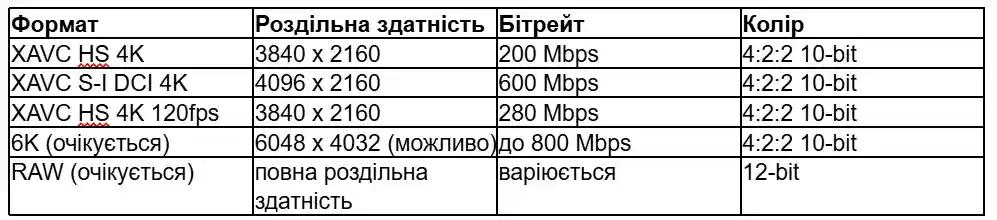
The FX3 already supports XAVC S-I (an intra-frame codec with a high bitrate) and XAVC HS (a long-GOP codec based on HEVC for smaller files). According to the official Sony FX3 specifications:
XAVC HS 4K 59.94p/50p: 200 Mbps (4:2:2 10-bit), 150 Mbps (4:2:0 10-bit), 100 Mbps (4:2:2 10-bit), 75 Mbps (4:2:0 10-bit), 45 Mbps (4:2:0 10-bit)
XAVC HS 4K 119.88p/100p: 280 Mbps (4:2:2 10-bit), 200 Mbps (4:2:0 10-bit)
XAVC S-I DCI 4K 59.94p: 600 Mbps, 50p: 500 Mbps
XAVC S-I DCI 4K 23.98p/24p: 240 Mbps
The FX3 II will likely expand this set:
6K XAVC S-I or XAVC HS modes with bitrates up to 800 Mbps
internal 12-bit RAW (possibly in X-OCN LT or Sony RAW format)
ProRes 422 HQ and ProRes 422 LT for compatibility with the Apple ecosystem
support for CFexpress Type A cards for fast recording at high bitrates
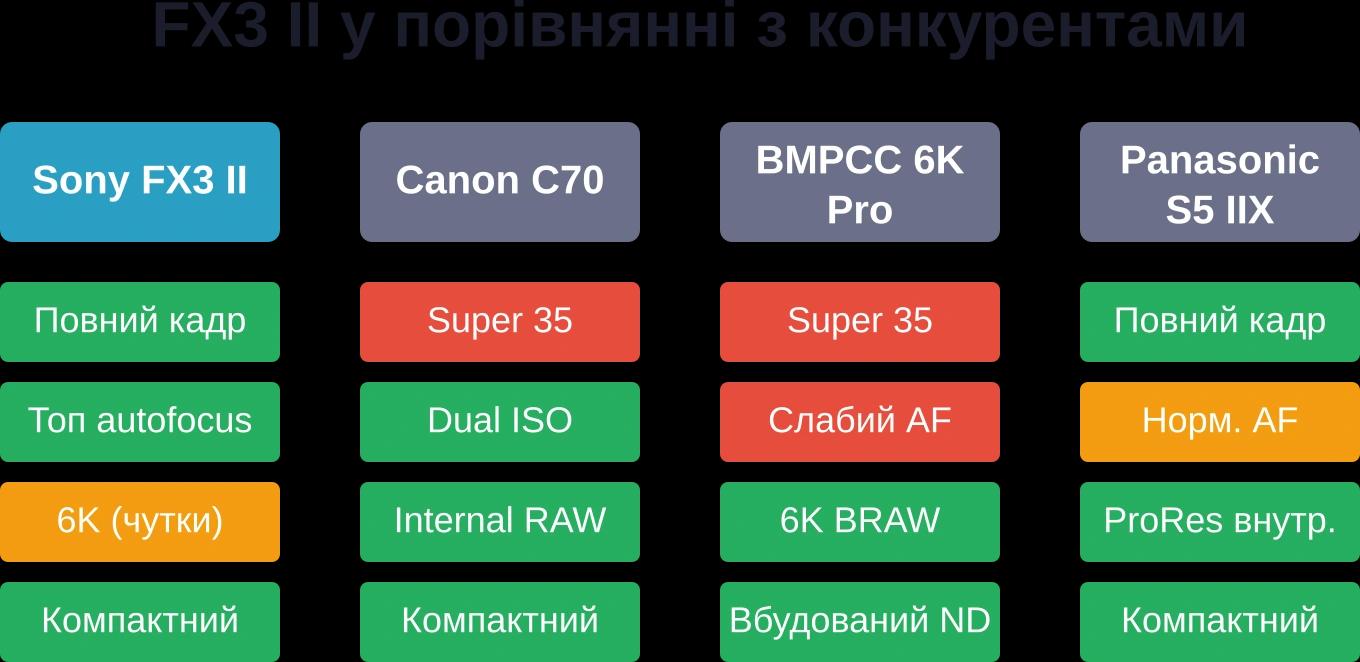
This would make the FX3 II a competitive alternative to the Blackmagic Pocket Cinema Camera 6K Pro, Canon C70, and Panasonic S5 IIX in the compact cinema camera segment.
Autofocus and object recognition: AI in action
Sony has long been a leader in hybrid autofocus. The FX3 uses a hybrid autofocus system with many phase-detection points covering most of the frame, and it can track people (eyes, faces, bodies), animals, and even birds in flight.
The FX3 II will receive the updated AI engine from the a7R VI and a9 III. This means:
more accurate subject recognition even in poor lighting conditions
the ability to recognize and track specific objects (cars, motorcycles, trains - useful for sports and action shooting)
improved predictive focusing for fast-moving subjects
Touch tracking - touching the screen instantly locks focus on the object
For solo operators shooting without a focus puller, advanced autofocus can be a useful assistant.
Release date and price: when to expect the FX3 Mark II?
There has been no official announcement. But if we analyze Sony's patterns and leaks:
Sony FX3 was released in February 2021. Five years have passed. Sony usually updates Cinema Line cameras every 3-5 years.
The Alpha a7R VI was released in May 2026. Historically, Sony announces several cameras during a year so they do not cannibalize each other's sales.
According to analyst speculation, the FX3 II could be announced in June-September 2026 (possibly at IBC 2026 in Amsterdam - a major broadcast technology exhibition), with sales starting in October-November 2026.
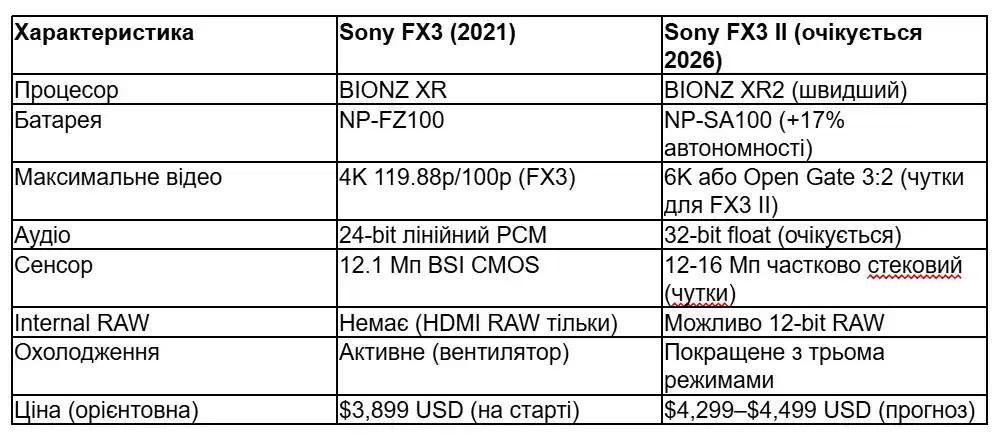
As for the price: Sony FX3 was released at $3,899 USD (body only) at launch. According to analyst estimates, taking inflation and new technologies into account, the FX3 II may cost around $4,299-$4,499 USD for the body.
This is still significantly cheaper than the FX6 ($5,998 USD), but more expensive than hybrid cameras such as the a7S III.
Competitors: how the FX3 II will fit into the market
The FX3 II is not arriving in a vacuum. Competition in the compact Cinema camera segment is tough. Here are the main rivals:
Canon C70
An excellent camera with a Super 35 sensor, dual native ISO, internal RAW, and Canon Log. But it has a shallower depth of field because of the crop sensor, and historically Canon has been slower than Sony in distributing firmware updates.
Blackmagic Pocket Cinema Camera 6K Pro
6K recording, Blackmagic RAW, advanced color grading capabilities, and a built-in ND filter. But it has contrast autofocus (without phase detection), which is considered less reliable for video, weaker ergonomics for run-and-gun shooting, and short battery life.
Panasonic Lumix S5 IIX
Full-frame, excellent autofocus (finally!), internal ProRes, compact. But the Panasonic ecosystem has fewer lenses compared to Sony E-mount, and Panasonic has a smaller presence in the professional Cinema segment.
Sony FX6
The older brother in the Cinema Line. Larger, heavier, with built-in ND filters, SDI outputs, dual base ISO, and a full set of professional features. But it costs more and is not as mobile.
According to speculation, the FX3 II will sit between a hybrid camera (a7S IV, if it is released) and the professional FX6. It is a camera for those who want cinematic quality, but without the weight and price of full-scale cinema systems.
What we would like to see: the dream section
Now a little imagination. Here are features that are unlikely to appear, but would be fantastic:
Built-in variable ND filters
The FX6 and FX9 have internal ND. This is a huge advantage - there is no need to carry glass filters, screw them onto the lens, or risk scratches, losses, and vignetting.
But integrating ND into the compact FX3 body is complicated and expensive. Sony may go the route of an adapter with internal ND (like PolarPro BaseCAMP), but a built-in mechanism is unlikely.
Dual base ISO
A technology that provides two native ISO values (for example, 800 and 4000) with minimal noise at both levels. The FX6 has this. But for the FX3 II, it would most likely overlap with the positioning of the FX6.
Full SDI output
HDMI is great for most users, but on professional film sets, SDI is the standard. It is more reliable, supports longer cables without signal loss, and has a locking connector.
But SDI adds size and weight. The FX3 II will most likely stay with HDMI to preserve compactness.
Ecosystem and accessories: what will work with the FX3 II
One of Sony's biggest advantages is the maturity of the E-mount ecosystem. Hundreds of lenses from Sony, Sigma, Tamron, Samyang, Zeiss, and Viltrox.
The FX3 II will inherit:
E-mount bayonet with full compatibility with all E-mount optics (full-frame and APS-C with auto crop)
XLR Handle Unit (or an updated module with 32-bit float)
compatibility with CFexpress Type A or SD cards
USB-C 3.2 for fast data transfer and power
HDMI Type A for monitoring/external recording
Multi-interface shoe for microphones and wireless systems
wireless control via the Sony Monitor & Control app on tablets and smartphones
This means owners of the FX3, a7S III, or other E-mount cameras will be able to integrate the FX3 II into their workflow smoothly without replacing the whole ecosystem.
Who is the FX3 II an ideal choice for?
Not every camera is the same for everyone. The FX3 II will be ideal for:
documentarians: mobility, excellent autofocus, low-light sensitivity, long recording without overheating
wedding videographers: compactness, fast AF with face recognition, 32-bit float audio for ceremonies with unpredictable sound
solo operators and content creators: an all-in-one solution without the need for a huge team, the ability to work with a gimbal, drone-mounted options
reporters and news shooters: fast setup, reliability, instant boot, a form factor suitable for working in crowds
low-budget indie filmmakers: cinematic quality, wide dynamic range, S-Log for grading, and a price lower than professional Cinema cameras
At the same time, the FX3 II is NOT for those who need:
built-in ND filters (choose the FX6)
SDI outputs and broadcast compatibility (FX6 or FX9)
8K recording (wait for the a7S IV or look at the a7R VI)
the cheapest possible solution (hybrid cameras such as the a7 IV may be a better choice)
FX3 vs FX3 II comparison: what will change
Frequently asked questions about Sony FX3 II
When will the Sony FX3 Mark II be released?
There has been no official announcement, but according to leaks and Sony's patterns, the most likely announcement date is June-September 2026 (possibly at IBC 2026), with sales beginning in October-November 2026.
How much will the Sony FX3 II cost?
The price has not been confirmed, but analysts expect $4,299-$4,499 USD for the body, or $4,799-$4,999 USD in a kit with the XLR module. This is higher than the FX3's launch price ($3,899), but lower than the FX6 ($5,998).
Will the FX3 Mark II record in 6K?
According to rumors - possibly. 6K or Open Gate 3:2 recording with the full sensor would provide more flexibility in post-production, especially for vertical formats and reframing without quality loss.
Will the FX3 II support internal RAW recording?
Possibly. The FX3 supports 16-bit RAW only through HDMI to external recorders. The FX3 II may receive internal 12-bit RAW, as in the higher-end FX6 and FX9 models, giving maximum flexibility in color grading.
Will the FX3 Mark II get a global shutter?
Unlikely. A global shutter is an expensive feature of fully stacked sensors such as the a9 III. But a partially stacked sensor could significantly reduce rolling shutter while preserving excellent low-light performance.
What batteries will the FX3 II use?
The FX3 II will most likely switch to the new NP-SA100 batteries that debuted in the a7R VI. They operate at a higher voltage (7.82 V instead of 7.2 V) and, according to Sony, provide 17% longer operating time compared to the NP-FZ100.
Will Sony FX3 Mark II have 32-bit float audio?
Very likely. This feature appeared in the a7R VI and allows sound to be recorded with such a wide dynamic range that it is practically impossible to "clip" the level. It is ideal for documentary filmmaking, weddings, and reporting.
Is the FX3 II compatible with lenses and accessories from the FX3?
Yes. The FX3 II will keep the E-mount bayonet. All E-mount lenses, XLR Handle, NP-SA100 batteries, cage systems, and accessories should work without problems.
Conclusion: is the FX3 II worth waiting for?
If you are currently choosing between buying the FX3 and waiting for the FX3 II - the answer depends on your timing and needs.
If you need a camera right now for projects in summer-autumn 2026 - the FX3 is still a fantastic camera. Its prices will likely drop after the FX3 II announcement, so you may be able to catch a good deal.
But if you can wait until the end of 2026 - the FX3 II promises to be a significant upgrade. A new processor, longer-lasting batteries, possible 6K recording, an improved sensor, 32-bit float audio - all of this makes the camera much more powerful for professional use.
For those working in demanding conditions (low light, long recordings, fast movement, complex sound) - the FX3 II may be the right tool for several years.
Follow Sony's official announcements in June-September 2026. And for now - prepare your budget and plan upgrades for lenses, memory cards (CFexpress Type A is recommended for high bitrates), and supporting accessories.
Sony FX3 II may offer significant improvements for users of compact Cinema cameras.