

Sony RX100 VIII Review: The Truth About a Non-Existent Model
May 12, 2026
Quick Summary: The Sony RX100 VIII no longer exists—the series stopped with the RX100 VII (seventh generation), released in 2019. The RX100 VII offers a 20.1 MP 1.0" sensor, a 24-200mm f/2.8-4.5 lens, 357 phase-detection AF points, 4K video recording, and all the advanced features of a premium compact camera in a pocketable body.
The internet is awash with searches for the Sony RX100 VIII. Vloggers are writing "reviews," forums are discussing "specs," and users are waiting for an announcement. But here's the rub.
The Sony RX100 VIII simply doesn't exist.
The RX100 series, one of the most successful compact camera lines of the past decade, has stopped at its seventh iteration—the RX100 VII (also known as the DSC-RX100M7). The RX100 VII was unveiled in July 2019, according to Imaging Resource (published on July 25, 2019). Since then, the company hasn't announced the eighth model.
So where did all the hype around the RX100 VIII come from?
Why is everyone talking about a non-existent camera?
The story of the RX100 VIII is a classic example of how rumors and expectations turn into pseudo-reality. Since 2012, Sony has released a new RX100 model almost every year, sometimes even two versions per season. This predictability generated anticipation.
When no new model appeared after 2019, enthusiasts began speculating about a series update. Various discussions and predictions about a possible RX100 VIII have appeared online.
All this is fantasy, wishful thinking, and reality.
According to the latest available information, Sony's official website contains no mention of the RX100 VIII. The flagship of the line remains the RX100 VII, which continues to be sold and supported.
What official sources show
A check of Sony's official catalog confirms that the current RX100 lineup includes models one through seven. There's no eighth iteration on the list.
Moreover, in recent years, Sony has shifted its focus to mirrorless cameras with the Alpha and ZV series (video-focused models). The compact segment has fallen by the wayside as the market shifts toward mirrorless cameras and video-focused devices.
Does this mean the RX100 VIII will never appear? Not necessarily. But the fact remains: such a camera doesn't currently exist.
What does the RX100 VII actually offer?
Now that we've cleared up the myth of the eighth model, let's look at the reality: the RX100 VII, which many mistakenly consider the predecessor to the non-existent VIII.
This camera is a true technological masterpiece in a tiny body. And here's why.
Sensor and Processor
The RX100 VII is equipped with a 1.0-inch (13.2 x 8.8 mm) Exmor RS CMOS sensor with an effective resolution of approximately 20.1 megapixels. This is the same physical The same size as previous models, but with fundamentally new internals.
The key difference is the multi-layer structure. The RX100 VII's sensor is a stacked Exmor RS CMOS sensor. The result? Continuous shooting at up to 20 fps at full resolution and continuous autofocus.
A comparison with previous compacts shows an advantage. According to DXOMark data (published September 5, 2012), the original RX100 received an overall score of 66 (54th place among all cameras tested). The source indicates that the RX100 ranked first among regular digital compacts with a zoom lens. The Canon PowerShot S100 scored 56 points on DXOMark.
The RX100 VII continues this tradition of excellence. The sensor is 70% larger in area than typical compacts, with a pixel pitch of 2.4 µm in the Sony RX100 versus 1.8 µm in the Canon PowerShot S100. Canon S100.
ZEISS Vario-Sonnar T* Lens
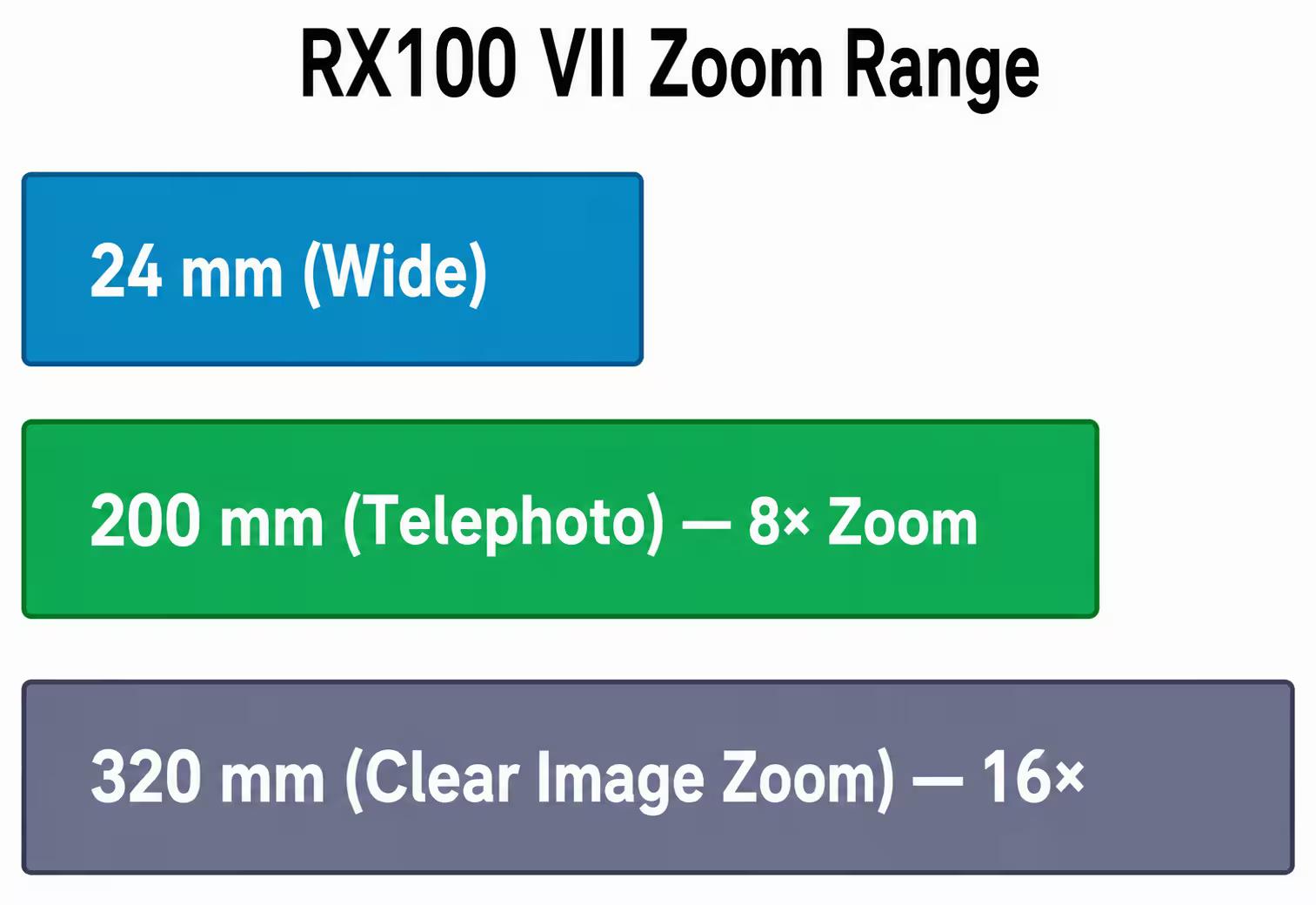
One of the most impressive features is the lens. It's a ZEISS Vario-Sonnar T* with a 24–200mm range (35mm equivalent) and an f/2.8–4.5 aperture.
8x optical zoom in a camera that fits in your jeans pocket. Let that sink in for a second.
The design features 15 elements in 12 groups, including eight aspherical lens elements (including Advanced Aspherical). This optical design ensures sharpness from corner to corner, even at maximum zoom.
The minimum focusing distance is 8 cm at the wide-angle end and 100 cm at the telephoto end. This allows for macro shooting without the need for special modes.
Clear Image Zoom (digital zoom with intelligent processing) expands the range to 16x at full 20MP resolution, and up to 22x at 10 MP, up to 32× at 5 MP and up to 121× at VGA.
The autofocus system is the fastest in its class
This is where the RX100 VII truly shines. Its autofocus system is taken directly from Sony's flagship Alpha A9 mirrorless camera.
The sensor features 357 phase-detection AF points, covering approximately 68% of the frame—the largest number in the RX100 series and the most in a 1-inch compact camera. Additionally, 425 contrast-detection AF points are available.
Real-time Tracking and Eye AF
The RX100 VII is the first in the series to feature Real-time Tracking technology—an intelligent subject tracking system. Artificial intelligence analyzes color, brightness, distance, and pattern recognition to maintain focus even on erratically moving subjects.
Simply tap the screen to select a subject, and the camera will track it across the frame. Eye AF works for both people and animals. The system recognizes faces and automatically focuses on the closest eye, even when the subject is turning or partially obscured.
This revolutionizes workflow for portrait and street photography.
Continuous Shooting and Buffer
The maximum continuous shooting speed with the electronic shutter is approximately 20 fps with autofocus (Continuous Shooting Hi with the electronic shutter). In Single Burst mode with the electronic shutter, the speed is approximately 90 fps (Single Burst Shooting Hi).
The electronic shutter supports shutter speeds up to 1/32000 second, allowing you to shoot with a wide aperture even in bright sunlight.
Display and Viewfinder
The RX100 VII features a retractable OLED electronic viewfinder with a resolution of 2.36 million dots. Frame coverage is 100%, with a magnification of approximately 0.59× (equivalent to a 50mm lens on full frame at -1 diopter).
Diopter correction is adjustable from -4.0 to +3.0 m⁻¹, suitable for most users, including eyeglass wearers.
The retractable mechanism is compact—the viewfinder barely protrudes beyond the body when folded. Activation occurs automatically upon removal or manually via a button.
Articulating Touchscreen
The 3.0-inch LCD with a resolution of 921,600 dots flips up 180° and down 90°. This design allows for shooting selfies, vlogs, and content at difficult angles.
Touch controls support touch-based focus selection, menu navigation, and gallery navigation. The interface is responsive, although Sony's menus are traditionally confusing—a weakness of the brand's overall ecosystem.
Professional-Level Video Shooting
The RX100 VII isn't just a still camera. It's a fully-fledged video production tool for vloggers, content creators, and documentarians.
The camera supports 4K video (3840 × 2160) at up to 30 fps, according to the camera's recording specifications. Full HD 1920 × 1080 recording at 120 fps is also available for smooth slow motion.
Specifications also support AVCHD recording at 1920 × 1080 at 60p with a bitrate of 28 Mbps. For quick sharing, MP4 is available with a resolution of up to 1440 × 1080 at 30 fps and a bitrate of 12 Mbps.
Super Slow Motion
High Frame Rate (HFR) mode records video at up to 960/1000 fps. This allows you to record slow-motion video at a very high frame rate for later playback in slow motion.
The resolution in this mode drops (usually to VGA 640×480), but the ability to capture a hummingbird's wing, a drop of water, or the moment of impact is invaluable for creative projects.
Even at the maximum zoom of 200mm, super slow-mo shooting remains possible—a unique feature for a compact camera.
Stabilization and Microphone Input
Built-in optical image stabilization is present, designated as STEADYSHOT in the specifications. In practice, this means you can shoot handheld video with a telephoto lens without noticeable shake.
A combo microphone input (3.5mm) is provided for connecting an external microphone. This is crucial for vloggers, as the built-in sound in compact cameras is usually mediocre.
There is no headphone jack, making real-time audio monitoring difficult. This is a tradeoff for compactness.
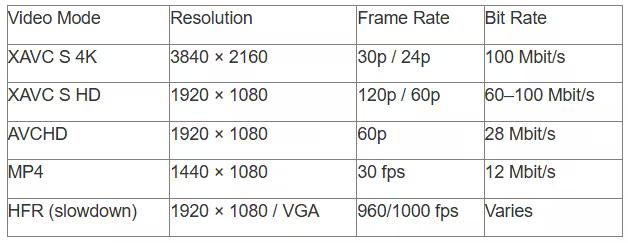
Image Quality and Performance
Despite its compact sensor, the RX100 VII produces impressive quality. JPEGs straight from the camera are well-balanced—vivid colors without oversaturation, detailed textures, and good contrast.
Dynamic range is inferior to full-frame and even APS-C cameras, but for a 1-inch sensor, it's excellent. The Auto HDR feature stitches multiple exposures to expand the tonal range in challenging scenes (such as backlit scenes).
Dynamic Range Optimizer (DRO) works on a single image, pulling detail out of shadows and controlling highlights. Its effectiveness is moderate, but it's useful for everyday shooting.
High ISO Performance
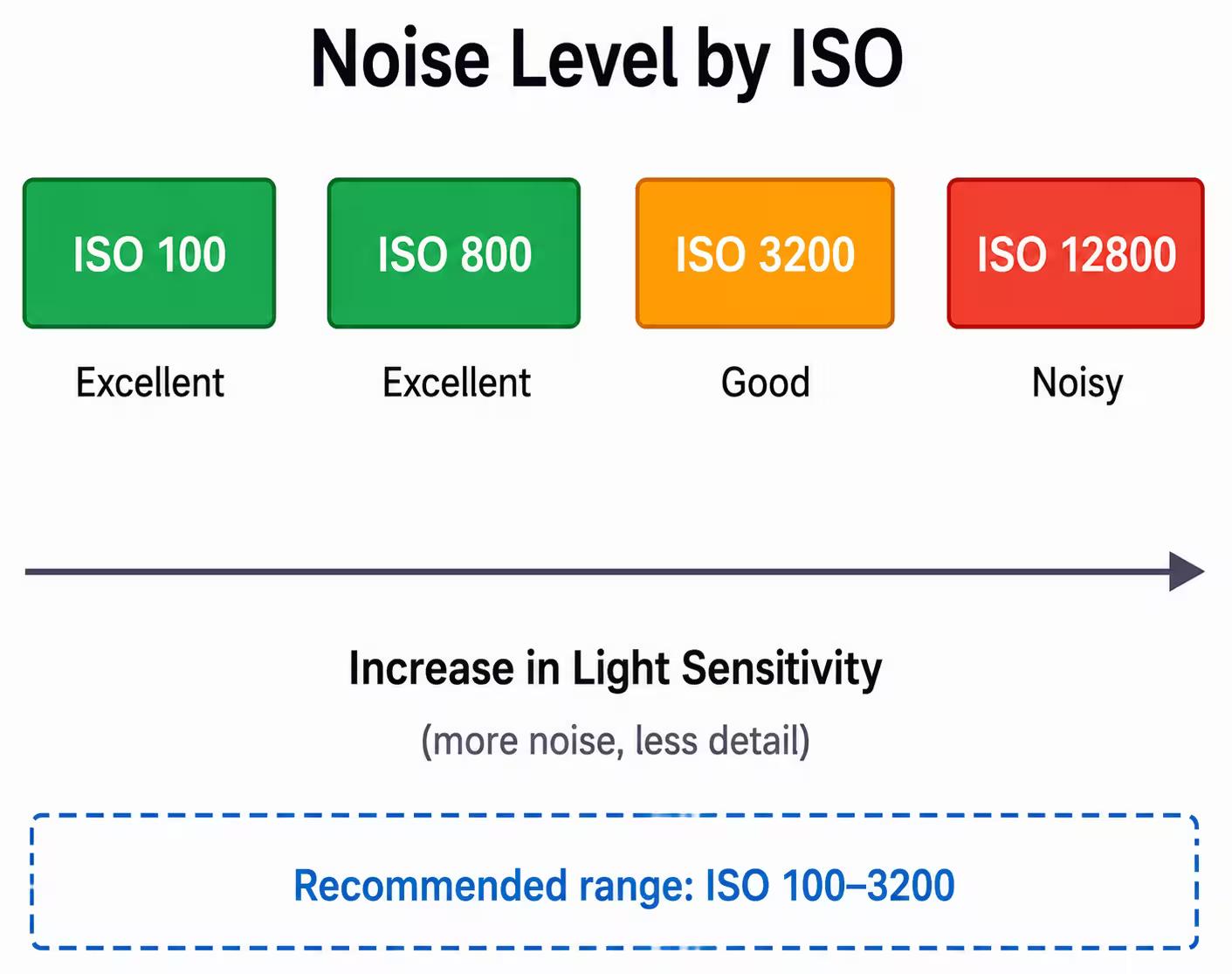
The native ISO range is from 100 to 12,800. The advanced Multi Frame Noise Reduction mode allows shooting up to ISO 25,600, stitching multiple frames together to reduce noise. Detail remains acceptable up to ISO 3200. At ISO 6400, noticeable noise appears, but the image remains suitable for web and social media. ISO 12800 and above is a failsafe, with significant loss of detail.
DXOMark notes that the original RX100 outperforms its competitors thanks to its larger pixel size (2.4 µm) and improved low-light processing. The RX100 VII continues this line of improvement.
RAW Shooting
The camera saves RAW files in Sony ARW format (14-bit). These files contain more information for post-processing, such as shadow enhancement, exposure correction, and white balance.
Various programs are available for processing RAW files, including Sony's own software (Imaging Edge Mobile and Imaging Edge Desktop).
The dynamic range of RAW allows for approximately 2–3 stops of exposure recovery without critical loss of quality. This is less than that of a full-frame camera, but sufficient for most scenarios.
Ergonomics and Design
The RX100 VII remains one of the most compact cameras with these capabilities. Its magnesium alloy body is durable yet lightweight. The front panel is textured for a secure grip. The prominent handgrip is minimal but provides ample support for the index finger.
Controls are tightly packed. The buttons are small and may be uncomfortable for those with larger fingers. The exposure compensation dial on the top panel is easy to accidentally hit, disrupting settings.
Interface and Connections
Connectors include micro-USB (Type-B) for charging and data transfer, micro-HDMI (Type-D) for video output, and a combo microphone input (3.5 mm). A Multi Interface Shoe (hot shoe) allows connection of external Sony flashes and microphones.
Built-in Wi-Fi (802.11b/g/n) and Bluetooth enable wireless photo transfer to a smartphone via the Imaging Edge Mobile app. Remote shooting is also supported. NFC simplifies pairing with Android devices (simply tap the camera on your phone).
Battery and Battery Life
The NP-BX1 battery provides up to 330 shots according to the CIPA standard (with viewfinder), according to official Sony specifications. Video recording is supported according to specifications (CIPA battery life is listed as 165 minutes).
For active shooting, it's recommended to have 2-3 spare batteries. USB charging allows you to use power banks in the field.
RX100 Model Comparison: Which One to Choose
The RX100 series consists of seven models. The differences between them are significant—not only in price, but also in functionality.
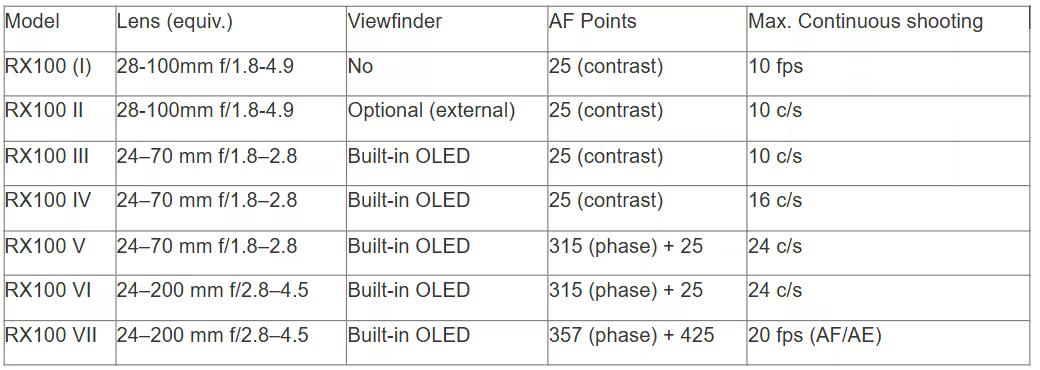
If you're on a budget, the RX100 III offers a great balance. It features a bright 24-70mm f/1.8-2.8 lens, a built-in viewfinder, and a compact body.
The RX100 V introduces phase-detection AF (315 phase-detection points + 25 contrast-detection points)—a huge leap in speed and accuracy. The difference is noticeable for action scenes.
The RX100 VI and VII add a 200mm super-telephoto lens. If you need versatility (from landscapes to wildlife), these models are unrivaled.
The RX100 VII is the pinnacle of the lineup. It features real-time tracking, Eye AF for animals, a microphone input, and time-lapse shooting. It's more expensive, but its capabilities match those features.
Who is the RX100 VII for?
This camera isn't for everyone. The price is high, and smartphones like the iPhone or Google Pixel take photos well suited for social media.
However, there are niches where the RX100 VII is indispensable.
Professional Photographers
Like a second camera, always in your pocket. Reporters, wedding photographers, and documentary filmmakers appreciate having a compact camera with near-APS-C quality when lugging a DSLR around is inconvenient.
The 200mm zoom lets you capture portraits, details, and distant moments. RAW provides ample room for color correction and post-processing.
Vloggers and Content Creators
Flip-out screen, microphone input, 4K video, and excellent stabilization. The RX100 VII is a popular choice for YouTube and TikTok.
Eye AF keeps the face in focus even when the presenter is moving. Super slow-mo adds creativity.
Enthusiasts and Travelers
For those who value quality but don't want to lug around a backpack full of equipment. One compact camera covers 90% of shooting scenarios—from architecture to street photography, from portraits to wildlife.
330 shots per battery are enough for a day's walk. Wireless sharing makes it easy to post to Instagram on the spot.
Disadvantages and Limitations
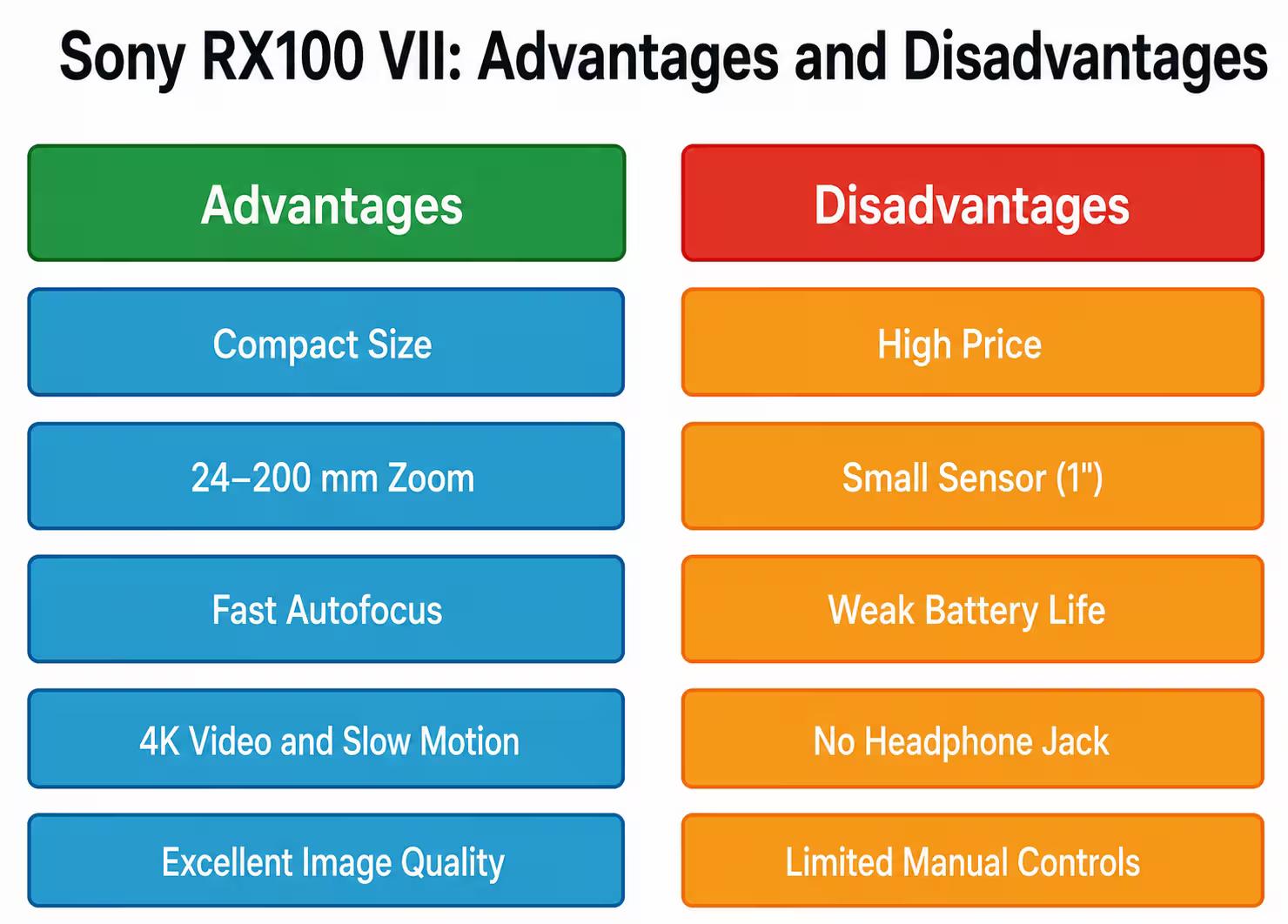
For all its advantages, the RX100 VII isn't perfect. Let's call a spade a spade.
Price
This is an expensive camera. Prices vary by region and time period—check the official Sony website or authorized retailers for current prices.
For the same price, you can buy an entry-level mirrorless camera with a kit lens. It's a matter of priorities: compactness versus a larger sensor and interchangeable lenses.
Small Sensor
The 1-inch sensor is a compromise. Dynamic range, high ISO performance, and bokeh (background blur) are inferior to APS-C and full-frame cameras.
At f/2.8 at 24mm, background blur is almost nonexistent. For portraits with beautiful bokeh, you'll need a 200mm telephoto lens at f/4.5—and even then, the effect is moderate.
Ergonomics
Small buttons, cramped control layout. Accidental presses are common. Shooting with gloves is practically impossible.
Sony's menus are confusing. Even experienced users need time to find the right setting. The lack of touch controls (touching only works for focusing) exacerbates the problem.
Lack of a headphone jack
This is critical for videographers. Audio monitoring is required after shooting, which increases the risk of poor quality due to background noise, wind, or improper recording levels.
Battery life
330 shots is modest by today's standards. Active shooting with the viewfinder, continuous shooting, Wi-Fi, and video drains the battery faster. Spare batteries are essential.
Alternatives: What Else to Consider
If the RX100 VII doesn't meet the price or features requirements, consider its competitors.
Canon PowerShot G7 X Mark III
A direct competitor with a similar 1-inch sensor, 24-100mm f/1.8-2.8 lens, flip-out screen, and microphone input. Slightly cheaper, but with a shorter zoom range and slower autofocus.
Panasonic Lumix ZS200 (TZ200)
Also with a 1-inch sensor, but with a 24-360mm lens—the longest zoom among compacts. The tradeoff is a smaller aperture (f/3.3-6.4) and slower autofocus.
Fujifilm X100V
APS-C sensor, fixed 23mm f/2 lens (35mm equivalent), retro design. Better image quality, but no zoom and larger dimensions.
Ricoh GR III
APS-C sensor in an ultra-compact body, fixed 28mm f/2.8 lens. Legendary for street photography. But without zoom or viewfinder.
Each alternative offers its own compromises. The RX100 VII excels in its balance of versatility, compactness, and advanced technology.
Will there be a Sony RX100 VIII?
That's the million-dollar question. The compact camera industry is shrinking – smartphones have captured the mass market. Manufacturers are focusing on niche segments: professional mirrorless cameras, specialized compacts, and video cameras.
Sony hasn't announced the RX100 VIII. Moreover, the company hasn't updated the lineup since 2019 – the longest hiatus in the series' history. Possible reasons for the delay include supply chain issues (the semiconductor shortage has affected all electronics), the refocusing of resources on profitable segments (Alpha cameras, lenses), and sales cannibalization (the ZV-1, a compact video camera based on the RX100, is selling well).
What the eighth model could offer
If Sony ever releases the RX100 VIII, here's what to expect:
An improved sensor—possibly with increased resolution (24-30 MP) or improved light sensitivity.
A longer battery life—the current NP-BX1 is underpowered for modern tasks.
The USB-C to micro-USB connector is outdated.
Improved stabilization—5-6 stops instead of the current 4.
4K recording at 60 fps—the standard for premium cameras in 2026.
Real-time tracking for birds—expanding Eye AF to cover more animal categories.
But this is speculation. There are no official statements yet.
Practical Tips for Using the RX100 VII
A few recommendations for getting the most out of the camera.
Customize Custom Buttons
The RX100 VII lets you assign functions to the C1 button, the center button of the multi-selector, and more. Set up quick access to frequently used settings like ISO, focus mode, and Eye AF.
Use Interval Shooting
The camera supports interval shooting with settings from 1 to 60 seconds between shots and up to 9999 shots. Ideal for timelapses of sunsets, moving clouds, and street traffic.
Shoot RAW + JPEG
JPEGs are convenient for quick viewing and sharing. RAW offers flexibility in processing. Simultaneous recording of both formats is the best option (if the memory card has sufficient capacity).
Calibrate white balance manually
The RX100 VII's automatic white balance is good, but not always accurate in mixed lighting (e.g., incandescent lighting + daylight from a window). Manual adjustment using a gray card eliminates color shifts.
Study the menu in advance
Sony's menus are a maze. Spend an hour at home learning the layout before taking the camera out on an important shoot. Create your own presets (Memory Recall) for typical scenarios—portrait, landscape, sports.
Frequently Asked Questions
Is there a Sony RX100 VIII?
No. Sony has not yet officially unveiled the RX100 VIII. The last current model in the series remains the RX100 VII, released in 2019. All mentions of the RX100 VIII are based on rumors and have not been confirmed by Sony.
What is the main difference between the RX100 VII and previous models?
The RX100 VII uses the autofocus from the flagship Sony A9: 357 phase-detection points and 425 contrast-detection points with support for Real-time Tracking and Eye AF for humans and animals. An external microphone input and time-lapse shooting have also been added.
Can the RX100 VII be used for professional video shooting?
Yes. The camera supports 4K video up to 100 Mbps, has high-quality stabilization, a flip-out screen, and a microphone jack. Many bloggers and content creators use it professionally. The main limitations are the lack of a headphone jack and relatively short battery life.
What memory card capacity does the RX100 VII need?
UHS-I U3 or UHS-II SD cards with a capacity of at least 64 GB are recommended. For 4K video and continuous RAW shooting, it's best to choose 128 GB or higher.
Is the RX100 VII worth buying in 2026 or should I wait for a new model?
The RX100 VII remains relevant even in 2026 thanks to its excellent autofocus, high-quality 24-200mm lens, and good video capabilities. If you need a camera now, there's little point in waiting for the RX100 VIII, as Sony hasn't confirmed its development.
How is the RX100 VII better than modern smartphones?
The main advantage is its 24-200mm lens with true optical zoom and a 1-inch sensor, which provides better detail, less noise, and natural background blur. The camera also offers full manual control, RAW shooting, and professional video modes.
Is the Sony RX100 VII waterproof?
No. The camera is not officially water- and dust-resistant. A separate protective housing is required for underwater shooting or use in challenging conditions.
Conclusion: Reality vs. Expectations
The Sony RX100 VIII is a dream, not a reality. It exists only in discussion and speculation. The true flagship of the series, the RX100 VII, remains one of the best compact cameras on the market.
Yes, it has its drawbacks. The price is high. The sensor is small compared to mirrorless cameras. The ergonomics aren't ideal. The battery drains quickly.
But the compromises are worth it for those who value portability without sacrificing quality.
200mm zoom in your pocket. Professional-grade autofocus. 4K video with super slow motion. Built-in viewfinder. RAW for serious editing.
All this fits into a body the size of a deck of cards.
If Sony ever releases the RX100 VIII, it will be a landmark event. In the meantime, the RX100 VII continues to serve as the benchmark for compactness and advanced technology.
Check Sony's official website for current prices, availability, and specifications. Technology changes, models are updated, but the principle remains: the best camera is the one you always have with you.
Ready to make a choice? Explore current deals on the RX100 VII, read user reviews, and try it out in-store. Specifications on paper are one thing, but the experience in real-world use is quite another.