

Updated Sigma I Series for Sony: 20, 45, 65, 90 mm
May 7, 2026
Brief summary: Sigma officially updated its I Contemporary series for Sony E-mount, releasing four lenses: 20mm F2, 45mm F2.8, 65mm F2, and 90mm F2.8 DG in January 2026. These compact full-frame prime lenses feature a sleek new design, improved autofocus algorithms, and full compatibility with modern Sony cameras.
Sigma Corporation has completed the long-awaited update to its iconic I Contemporary series, introducing updated versions for Sony E-mount. Following an initial announcement in February 2025 and subsequent release date updates, four key lenses in this lineup officially went on sale on January 22, 2026.
These lenses are the 20mm F2, 45mm F2.8, 65mm F2, and 90mm F2.8—compact full-frame prime lenses that combine portability with outstanding image quality. These updates affect not only the lenses' appearance but also their internal components.
For Ukrainian photographers and videographers, this means access to modern optics with improved autofocus performance and full support for the latest Sony camera features. Let's explore what exactly has changed and whether the updated models are worth upgrading to.
The History of the I Contemporary Series and the Reasons for the Update
The I Contemporary series debuted in response to the growing demand for compact, high-quality prime lenses for mirrorless cameras. Initially, the lineup included nine lenses with focal lengths from 17mm to 90mm.
The core philosophy of the series is a balance between portability and optical quality. These lenses were developed for photographers who need lightweight, reliable optics without compromising performance.
But why did Sigma decide to update the entire lineup? Several factors.
First, technological advances. Sony's modern full-frame mirrorless cameras offer features that weren't available when the original I Series was developed: improved in-camera stabilization, processor-level aberration correction, and faster object recognition algorithms.
Second, unification of the brand's visual language. Sigma rebranded in 2024-2025, and the updated lenses reflect the company's new design philosophy—a more elegant, minimalist approach.
Third, competition. Sony, Tamron, Viltrox, and other manufacturers are actively developing their lines of compact prime lenses. Sigma needed to stay relevant.
Release Schedule of the Updated I Series for Sony E-mount
According to official information from Sigma Corporation, the update of the I Contemporary series for Sony E-mount was carried out in stages:
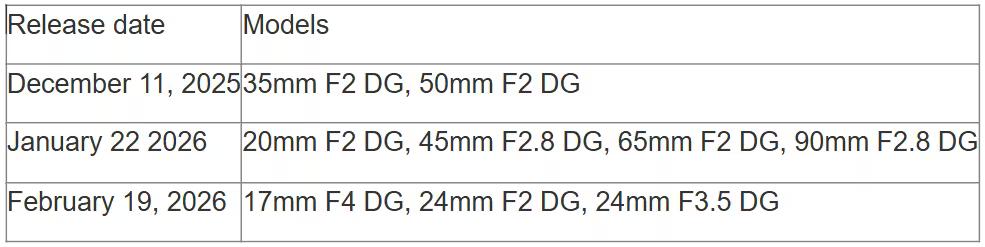
The first wave, in December 2025, included the most popular focal lengths—35mm and 50mm, traditional bestsellers. The second wave, on January 22, 2026, brought lenses for more specific applications.
For the Ukrainian market, this means that four updated lenses are already available through authorized dealers and specialized photo stores.
Sigma 20mm F2 DG DN Contemporary for Sony E-mount
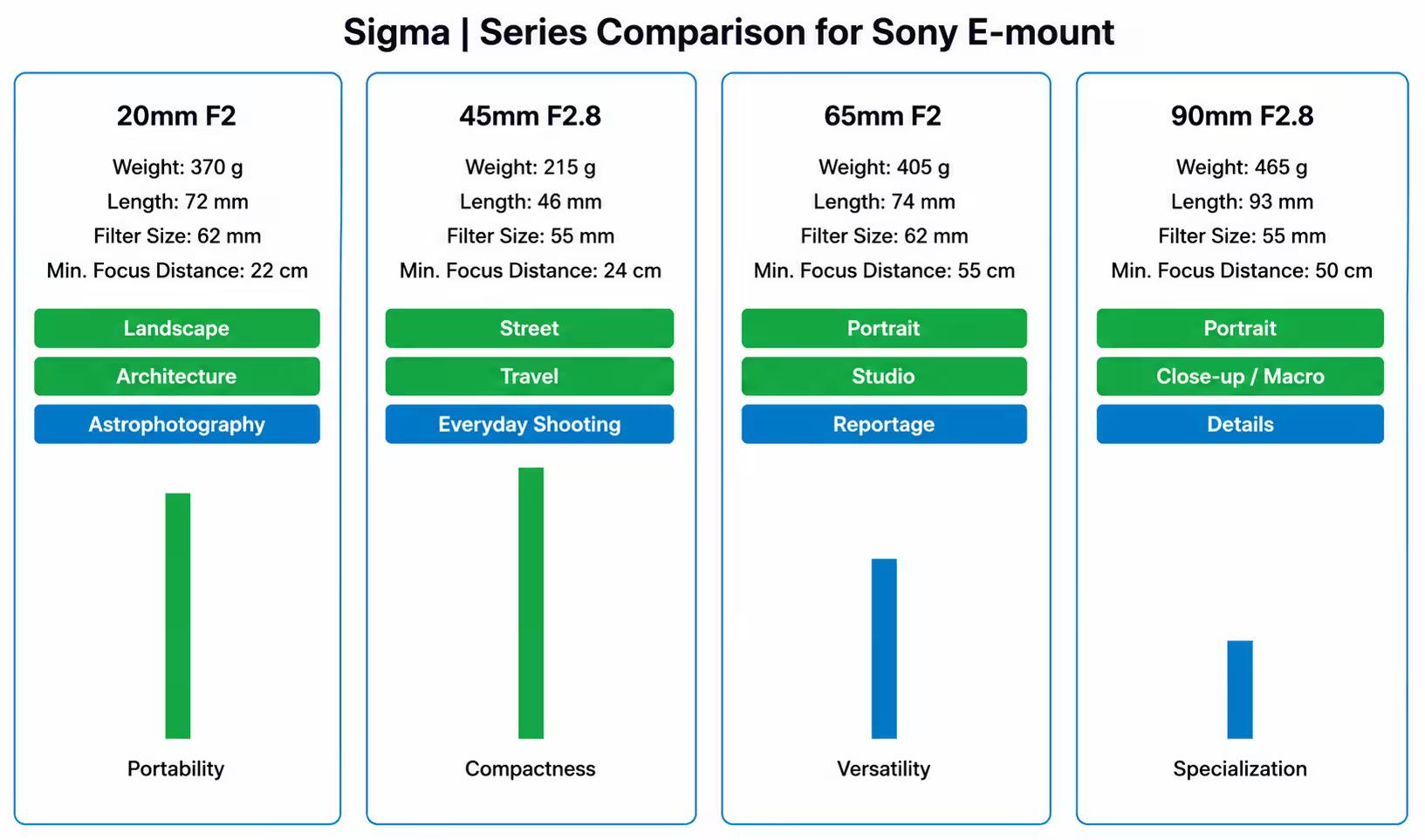
The first of the four lenses in today's review is the wide-angle Sigma 20mm F2. This is a versatile lens for landscape, architectural, and astrophotography.
The 20mm focal length provides a wide angle of view without the extreme distortion typical of 14-16mm ultra-wide-angle lenses. The F2 aperture allows for working in low light conditions and achieving dramatic background blur with proper composition.
Optical Design and Image Quality
The optical design features 11 elements in 9 groups with two aspherical lens elements. This design minimizes chromatic aberrations and distortion typical of wide-angle lenses.
A nine-blade aperture creates a rounded bokeh, which is important when shooting wide open. A minimum focusing distance of 22 cm allows for interesting compositions with an emphasis on the foreground.
The lens supports in-camera aberration correction for modern Sony cameras, improving edge sharpness and reducing vignetting in JPEG files.
Autofocus and Performance
An updated stepping motor control algorithm ensures fast and quiet focusing. Sigma has optimized communication between the lens and camera, which is particularly noticeable when using the eye and subject detection features on the Sony A7 IV, A7R V, or A9 III. Smooth, silent refocusing while recording is essential for videographers. The Sigma 20mm F2 handles this task without noticeable jerkiness or exposure pulsation.
Design and Ergonomics
The lens is compact and lightweight, making it an ideal companion for hikes and travel, where every gram counts.
The all-metal body is dust- and moisture-resistant.
The 62mm filter diameter is a popular size, compatible with many other Sigma and third-party lenses.
Sigma 45mm F2.8 DG DN Contemporary for Sony E-mount
Sigma 45mm F2.8 occupies an interesting niche between the standard 50mm and the portrait 85mm. This focal length is ideal for street photography, travelogues, and informal portraits.
The F2.8 aperture doesn't look impressive compared to F1.4 or F1.8, but it compensates for this with its extreme compactness and light weight. In fact, it's the most discreet lens in the updated lineup.
Optical Formula
The design features 8 elements in 7 groups. Two aspherical elements correct spherical aberrations and coma, ensuring high sharpness across the entire frame.
Despite its modest aperture, the lens delivers pleasing bokeh thanks to its nine-blade aperture. When shooting portraits at a distance of 1-2 meters, the background is blurred enough to visually separate the subject.
The minimum focusing distance of 24 cm allows for close-ups and detailed shots, expanding creative possibilities.
Why 45mm?
The 45mm focal length is often underestimated. It's not the classic 50mm standard, not the wide-angle 35mm, and not the portrait 85mm. But it's precisely in this in-betweenness that lies its strength. The 45mm offers a natural perspective, close to human perception, but with a slightly wider angle of view than the 50mm. This simplifies composition and avoids unnecessary elements.
For street photographers, it's the perfect balance: wide enough for context, long enough for delicacy.
Dimensions and Weight
The Sigma 45mm F2.8 is extremely compact and lightweight in its class. On a compact camera like the Sony A7C, this lens creates a virtually pocket-sized system that can be carried all day without fatigue. The filter diameter is 55mm.
Sigma 65mm F2 DG DN Contemporary for Sony E-mount
Sigma 65mm F2 is a compromise between standard and portrait focal lengths. The 65mm offers a slightly narrower angle of view than the 50mm, but without the perspective compression typical of the 85mm. The F2 aperture provides good subject-background separation, adequate low-light performance, and creative depth-of-field control.
Optical Construction
The lens features 11 elements in 9 groups with three aspherical lens elements. This configuration minimizes spherical and chromatic aberrations, delivering high sharpness and contrast.
The nine-blade aperture creates a smooth, rounded bokeh—an important characteristic for a portrait lens. At F2, background blur is expressive but not extreme, making it suitable for a wide range of applications.
The minimum focusing distance of 55 cm allows for head-and-shoulder portraits and still lifes at a comfortable working distance.
Portrait Applications
65mm is an unconventional focal length for portraits, but it's specifically designed for this purpose.
This makes it interesting. Unlike the 85mm, which requires you to stand 3-4 meters away for a half-length portrait, the 65mm allows you to work at a distance of 2-2.5 meters.
This distance simplifies communication with the model, especially in small studios or spaces. The perspective remains flattering for the face, without noticeable distortion.
For photographing couples or groups, the 65mm is also more convenient than the 85mm due to its slightly wider angle of view.
Body Specifications
The Sigma 65mm F2 is moderately lightweight and compact for its class. The 62mm filter diameter is the same as the 20mm F2, allowing you to use the same filter kit for both lenses.
Sigma 90mm F2.8 DG DN Contemporary for Sony E-mount
Sigma 90mm F2.8, a portrait telephoto lens with a focus on macro photography, rounds out the four. Although not a macro lens in the strict sense, its minimum focusing distance allows for medium-length shots of small objects.
90mm is traditionally considered the ideal focal length for classic portraiture. The compression of perspective is flattering for the face, and the working distance creates a comfortable space between the photographer and the subject.
Optical Design
The design features 10 elements in 9 groups, including one aspherical element. The design is optimized for a balance between sharpness and bokeh.
At F2.8, the lens demonstrates excellent sharpness in the center and at the edges of the frame. Bokeh is smooth, without harsh transitions or ghosting, thanks to the nine-blade aperture.
The minimum focusing distance of 50cm provides a maximum magnification of approximately 1:5, allowing you to capture small objects—jewelry, flowers, and details—with an interesting perspective and background blur.
Portrait Photography with 90mm
90mm compresses perspective slightly more than 85mm, making facial features more harmonious. The nose appears smaller, and the face flatter in a positive sense, as in classic portraits.
The working distance for a head-and-shoulders portrait is 1.5-2 meters, and for a half-length portrait, 3-4 meters. This creates a comfortable psychological space; the model doesn't feel the pressure of the camera.
The F2.8 isn't the fastest, but at 90mm, it provides a dramatic background blur. When shooting wide open, the background transforms into smooth splashes of color.
Dimensions and Ergonomics
The Sigma 90mm F2.8 remains compact by telephoto lens standards thanks to its Contemporary design. The filter diameter is 55mm, the same as the 45mm F2.8, making it easy to accessorize.
Key Improvements in the Updated I Contemporary Series
What exactly has changed in the updated versions compared to the original models? Sigma focused on several key aspects.
Improved Autofocus Algorithm
The main update is the optimization of the autofocus stepping motor control. Sigma has redesigned the firmware, improving communication between the lens and camera.
In practice, this means faster focusing, especially when working with the eye and object detection features of modern Sony cameras. The lens responds more quickly to commands and tracks moving subjects more confidently.
This is critical for video. Smooth, silent refocusing without jerking or exposure pulsation is exactly what you need when recording interviews or documentary footage.
Support for Modern Sony Camera Features
The updated lenses are fully compatible with in-camera image stabilization on Sony models that support it. Metadata is transmitted correctly, and the camera can accurately compensate for shake. In-camera correction of aberrations, including vignetting, distortion, and chromatic aberrations, is also supported. The camera automatically applies a correction profile to JPEG files, and RAW metadata is saved for processing in Adobe Lightroom or Capture One.
Updated Design and New Identity
The visually updated lenses reflect Sigma's new design language. The black barrel has become more elegant, with minimalist branding and high-quality materials.
The Sigma logo on the front end now has a new style. The focus and aperture rings have an improved texture for a more secure grip.
The magnetic metal lens cap is a welcome addition, simplifying one-handed installation and removal.
Maintaining Optical Quality
It's important to note: the optical designs remain identical to the original versions. Sigma has not redesigned the optics, meaning proven image quality has been maintained.
For owners of the original versions, this is both a good and a bad thing. Good because it proves that the original optics were so high-quality that they didn't require improvement. Bad because there's no reason to upgrade if current performance is satisfactory.
Pricing and Availability in Ukraine
Official retail prices in the US for the updated lenses according to the ProVideo Coalition:
Sigma 20mm F2 DG DN Contemporary — $599
Sigma 45mm F2.8 DG DN Contemporary — $549
Sigma 65mm F2 DG DN Contemporary — $699
Sigma 90mm F2.8 DG DN Contemporary — $699
For the Ukrainian market, it's best to check current prices with authorized dealers, as they depend on exchange rates, logistics, and inventory availability.
Sigma typically positions the Contemporary series as an affordable alternative to the premium Art series, so prices remain competitive with original Sony lenses.
Comparison with the market competitors
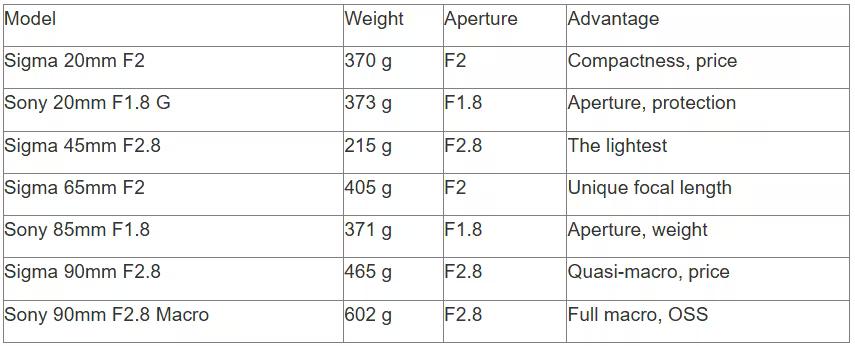
How do the updated Sigma I Series compare to the competition? Let's look at the main competitors in each category.
20mm F2 vs. Sony FE 20mm F1.8 G
The Sony FE 20mm F1.8 G is one stop faster and offers a more premium design with dust and moisture resistance. However, it is also significantly more expensive and heavier—373 grams versus 370 grams for the Sigma.
The Sigma 20mm F2 offers 95% of the performance for significantly less money. For most purposes, a one-stop difference is not critical.
45mm F2.8 vs. Tamron 35-150mm F2-2.8
The 45mm F2.8 has few direct competitors—it's an unconventional focal length. The closest alternatives are versatile zooms like the Tamron 35-150mm F2-2.8, which cover this range. But the zoom weighs 1165 grams, which is five times heavier than the Sigma 45mm. If portability is more important than versatility, the Sigma wins.
65mm F2 vs. Sony FE 85mm F1.8
The Sony FE 85mm F1.8 is a classic portrait lens, faster and with a narrower angle of view. It weighs 371 grams, slightly lighter than the Sigma 65mm (405 g).
Choosing between them is a matter of focal length preference. The 65mm gives more context, while the 85mm compresses perspective more and blurs the background.
90mm F2.8 vs. Sony FE 90mm F2.8 Macro G OSS
The Sony FE 90mm F2.8 Macro G OSS is a full-fledged macro lens with 1:1 magnification and optical image stabilization. It is significantly heavier than the Sigma 90mm F2.8. The Sigma 90mm F2.8 isn't a macro lens, but it offers a decent 1:5 magnification for quasi-macro photography. If full-scale macro isn't required, the Sigma is a more portable and affordable option.
Who are the updated Sigma I Series for?
These lenses aren't for everyone. Sigma clearly targeted a specific audience when developing the I Contemporary series.
Mirrorless enthusiasts
Photographers who value a balance between image quality and portability. Those who don't want to lug around heavy F1.4 Art series lenses but refuse to compromise on optical quality.
The I series is ideal for travel, when every gram counts, but the images must remain professional-quality.
Street photographers
Compactness is a critical factor for street photography. A small lens attracts less attention, allowing for subtle and discreet work.
The Sigma 45mm F2.8, in particular, is designed for street photography. Lightweight, discreet, and with a natural perspective, it's the perfect tool for documenting urban life.
Mirrorless Videographers
Improved autofocus and silent focusing make these lenses attractive for video shooting. Their compact size simplifies use with gimbals and stabilizers.
However, the lack of in-body stabilization means complete reliance on the camera's IBIS, which should be taken into account when planning a shoot.
Sony Compact Camera Owners
On cameras like the Sony A7C, A7C II, or ZV-E1, these lenses create a perfectly balanced system. The compact camera body isn't overloaded with heavy optics, maintaining balance and ergonomics.
Is it worth upgrading from the original versions?
If you already own the original versions of these lenses, is it worth buying the updated ones? The short answer: probably not.
The optical designs are identical, and image quality hasn't changed. The main improvements are the autofocus firmware and cosmetic redesign.
Improved autofocus may be important for those who actively shoot video or use continuous autofocus for fast subjects. But for static subjects, the difference will be minimal.
The magnetic lens cap and new design are nice bonuses, but hardly enough to justify replacing a fully functional lens.
When Upgrading Makes Sense
There are several scenarios where upgrading to updated versions is justified:
Working with the latest Sony cameras (A7R V, A9 III), where improved lens communication provides maximum benefit
Active video shooting, where smooth autofocus is critical
Desire to unify the design of a lens collection
Selling the original version at a good price with minimal additional payment
Mount Conversion Service: Investment Protection
A unique feature of Sigma lenses is the Mount Conversion Service, a bayonet replacement service. If in the future you need to switch from a Sony E-mount to an L-mount (or vice versa), Sigma can reinstall the lens mount.
This protects your investment in optics. Instead of selling the lens at a loss in value and buying a new one, you can simply replace the mount for a reasonable fee. This service is not available for all lenses and requires sending it to a Sigma service center. However, the service itself is a significant competitive advantage for those considering different systems.
Practical Tips
Here are some recommendations for those planning to purchase or who have already purchased these lenses.
Update your camera firmware
Make sure your Sony camera is running the latest firmware version. Sigma has optimized its lenses for modern autofocus algorithms, which are only available in recent updates.
You can check and update the firmware through the official Sony website or the Imaging Edge Mobile app.
Customize buttons for quick access
I-series lenses have minimal physical controls—only the focus ring. To quickly switch between autofocus modes, customize the camera buttons.
Useful assignments: AF-ON for separate focus control, switching between AF-S and AF-C, and focus area selection.
Use correction profiles
Activate correction for vignetting, distortion, and chromatic aberrations in-camera. Sigma provides profiles for its lenses, and the camera automatically applies them to JPEGs.
For RAW files, profiles are embedded in the metadata and are automatically applied in Adobe Lightroom Classic and Photoshop upon import.
Protective filters
Consider installing a high-quality protective UV or Clear filter. The front element is not recessed into the barrel, making it vulnerable to scratches and dirt.
Choose multi-coated filters from trusted manufacturers (Hoya, B+W, Sigma) to minimize the impact on image quality.
Frequently asked questions about the updated Sigma I Series
What is the difference between the original and updated versions?
The main differences are an improved autofocus algorithm, a redesigned barrel, and a magnetic metal cover. The optical designs are identical, and image quality remains unchanged. Improvements include autofocus speed and smoothness, especially when shooting video and using continuous AF.
Are these lenses compatible with Sony APS-C cameras?
Yes, the updated Sigma I Series lenses can be used on APS-C Sony cameras such as the A6700 or ZV-E10. However, the effective focal length will increase by 1.5x due to the crop factor. For example, 20mm will become equivalent to 30mm, 45mm to 67.5mm, 65mm to 97.5mm, and 90mm to 135mm.
Can these lenses be used for professional work?
Absolutely. The optical quality of the I-series meets professional standards. Many photographers choose these lenses for weddings, reportage, and commercial shoots. The limitations—the lack of weather sealing and average aperture—must be taken into account when planning a shoot, but they don't make these lenses amateur-grade.
Do these lenses support Eye AF on Sony cameras?
Yes, the updated lenses fully support Eye AF (eye detection) for humans and animals on modern Sony cameras. Improved firmware ensures fast communication with the camera, making Eye AF responsive and accurate. This is especially useful for portrait photography and working with models.
Is it worth buying the updated version if I have the original?
For most users, no. If the current lens is working properly, the optical quality has not changed. Upgrading only makes sense if maximum autofocus speed is critical for video or continuous AF, or if you can sell the old version for a minimal premium.
What accessories are included?
Each lens comes with a petal-shaped lens hood, a magnetic metal lens cap, a plastic front lens cap, a rear lens mount cap, and a soft case. The lens hood helps minimize glare and protects the front element, and the magnetic cover makes it easy to install with one hand.
Conclusion: Compact Quality for Modern Sony Cameras
The updated Sigma I Contemporary series for Sony E-mount is a thoughtful evolution of a successful concept. Four lenses—20mm F2, 45mm F2.8, 65mm F2, and 90mm F2.8—offer a balance between portability and optical quality that's hard to find in competitors.
Improved autofocus makes these lenses even more relevant for modern Sony cameras with advanced image recognition systems. Support for Eye AF, continuous autofocus, and smooth video recording expand their application range.
For Ukrainian photographers, the availability of these lenses through authorized dealers is welcome news. You can assemble a high-quality optics kit without breaking the bank, gaining tools for a wide range of tasks.
The I Contemporary series proves that professional quality doesn't have to be heavy and expensive. Sometimes, a sensible balance is all it takes.
Ready to upgrade your optics kit? Check for updated Sigma I Series lenses at authorized dealers in Ukraine and get the latest lenses for your Sony camera.